
This model intercomparison constituted one of the cases for the 11th International Cloud Modeling Workshop (ICMW), held at Yonsei University, Seoul, South Korea, the week preceding the International Conference on Clouds and Precipitation, in July 2024. In this intercomparison, we used several models and types of models (including bulk, large-eddy simulation (LES), and direct numerical simulation (DNS)) to try to reproduce the results of a laboratory mixed-phase cloud convection chamber experiment. The bulk approach assumes a well-mixed domain and provides quick results with continuous control variables. The LES approach resolves energy-carrying turbulence and associated turbulent fluctuations, and when combined with Lagrangian or bin-resolveing microphysics, it predicts the droplet size distribution. The DNS approach resolves all relevant turbulence scales and evolves Lagrangian particles. All three approaches enable the separate examination of liquid and ice properties, a task that is challenging in laboratory measurements.
All approaches demonstrate that, with an increased ice number concentration, the flow and microphysical properties exhibit similar trends. Additionally, all approaches show that the ice integral radius reaches the theoretical glaciation threshold when the cloud is subsaturated with respect to liquid water. The main difference between the results of the two approaches is that the bulk model allows for the complete glaciation of the cloud. However, LES and DNS results reveal that, in a dynamic system, the cloud is not completely glaciated because liquid water droplets are continuously produced near the warm lower boundary and subsequently mixed into the chamber interior. These results highlight the importance of the ice mass fraction in distinguishing the mixed phase and ice clouds, as shown in the graphic. Ni is the steady-state ice particle number concentration.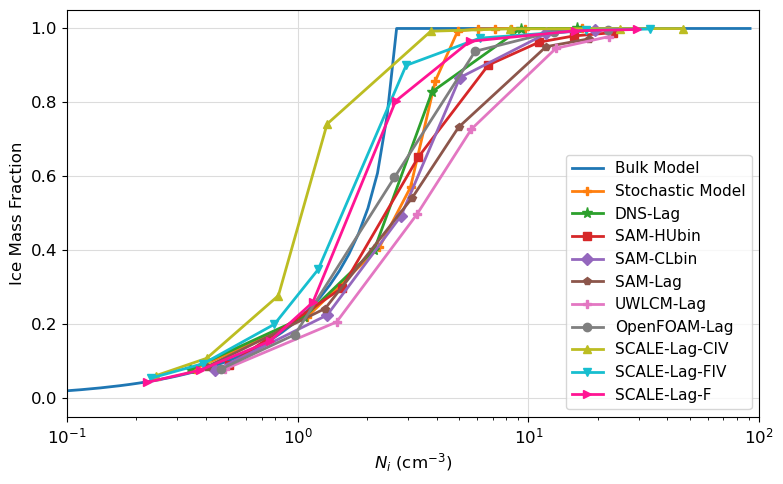
 - Indicates paper has been withdrawn from meeting
 - Indicates an Award Winner