
Tuesday, 7 January 2025
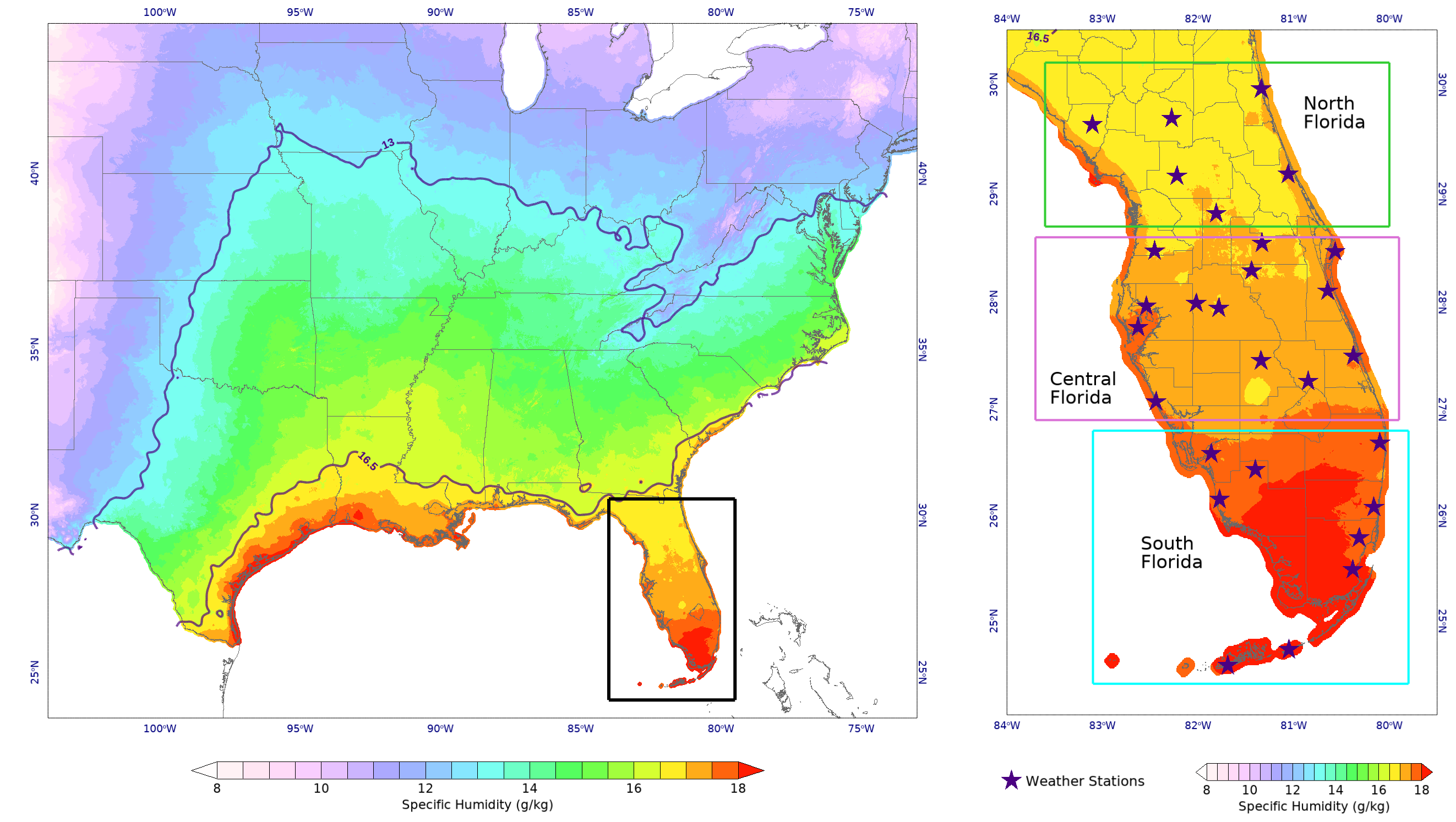
As a result of global warming, air moisture is increasing alongside temperature--especially in the subtropics. Higher levels of air moisture in “seasonally muggy” climates contribute to dangerous heat hazards, limiting thermoregulation of the human body. In these climates, where average daily dew points remain well above what the National Weather Service labels an “oppressive” ~18 °C (65 °F), high air moisture not only intensifies heat hazards during the day, but also limits cooling of the surface at night. Here, we examine how air moisture influences nighttime land surface temperatures (LSTs) and thermal comfort across the Florida peninsula during summer months, where the average dew point exceeds 18 °C and reaches the highest values of anywhere in the US. For June–August during 2018–2022, we ask: 1) How do urbanicity, measured as impervious surface, and geography, measured as latitude and distance from the coast, modulate air moisture, measured as specific humidity? 2) How does specific humidity limit LST cooling at night? And 3) What are the resulting consequences for thermal comfort? Based on data from 28 weather stations along the peninsula, we find that specific humidity remains relatively constant across varying levels of urbanicity. Specific humidity increases, however, closer to the coast and at lower latitudes. Under higher air moisture levels, LSTs cool off less at night (as measured at 1 AM), resulting in lower differences between daytime and nighttime (diurnal) LSTs. This effect is especially pronounced in the more tropical climate of South Florida and along the peninsula’s Gulf coast, where specific humidity is highest. Elevated nighttime LSTs have pronounced implications for measures of thermal comfort—for every 1 °C increase in nighttime LST, nighttime surface air temperatures increase, on average, by 1.1 °C, heat indices by 2.0 °C, and wet bulb temperatures by 0.48 °C. This analysis therefore underscores the importance of heat mitigation and adaptation strategies that address elevated nighttime LSTs and decreased thermal comfort in regions with seasonally muggy climates.
 - Indicates paper has been withdrawn from meeting
 - Indicates an Award Winner