
Wednesday, 15 January 2025: 2:00 PM
205 (New Orleans Ernest N. Morial Convention Center)
Global mean surface temperature (GMST) has become the de facto index of anthropogenic global warming. Statistical relationships with GMST are commonly used to assess the economic risk of climate change. A virtue of GMST is that it is easy to describe and compute. But is GMST necessarily the optimal index to characterize global warming? We know that phenomena unrelated to anthropogenic global warming, such as El Niño, also affect GMST. Smoothing the GMST time series using a running average can filter out the impact of short-term natural variability, but it will reduce the degrees of freedom available for determining statistical relationships and also introduce edge effects preventing extrapolation into the future.
In this presentation, we explore the use of alternative indices to characterize global warming using signal-to-noise maximizing patterns and low-frequency component analysis. A potential issue with more optimal indices is their robustness, e.g., their structure could be sensitive to the “fitting period” used to define them. Preliminary results suggest that an optimal index can capture the more monotonic signal of global warming even beyond its fitting period, by weakening the confounding influence of El Niño events. This could help in more clearly identifying changes in the global warming trend.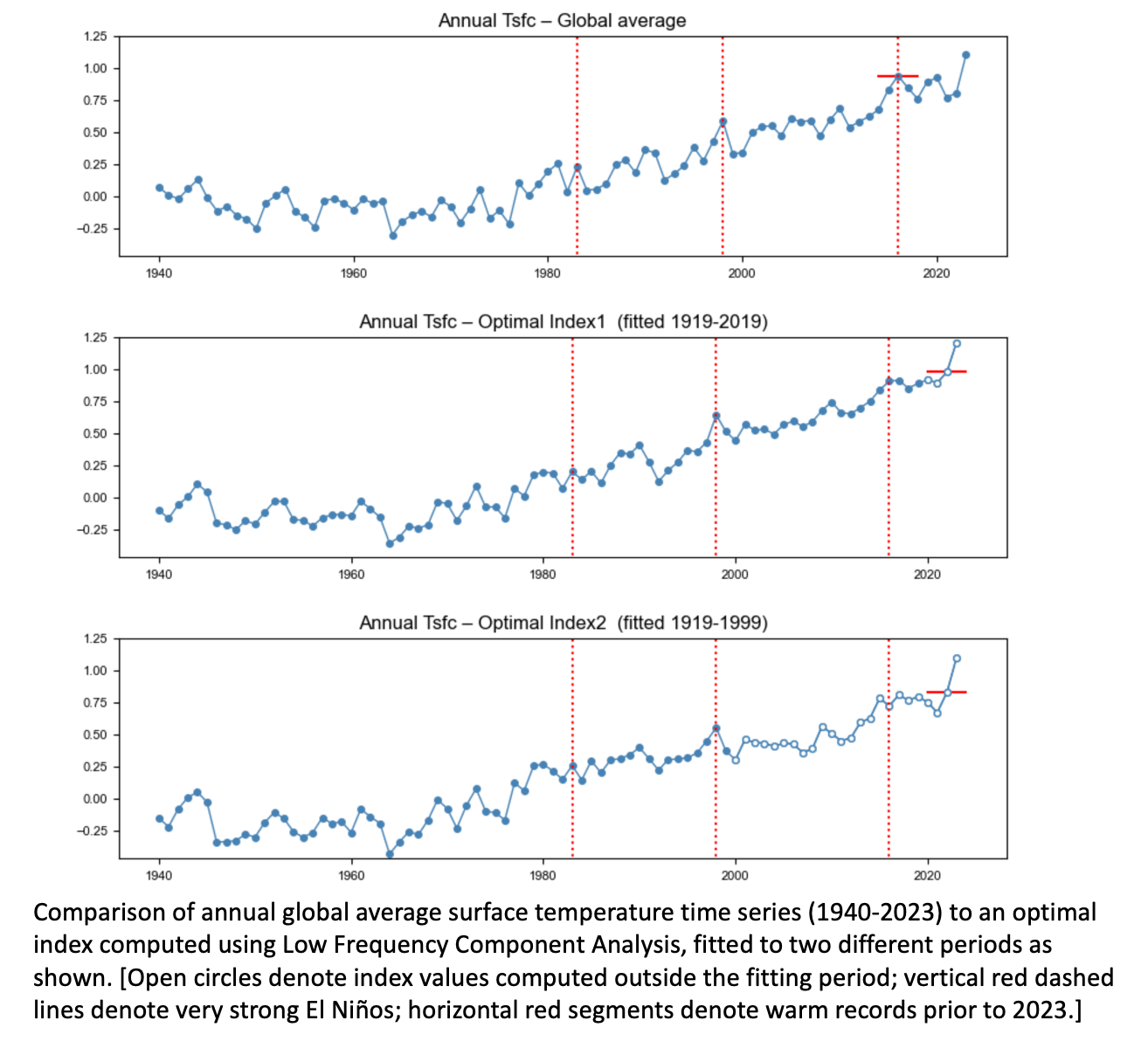
 - Indicates paper has been withdrawn from meeting
 - Indicates an Award Winner