
- INTRODUCTION
As cities worldwide grapple with rising temperatures, the need to understand the specific characteristics of green spaces that effectively mitigate urban heat islands (UHIs) becomes crucial. UHIs are localized areas where urban environments experience higher temperatures than nearby rural regions.
While studies such as Coutts et al. (2007) have shown a negative correlation between green space and UHI intensity (UHII), not all green spaces are equally effective. Some research e.g., Zhou et al., (2017) highlights the complexity of this relationship, suggesting that the type and structure of green space, particularly tree canopy cover, may play a significant role in determining its cooling effect. This study investigates whether different green spaces have a distinct influence on the urban heat island effect (UHIE) on a more localized, lived scale using mobile transects.
- METHODOLOGY
This study was conducted in Albuquerque, New Mexico, a high-desert city with a semi-arid climate, characterized by low annual precipitation, hot summers, and cool winters. The city has a population of approximately 562,000 and covers about 195 square miles.
To investigate the impact of different types of green space on the UHIE at a local scale, air temperature (TAIR) was measured using a mobile transect along the historic Route 66, passing through areas with varying levels of anthropogenic activity, including Old Town, the Albuquerque Country Club, and Tingley Beach (Fig 1).
The transect was walked two days a week, Wednesday and Sunday, during three distinct time intervals, morning (08:00), afternoon (14:00), and evening (19:00). TAIR data was collected each second using an AirBeam3 sensor, which measured the internal temperature of its radiation-shielded case. To correct these measurements for true, unshielded TAIR, data from a Kestrel 3000 sensor was collected at predetermined stations approximately every five minutes. A mathematical model, utilizing a degree 2 polynomial curve fitting, was applied for corrections. Data collection was avoided during severe weather conditions to ensure consistency.
- RESULTS and DISCUSSION
This study was designed to address two research questions:
- What effect does green space have on TAIR on a local scale?
- Which characteristics of green spaces most effectively mitigate the UHIE?
Figure 2 plots the green space percentage within a 300-foot radius of each station, considering all green areas. The radius of 300 feet was 100 times the measured height (3 feet), as recommended by Yokohari et al., (2001). Average temperature was calculated for morning, afternoon, and evening time frames.
Analysis reveals that not all green spaces contributed equally to cooling; while a weak correlation was observed between TAIR and general green coverage in the morning and evening, a stronger positive correlation was noted in the afternoon. To further investigate, the study focused only on tree canopy cover, using current data from The Nature Conservancy of New Mexico (Basset, 2022). Figure 3 was constructed similarly, though only canopy cover was considered, and the data was taken every sixty seconds, as opposed to every five minutes.
This plot shows that tree canopy provided a more significant cooling effect, particularly in the morning and evening. The correlations between canopy and TAIR were 6 and 4 times steeper in the morning and evening, respectively, compared to the correlation between all green spaces and TAIR. This suggests that the tree canopy is more effective in mitigating UHIE than smaller plants. However, in both cases, the afternoon data showed a positive correlation between TAIR and canopy cover, consistent with other studies (e.g., Qui et al., 2017) that found green spaces are less effective during periods of high solar intensity. Selecting a representative day, we see that the correlation between UHII and canopy cover is similar, inverse during the morning and evening, and positive in the afternoon. The UHII ranged from ~12°F in the morning, ~11.5°F in the afternoon, and ~16°F in the evening.
4. CONCLUSIONS
The results of this study demonstrate that the effectiveness of green spaces in mitigating the UHIE varies significantly depending on their characteristics. Specifically, tree canopy cover is more effective in reducing TAIR during periods of lower solar intensity, such as the morning and evening. In contrast, general green space, including smaller plants, exhibits a weaker cooling effect. These findings are important for use in city planning, as it informs what greenery types should be used to best mitigate UHII. Further research is needed to explore the positive correlation between canopy cover and TAIR observed in the afternoon, which may suggest limitations of green spaces during peak solar periods.
Acknowledgments
This work was funded by NSF grant 2246468. The authors wish to thank Heather Fox-Gardner for providing TRURAL data and Professor Melanie Will-Cole for her patience, guidance, and mentoring.
References
Bassett, Steve. “New Canopy Cover Data for Albuquerque — New Mexico Conservation Science.” New Mexico Conservation Science, 22 February 2022, https://www.nmconservation.org/field-notes/abq-canopy-2020.
Chen, Yifang, et al. "Experimental Studies on the Effects of Green Space and Evapotranspiration on Urban Heat Island in a Subtropical Megacity in China." Building and Environment, vol. 72, 2014, pp. 51-59.
Coutts, A. M., Beringer, J., & Tapper, N. J. (2007). Impact of increasing urban density on local climate: Spatial and temporal variations in the surface energy balance in Melbourne, Australia. Journal of Applied Meteorology and Climatology, 46(4), 477-493.
Yokohari, R.D. Brown, Y. Kato, S. Yamamoto. (2001). The cooling effect of paddy fields on summertime air temperature in residential Tokyo, Japan Landscape and Urban Planning, 53, pp. 17-27.
Zhou, W., Wang, J., & Cadenasso, M. L. (2017). Effects of the spatial configuration of trees on urban heat mitigation: A comparative study. Remote Sensing of Environment, 195, 1-12.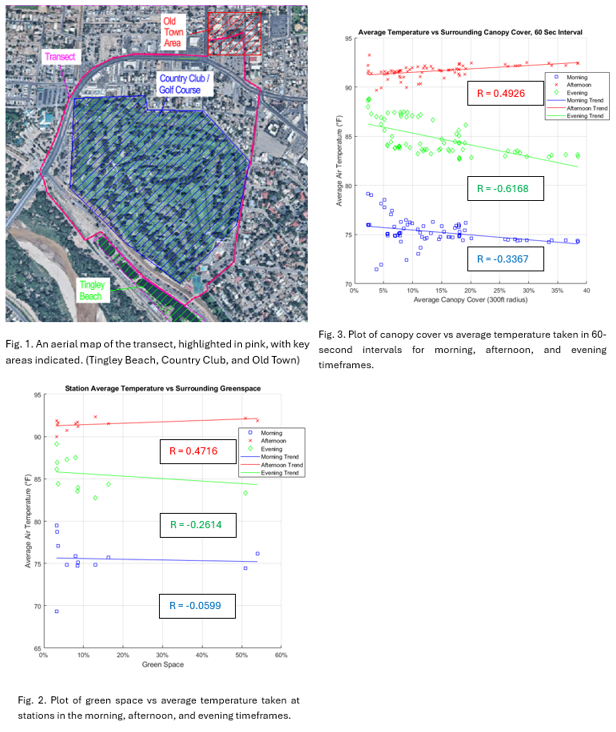
 - Indicates paper has been withdrawn from meeting
 - Indicates an Award Winner