
- INTRODUCTION
As the effects of the ongoing climate crisis become more apparent, urban sprawl remains the main antagonist, the once overlooked microclimates have now been exacerbated. Creating what is known as the urban heat island effect (UHIE). Which can be defined as an area of cityscape that is significantly warner than the surrounding rural area. Several mitigation strategies have been observed in the science community which include but are not limited to, urban geometry that allows for more efficient airflow through city canopies and increase greenspace in urban areas (Soltani & Sharifi, 2017). This experiment takes inspiration from CAPA Strategies LLC and analyzes thermal signatures at a neighborhood scale using the mobile transect method (CAPA Strategies, 2021). Simultaneously providing an outline for optimizing bi-facial photovoltaics (BFPVs) in and around areas that can be defined as urban hotspots.
- METHODOLOGY
Recent studies have concluded that the mobile transect method in conjunction with remote sensing data are widely accepted methods of studying the UHIE (Sun, Kato, & Gau, 2019). To analyze the UHIE, in conjunction with optimal locations for BFPVs, we utilized the tools developed by Sandia National Laboratories (SNL), and tuned by NASA remote sensing data, to model photovoltaic configurations at various latitudes (Anderson, et al., 2023). With limited resources in our study, this meta-data serves to accurately estimate the efficiency of BFPVs in Albuquerque, NM, with hopes of providing artificial canopies to reduce the UHIE.
Our area of study was a 2.5-mile closed-loop, walked every Sunday and Wednesday collecting data every 5 minutes for 12-weeks at the following intervals, morning (08:00), afternoon (14:00) and evening (19:00) (See Figure 1). Due to weather, and troubleshooting during the calibration phase, some data points were deemed unsuitable and have been omitted. We walked along Paseo Del Norte Blvd, and the Paradise Hills neighborhood collecting air-temperature (TAir) and relative humidity (RH), approximately every five minutes using a radiation-shieled AirBeam3 sensor, and an non-radiation shielded Kestrel 3000 TAir sensor. A mathematical model utilizing data from both sensors in combination with a 2nd order polynomial, a curve fit was used to calibrate the TAir raw data.
Surface-temperature measurements (TSurface) of prominent materials in our area of study such as concrete, sand/gravel, and asphalt were taken using a Thermal Works IRK-2 sensor, at the same time intervals as TAir and RH.
- RESULTS AND DISSCUSSION
This case study is designed to investigate the following research questions:
- What materials or combination of materials contribute most to the UHIE on a neighborhood scale?
- Can bi-facial photovoltaics reduce the effects of the UHIE on a neighborhood scale by providing an artificial canopy in leu of trees?
- What is the threshold of BFPVs in urban hotspots before their efficiency begins to taper off?
The basis of this study sought out answers to what contributes to the UHIE at a neighborhood scale. The results have concluded that the afternoons of any given day produced the highest TAir (See Figure 2) and TSurface (See Table 1) while mornings are much cooler than the evenings. Furthermore, we confirmed that TAir and RH are inversely proportional to each other (See Figure 3). To our surprise, sand/gravel produced high TSurface but cooled off sooner than other materials tested. However, asphalt retained high TSurface for longer periods of time compared to concrete, due to more direct sunlight exposure.
This information allowed us to conclude that while trees often provide shade beneath them, reducing the UHIE, other means of shade also reduce TSurface thus reducing the UHIE at neighborhood scale. This case study was only able to estimate the potential efficiency of BFPVs, however, we were able to conclude that with an albedo value of 0.5 and modules with an elevation of at least one meter, the bifacial gain can be increased to 30% (Rodriguez-Gallegos, et al., 2018). Unfortunately, it is still unclear at what temperatures these gains begin to taper off, thus reducing the cost effectiveness of this mitigation strategy.
- CONCLUSIONS
There are still pending questions in the case study, however, this preliminary work has been able to conclude that concrete and asphalt exhibit a higher thermal absorbance than sand/gravel, which contributes more to the urban heat island effect. Furthermore, if prolonged sun exposure to these materials is reduced, then the amount of infrared radiation remitted into the atmosphere is reduced. Lastly, we deduced that Albuquerque’s latitude is an optimal location for bi-facial photovoltaics, however, we are unable to confirm the optimal operating temperature threshold for their implementation to be cost effective.
Acknowledgment.
This work is funded by NSF grant award 2246468.
Dr. M. Will-Cole for support and guidance.
Heather Fox-Gardner for providing TRURAL data.
References
Anderson, K., Hansen, C., Holmgren, W., Jensen, A., Mikofski, M., & Driesse, A. (2023). pvlib python: 2023 project update. Journal of Open Source Software, 8(92), 5994.
CAPA Strategies. (2021). Albuquerque NM Heat Watch Report. Albuquerque.
Rodriguez-Gallegos, C. D., Bieri, M., Gandhi, O., Singh, J. P., Reindl, T., & Panda, S. K. (2018). Monofacial vs bifacial Si-based PV modules: Which one is more cost-effective? Solar Engergy, Vol. 176, Pages 412-438.
Soltani, A., & Sharifi, E. (2017). Daily variation of urban heat island effect and its correlations to urban greenery: A case study of Adelaide. Southeast University, 10.
Sun, C.-Y., Kato, S., & Gau, Z. (2019). Application of Low-Cost Sensors for Urban Heat Island Assessment: A Case Study in Taiwan. Sustainability, 13.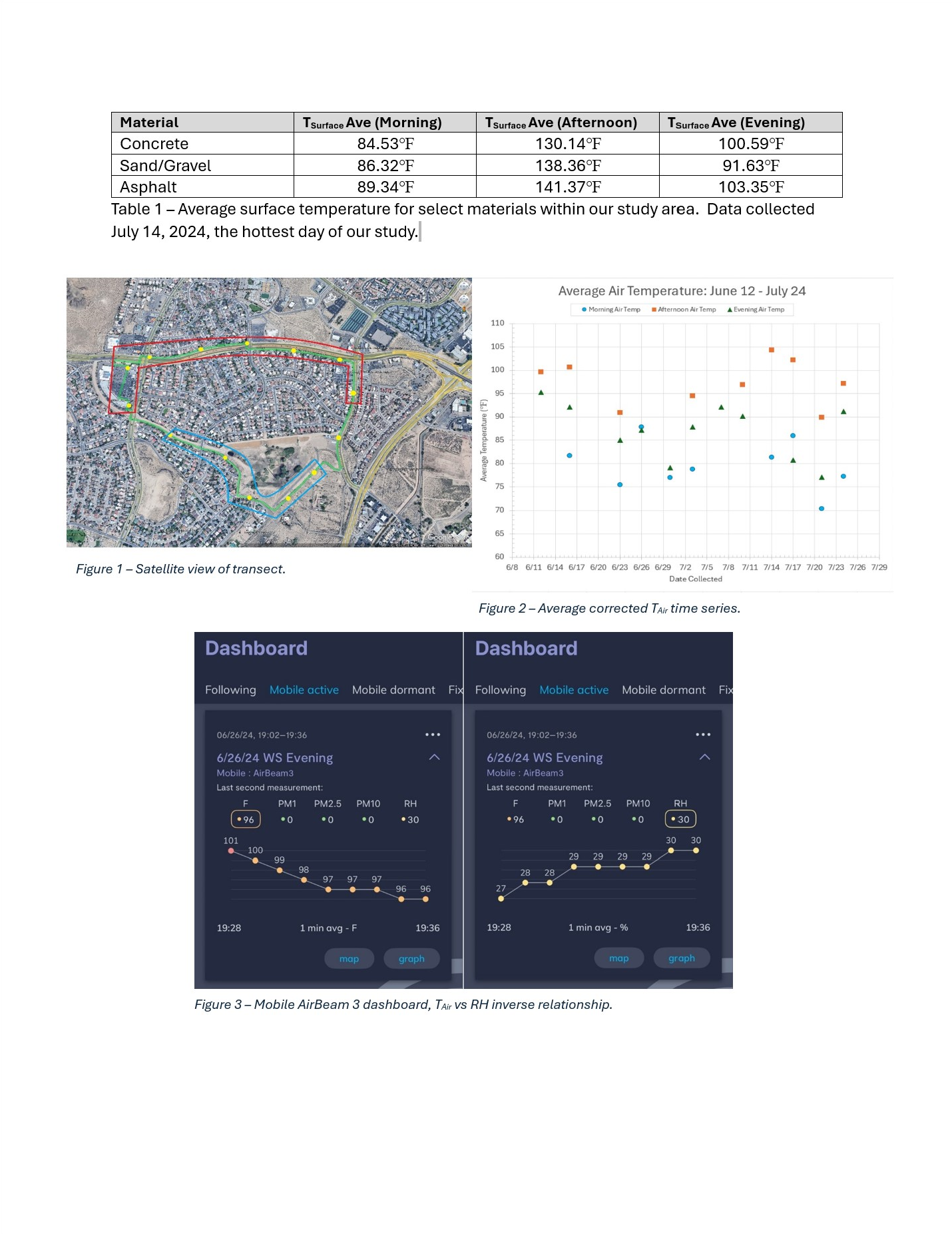
 - Indicates paper has been withdrawn from meeting
 - Indicates an Award Winner