
- Background
India’s agricultural sector remains largely dependent on monsoon rainfall, with 51% of the country's net sown area being exclusively rain-fed. This makes the sector highly vulnerable to climate variations, significantly impacting both domestic and global food supply. This study investigates the influence of a global climate phenomena, the El Niño Southern Oscillation (ENSO), on crop yields and food prices across different agroclimatic zones in India. ENSO involves periodic changes in the temperature of the tropical Pacific Ocean, ranging from 1℃ to 3℃. An above-average sea-surface temperature (SST) is called El Niño, and a below-average SST, is termed La Niña. The fluctuations in SST are coupled with fluctuations in air pressure, termed Southern Oscillation. El Niño events are associated with increasing temperatures and weakened monsoon conditions in tropical countries like India, raising drought risks and impacting Indian agriculture yields negatively. Conversely, an above-average monsoon rainfall during La Niña is generally recorded.
India’s agricultural activity is broadly classified into Kharif and Rabi. The Kharif season coincides with southwest summer monsoons, with crops like rice, maize and soybean sown during June-September and harvested in October-November. On the other hand, Rabi crops like wheat, oats and oilseeds are sown during the retreating southwest monsoons in November-December and harvested in spring during March-April. Therefore, summer monsoons and the northeast winter monsoons together determine agriculture productivity in India. In this study, we explore the heterogenous impacts of ENSO on agricultural productivity across different agroclimatic zones. We also find evidence for the lagged effects of ENSO events on agriculture.
- Data and Methodology
Data on agricultural inputs, productivity and farm gate prices were obtained from the International Crops Research Institute for the Semi-Arid Tropics (ICRISAT) and the Ministry of Agriculture and Farmers Welfare, India for 579 Indian districts. Historical weather data for each district was sourced from NASA’s Prediction Of Worldwide Energy Resources (POWER) database, and the Oceanic Niño Index (ONI) from the National Oceanic and Atmospheric Administration (NOAA).
This analysis investigates ENSO's impact on the most extensively grown crops in Kharif and Rabi seasons, rice (Oryza sativa) and wheat (Triticum aestivum), respectively. Additionally, we also consider sugarcane (Saccharum officinarum), which is the most widely grown commercial crop in India. We include weather variables such as temperature, precipitation, root zone soil moisture, and number of hot and wet days (calculated using the thresholds for each zone as defined by the Indian Meteorological Department). We also include additional control variables: irrigated area and fertilizer consumption. Unobserved soil and other geophysical characteristics are captured using dummy variables for the various agroclimatic zones in Inda, as presented in Khanna (1989) (refer to Figure A.1). We capture the impact of El Niño and La Niña events using an interaction term of the ONI index and dummies for the occurrence of the events (using thresholds defined by NOAA).
We specify two models to discern the contemporaneous and lagged impacts of ENSO on agricultural yields. In the contemporaneous model, we consider the ONI values for months that coincide with the crop’s growing season (June-October for Kharif and November-March for Rabi). In the lagged model, we also include terms for the preceding cropping season.
Therefore, the contemporaneous model can be specified as: Y_it = β_0 + Σ(k=1 to 4)[β_k X_kit] + γ_1 (El Nino × ONI)(i,t) + γ_2 (La Nina × ONI)(i,t) + Σ(m=1 to 2)[α_m Z_mit] + Σ(z=1 to 14)[δ_z Zone_zi] + ϵ_it
The lagged-effects model is specified as: Y_it = β_0 + Σ(k=1 to 4)[β_k X_kit] + γ_1 (El Nino × ONI)(i,t) + γ_2 (La Nina × ONI)(i,t) + γ_3 (El Nino × ONI)(i,t-1) + γ_4 (La Nina × ONI)(i,t-1) + Σ(m=1 to 2)[α_m Z_mit] + Σ(z=1 to 14)[δ_z Zone_zi] + ϵ_it
Where Y is agricultural yield, X is the vector of climatic control variables, including temperature, precipitation/ soil moisture, number of hot days, and number of wet days in district i in season t, Z is the vector of non-climatic controls such as level of irrigation and fertilizer consumption. We also include dummy variables for different agroclimatic zones to account for geophysical and soil characteristics. The fixed-effects regression model is employed as suggested by the Hausman test, thereby controlling for time-invariant district-specific characteristics, producing reliable and unbiased estimates.
- Results
The results of fixed-effects regression are presented in Table 1. The results indicate that El Niño events are consistently associated with reduced yields for all three crops considered, with the greatest impact observed for sugarcane. We also find evidence for the positive influence of La Niña events, with wheat experiencing the greatest gains. The impacts remain consistent when lagged effects are considered.
|
Effect (kg/hectare) |
Rice |
Wheat |
Sugarcane |
Food prices (Rs/quintal) |
|||||||||||
|
(a) |
(b) |
(a) |
(b) |
(a) |
(b) |
||||||||||
|
El Niño (Contemporaneous) |
-121.41*** |
-133.29*** |
-119.7*** |
-105.96*** |
-301.77*** |
-295.10*** |
16.87*** |
||||||||
|
El Niño (Lagged) |
-37.90*** |
-34.22*** |
-61.58*** |
-58.36*** |
-139.74*** |
-128.45*** |
5.80*** |
||||||||
|
La Niña (Contemporaneous) |
12.38*** |
11.69*** |
115.80*** |
98.78*** |
92.31*** |
83.29*** |
-3.73*** |
||||||||
|
La Niña (Lagged) |
2.07*** |
5.22*** |
43.75*** |
46.47*** |
28.15*** |
22.34*** |
-0.71*** |
||||||||
|
Temperature |
Y |
Y |
Y |
Y |
Y |
Y |
|
||||||||
|
Precipitation |
Y |
|
Y |
|
Y |
|
|
||||||||
|
Root zone soil moisture |
|
Y |
|
Y |
|
Y |
|
||||||||
|
R2 (contemporaneous) |
.623 |
.617 |
.679 |
.735 |
.759 |
.780 |
.460 |
||||||||
|
R2 (lagged) |
.759 |
.772 |
.794 |
.783 |
.802 |
.818 |
.582 |
|
|||||||
Note: *** p-value < 0.01. R-squared values reported are weighted overall R-squared. The food price variable is obtained by employing principal component analysis (PCA) on farm gate prices of rice, wheat and sugarcane.
- Conclusion
The study provides evidence that El Niño conditions detrimentally affect productivity of all three crops considered - rice, wheat, and sugarcane, while La Niña conditions impact them positively. The most significant impacts are found in plain and plateau regions of India, where agriculture is heavily dependent on southwest monsoon precipitation. Additionally, Kharif crops are found to be more vulnerable to weather anomalies compared to Rabi crops. The study also finds first evidence that ENSO events trigger variations in the farm gate prices earned by farmers, rendering them particularly vulnerable to climate change. These findings highlight the need for adaptive strategies to mitigate climate-related risks and ensure food security in developing, primarily agrarian societies like India's.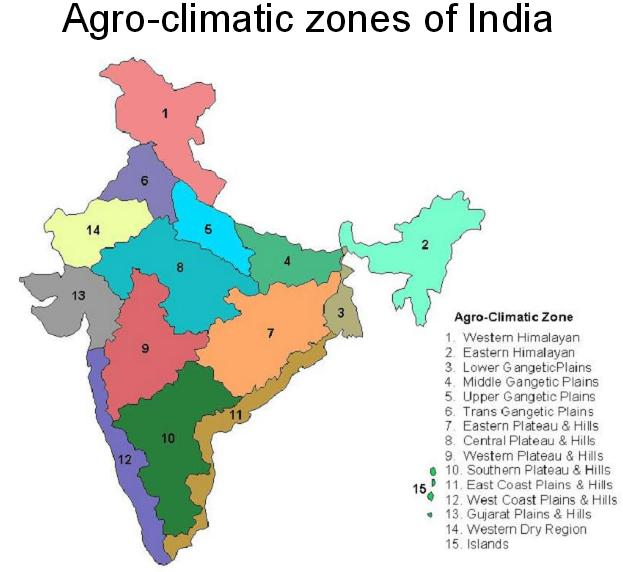
 - Indicates paper has been withdrawn from meeting
 - Indicates an Award Winner