
Sunday, 12 January 2025
Hall C (New Orleans Ernest N. Morial Convention Center)
Specific differential phase (KDP) is an important radar product used for quantitative precipitation estimation as well as an input for many other radar products. The existing methods for obtaining KDP rely on various radar data, mainly differential phase, to estimate its value. We use a machine learning algorithm to estimate KDP from differential phase data. The machine learning algorithm is based on the Keras dense neural network with several layers which produced the best results. The model was then trained using simulated profiles of differential phase associated with known values of KDP. This produced a model that was able to predict results similar to existing KDP algorithms both in location and intensity.
As with other cases in meteorology where artificial intelligence has helped improve upon existing methods, the use of machine learning in KDP prediction could lead to improvements in the accuracy of KDP estimates. This would lead not only to better products that use KDP in determining regions of precipitation, but also in other products that rely on KDP as an input variable. This presentation will look at the advancement of training and using a machine learning model to predict KDP and how it can be improved in the future.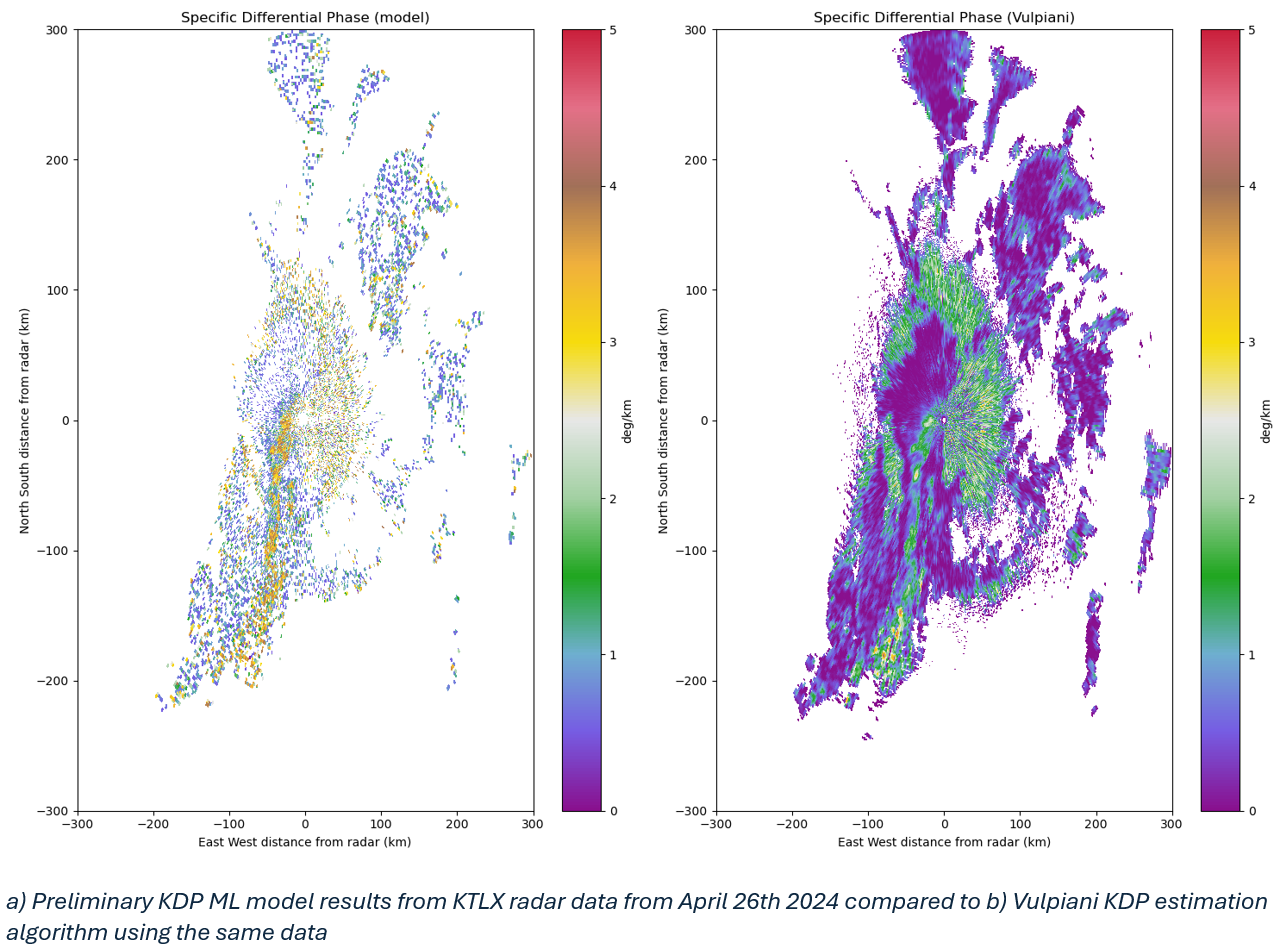
 - Indicates paper has been withdrawn from meeting
 - Indicates an Award Winner