
Sunday, 12 January 2025
Hall C (New Orleans Ernest N. Morial Convention Center)
Handout (4.7 MB)
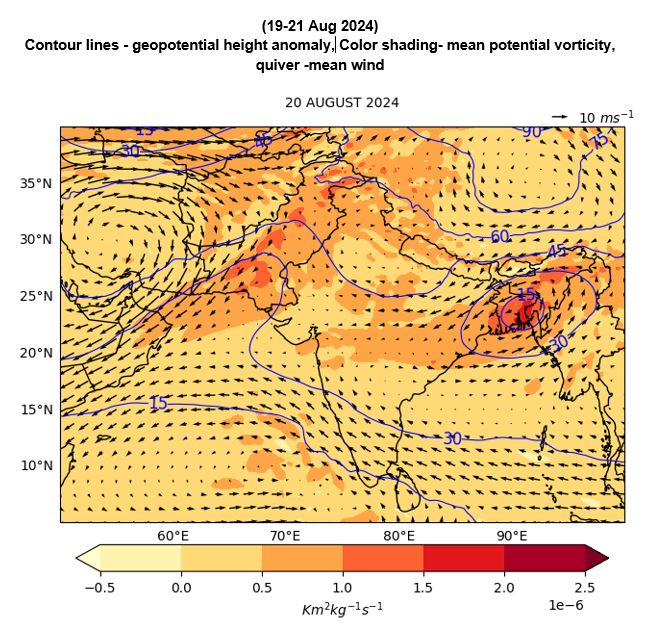
Bangladesh experiences frequent extreme rainfall events during the summer monsoon (June-October), making it one of the rainiest places on Earth. Its location under the South Asian Monsoon belt, near the Bay of Bengal, and at the foothills of the Himalayas contributes to this. The Bay of Bengal, with sea surface temperatures above 26°C year-round, further influences weather patterns, including cyclones. In recent years, the frequency and intensity of extreme rainfall in Bangladesh have increased. Since 2017, the country has seen ten events where over 300 mm of rain fell in 24 hours, causing significant loss of life and infrastructure damage. Despite this, the meteorological drivers behind these extreme events remain poorly understood. This study investigates extreme rainfall events in Bangladesh since 2010, focusing on identifying the key factors that lead to such events. Preliminary findings reveal that extreme rainfall occurs when several meteorological conditions combine, each capable of producing heavy rain. These conditions include the blocking of the subtropical Jetstream over the Indian subcontinent, stagnation of the South Asian monsoon circulation, the presence of a monsoon low-pressure system, and large-amplitude of the Madden–Julian Oscillation (MJO) in Phases 3 and 4. The more these factors align, the greater the likelihood of extreme rainfall. The position of the upper-level jet over the Indian subcontinent plays a significant role in determining the location of these events. These findings offer valuable insights for improving extreme rainfall forecasts in Bangladesh, helping weather forecasters provide more accurate and timely warnings.
 - Indicates paper has been withdrawn from meeting
 - Indicates an Award Winner