
In this study, we analyze the cloud radiative properties of 72 intense MCAO events over the BS from 2000 to 2018, identified based on the M-index (a measure of the temperature contrast between the surface and the 800 hPa level) calculated from ERA-Interim reanalysis data. CERES (SYN1deg Ed4A) and MODIS (MOD06/MYD06) satellite data were used to evaluate the macro- and microphysical parameters of clouds and their radiative properties within selected MCAOs, their dependence on sea ice concentration, and their initial air mass properties using satellite data. Specifically, we focus on the cloud radiative effects (CRE), including longwave (CRELW) and shortwave (CRESW) components, and their impact on the overall radiative flux. We also investigate various cloud characteristics during intense MCAOs (cloud height, cloud fraction, liquid water path, cloud top and base pressure, cloud particle phase etc). Cloud properties were analyzed across the entire BS, with particular focus on the central ice-free region and the transition of clouds along the 38°E meridian to capture open-water cloud transformations.
Our findings reveal a substantial increase in low-level cloud cover near the ice edge (up to +25% anomalies) during MCAOs, transitioning gradually to upper-level clouds as the outbreaks move southward, with low-cloud fraction decreasing by ~4% per 100 km. The total cloud top height is generally 500–700 m lower during MCAOs compared to neutral conditions. MCAOs induce a positive net cloud radiative effect, peaking at +20 W m-² ~100 km from the ice edge and decreasing inland at -2.3 W m-² per 100 km. Furthermore, we quantify the dependence of cloud properties on background environmental conditions: a 1°C increase in sea surface temperature leads to an increase in CRELW by ~6 W m-², low-level cloud cover by ~7%, and moisture content by 9.4 g m-². Similarly, every 100 km of downwind propagation from the ice edge results in an increase in total cloud fraction by 2.4% and total liquid water path by 5.4 g m-². Additionally, a 1 kg m² increase in initial air mass water vapor content enhances liquid water path by 9.1 g m-², total cloud fraction by 9.8%, and CRELW by 4.0 W m-².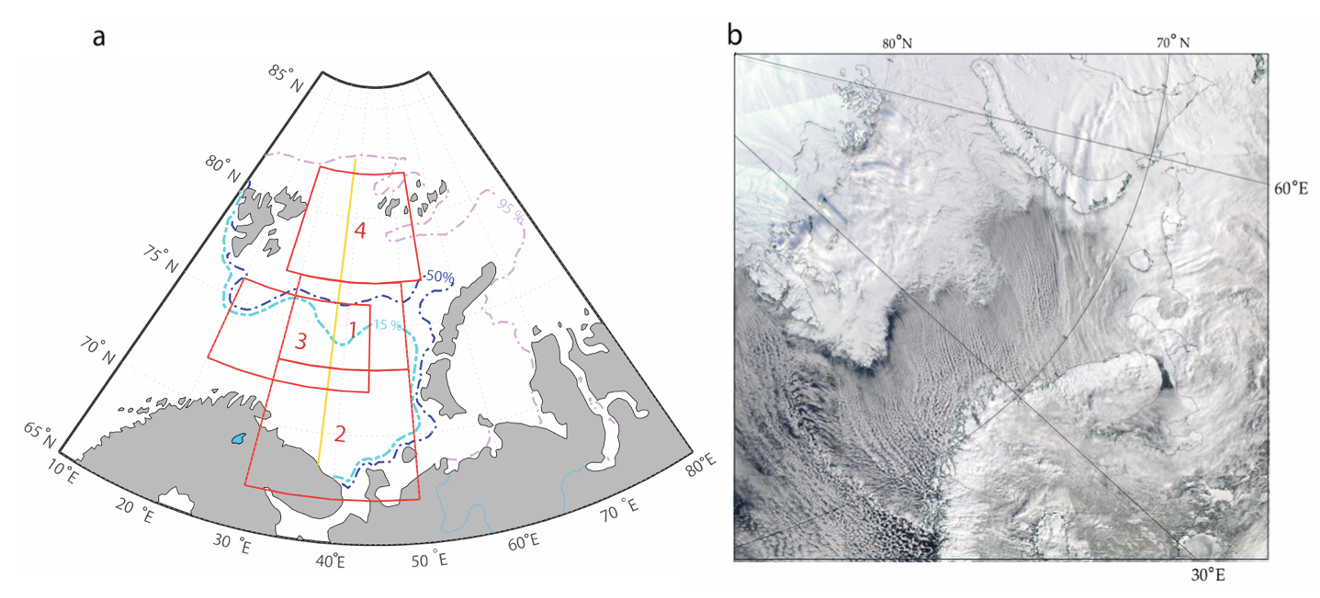
 - Indicates paper has been withdrawn from meeting
 - Indicates an Award Winner