
This study utilizes simulations from 14 Coupled Model Intercomparison Project Phase 6 (CMIP6) models to project SST changes across the North Atlantic and the wider Caribbean under the SSP2-4.5 and SSP5-8.5 scenarios. A multi-model ensemble approach is employed to minimize uncertainties and biases, enhancing the reliability of regional SST projections. Model validation and performance assessment were conducted using historical SST data (1982–2011) from the NOAA Optimum Interpolation SST (OISST) dataset. Results indicate strong model agreement with observations, with Pearson correlation coefficients of 0.84 for the LRS and 0.85 for the annual cycle, capturing approximately 72% of observed SST variance. The ensemble mean demonstrates a root mean square error (RMSE) of 0.17°C, suggesting a high level of predictive skill.
Projected SST changes for the mid-21st century (2036–2065) and late-century (2071–2100) reveal pronounced warming in the Caribbean Sea and Gulf, with the highest increases observed in these regions. Spatial analyses indicate a marked rise in SSTs across the LRS, with exponential warming trends under both SSP scenarios relative to the historical period. The projected intensification of SSTs has significant implications for regional climate, potentially influencing precipitation variability, hurricane activity, and marine heatwave occurrences. This study provides critical insights to inform adaptation strategies and climate risk mitigation in vulnerable tropical regions by advancing our understanding of future SST trajectories.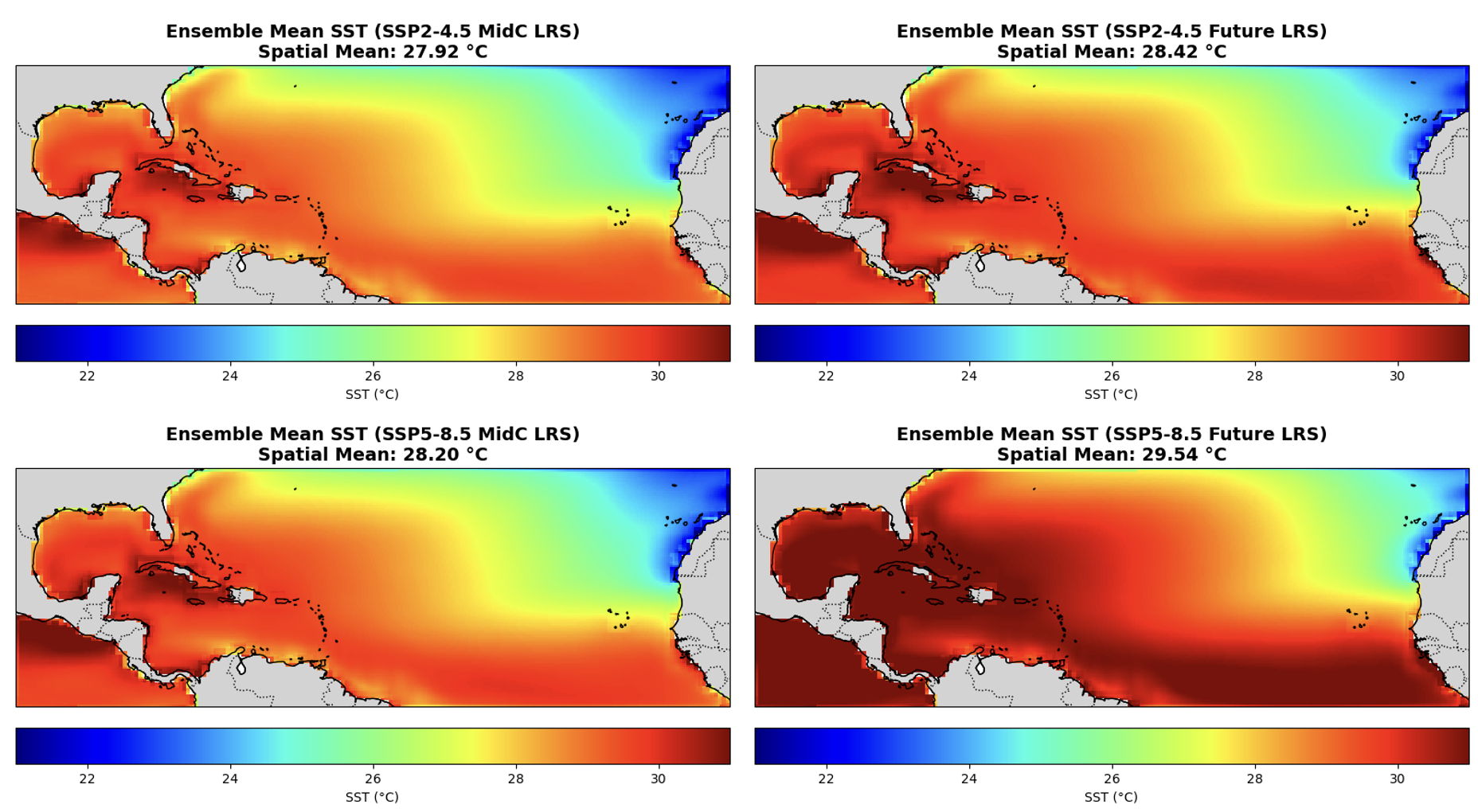
 - Indicates paper has been withdrawn from meeting
 - Indicates an Award Winner