
Handout (1.5 MB)
Localized severe weather causes serious damage on our life. To prevent dangerous disasters such as typhoons, heavy rains, fog and hail, real-time observation of Precipitable Water Vapor (PWV) and water vapor profiles efficiently detects the precursor phenomenon. Generally, radiosondes (SONDE) have been used to observe atmospheric profiles, but only twice a day. On the other hand, Microwave Radiometer (MWR) enable observations every few minutes and provide an effective solution for real-time atmospheric observation. However, conventional MWRs are large and heavy, and local meteorological and network observations are not easy. Based on this background, FURUNO research department developed a compact and light-weight MWR as shown in Fig. 1. This report shows results of evaluation of compact MWR.
Data and Methods
In this study, the PWV and water vapor profiles observed by MWR were evaluated. To estimate PWW and profiles, machine learning was used. GNSS and SONDE were used as training data for PWV and water vapor profile, respectively. Data from June 2021 to March 2022 were used for training, and data from April 2022 to March 2023 were used for evaluation. For the evaluation, we compared three meteorological observation systems in Tsukuba, MWR (by FURUNO), SONDE (by Japan Meteorological Agency) and GNSS (by FURUNO). For the evaluation of PWV, data estimated by MWR, PWV obtained from SONDE, and PWV obtained from GNSS were compared, respectively. For the evaluation of profiles, MWR and profiles obtained from SONDE were compared.
Results
The root-mean-square error (RMSE) of MWR-derived PWV compared to GNSS-derived PWV was 2.7 mm, and MWR-derived water vapor density compared to SONDE at the lowest layer of the atmosphere was 2.4 g m-3 as shown in Fig. 2. MWR-derived PWV showed better agreement with SONDE-derived PWV than with GNSS-derived PWV as shown in Fig. 3. It was also found that the estimation of the water vapor profile performs well for cases with simple vertical structures but less accurate for cases with complex structures, such as those involving water vapor inversion layers as shown in Fig. 4.
Conclusions
We have developed a compact, lightweight, low-cost ground-based MWR that uses a machine learning methods to estimate water vapor.This study demonstrates that even a compact MWR can observe water vapor with good accuracy. The water vapor observation data obtained by our compact MWR can be used for data assimilation and it could contribute to weather forecasting. As a future work, we plan to incorporate ground weather data (such as temperature, pressure, humidity) into machine learning models to improve PWV and water vapor profile estimations. The simplicity and mobility of our compact MWR will enable deployment in areas where water vapor observations have been challenging, such as on ships, and it will facilitate innovative water vapor observations.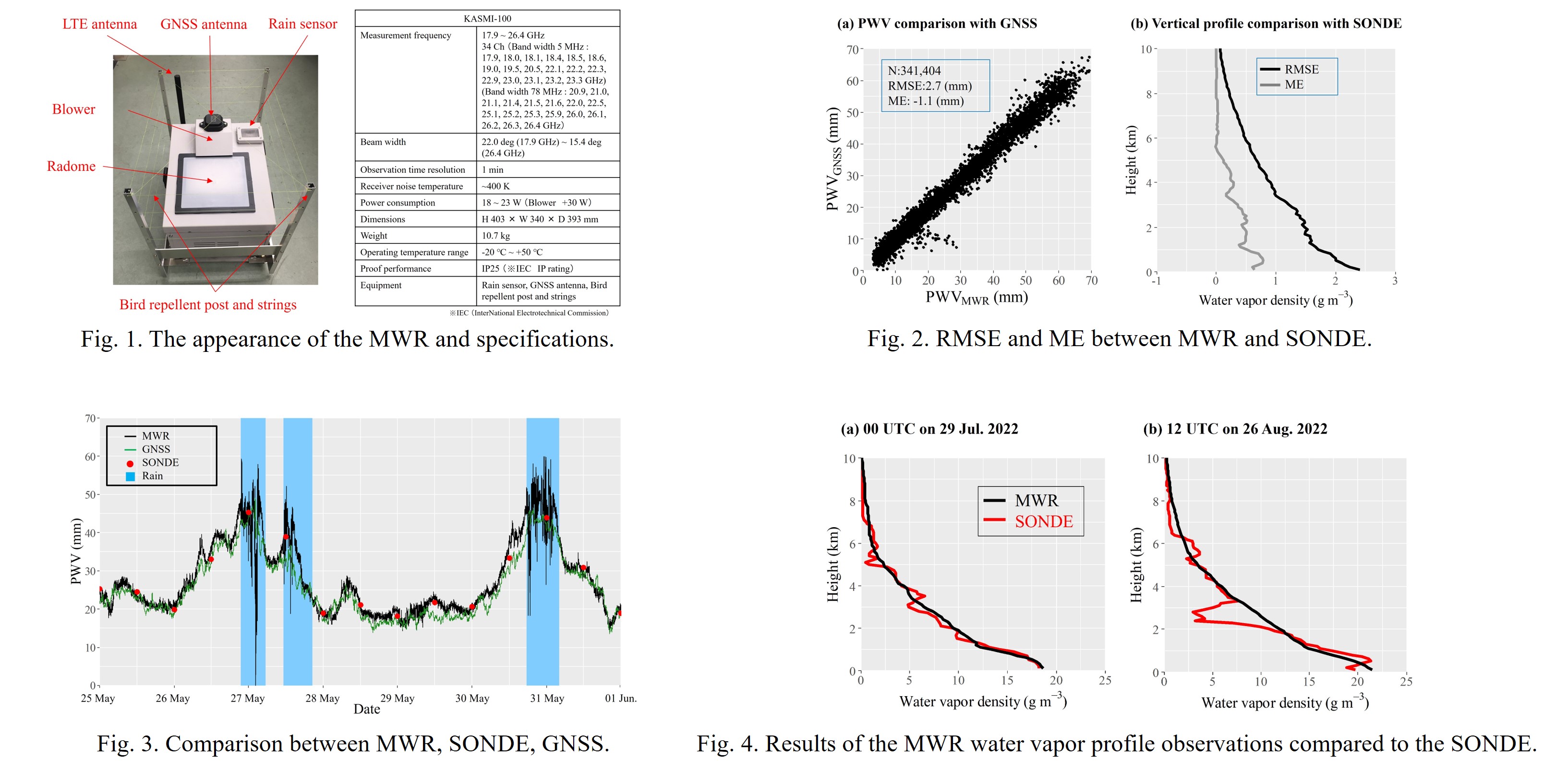
 - Indicates paper has been withdrawn from meeting
 - Indicates an Award Winner