
Monday, 13 January 2025: 8:30 AM
219 (New Orleans Ernest N. Morial Convention Center)
Thunderstorms occur in any given calendar month along the Texas Gulf Coast region. Deep convective clouds (DCCs) are responsible for the regular occurrence of thunderstorms and heavy precipitation that impact vulnerable populations and infrastructure due to lightning strikes and flooding. An accurate assessment of the aerosol effects on DCCs remains challenging, because of highly complex cloud charging and precipitation processes and the difficulty in representing the aerosol and cloud processes in atmospheric models. This study seeks to compare and contrast the behavior of DCCs that develop within deep convective systems (DCS) forced by sea/land breeze circulations, mesoscale convective systems, and tropical cyclones (e.g., eyewall and feeder band electrified deep convection) in polluted and clean environments along the Texas Gulf Coast region. The primary hypothesis is that the combination of elevated aerosol levels from various emission sources as well as favorable thermodynamic and dynamic conditions (i.e., high humidity and dynamic lifting) renders the southeast Texas region highly susceptible to aerosol-cloud-lightning interactions. Selected DCS cases examined and analyzed in this study will address three scientific questions: (1) What are the observational evidence and mechanisms for the impacts of aerosols derived from anthropogenic (urban/industrial/vehicle) and natural sources (e.g., agriculture and wildfire smoke) on the evolution of cloud microphysics, charge structures, and precipitation patterns of electrified deep convection along the Texas Gulf Coast? (2) How can the evolution of the charge structure of DCCs be better constrained and simulated, in model sensitivity work which includes detailed aerosol, cloud condensation nuclei (CCN), ice nucleating particles (INP), and lightning parameterizations, to account for (a) clean vs. polluted conditions, (b) similar vs. variable dynamic/thermodynamic settings, and (c) continental vs. marine interface regimes? and (3) How can atmospheric models be improved for accurate simulation and quantification of aerosol-lightning-precipitation interactions by using the multiscale-resolution/multiplatform-observations provided by the recent NSF Experiment of Sea Breeze Convection Aerosols and Precipitation (ESCAPE) and DOE Tracking Aerosol Convection Interactions Experiment (TRACER) intensive observation periods, Houston Lightning Mapping Array (HLMA), stationary and mobile radar assets, aircraft, and auxiliary ground-based aerosol, cloud microphysical, meteorological, and trace gas measurements? Charge structure information derived from the HLMA in conjunction with the chemical and ice nucleating nature of the ambient aerosols present in the pre-existing storm environment are analyzed and discussed for the selected DCS cases. Model simulation output is used to establish the relative importance of the various CCN, INP, and secondary ice processes (e.g., ice splintering/multiplication) in cloud formation, charge separation, and precipitation amount/rate.
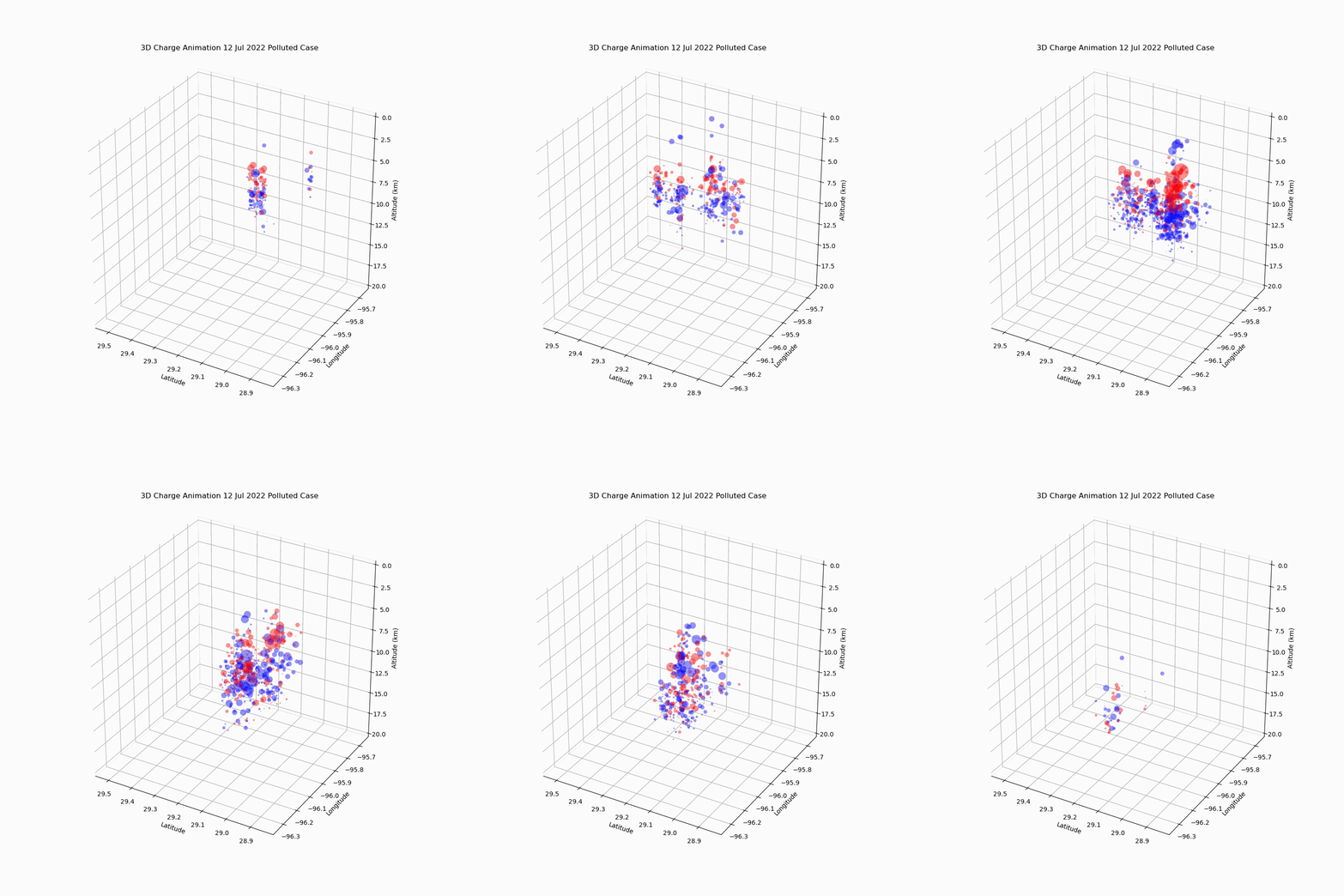
Supplementary URL: https://lightning.geos.tamu.edu/hlma/
 - Indicates paper has been withdrawn from meeting
 - Indicates an Award Winner