
During the Spring 2024 severe weather season in the Upper Ohio Valley and Mid-Atlantic regions, an unusually large number of tornadoes of EF0-EF2 intensity occurred from convective cells that bore a number of similarities to mini-supercells. Many of these cells were smaller than average in horizontal scale and vertical depth (approximately 3600-6000 meters deep), and a large number of which lacked lightning.
The most remarkable aspect of many of these tornadoes is that they were produced in cells exhibiting low-level rotational velocity of 7.0-12.0 m/s in the radar display, notably below the threshold of 15 m/s that is typically recommended during convective training.
This study investigates the environments in which these convective cells developed, examines the rotational structure of several cells, offers comparisons to the findings of Burgess et al. (1995), and discusses potential implications for warning decisions to help raise awareness for National Weather Service operations.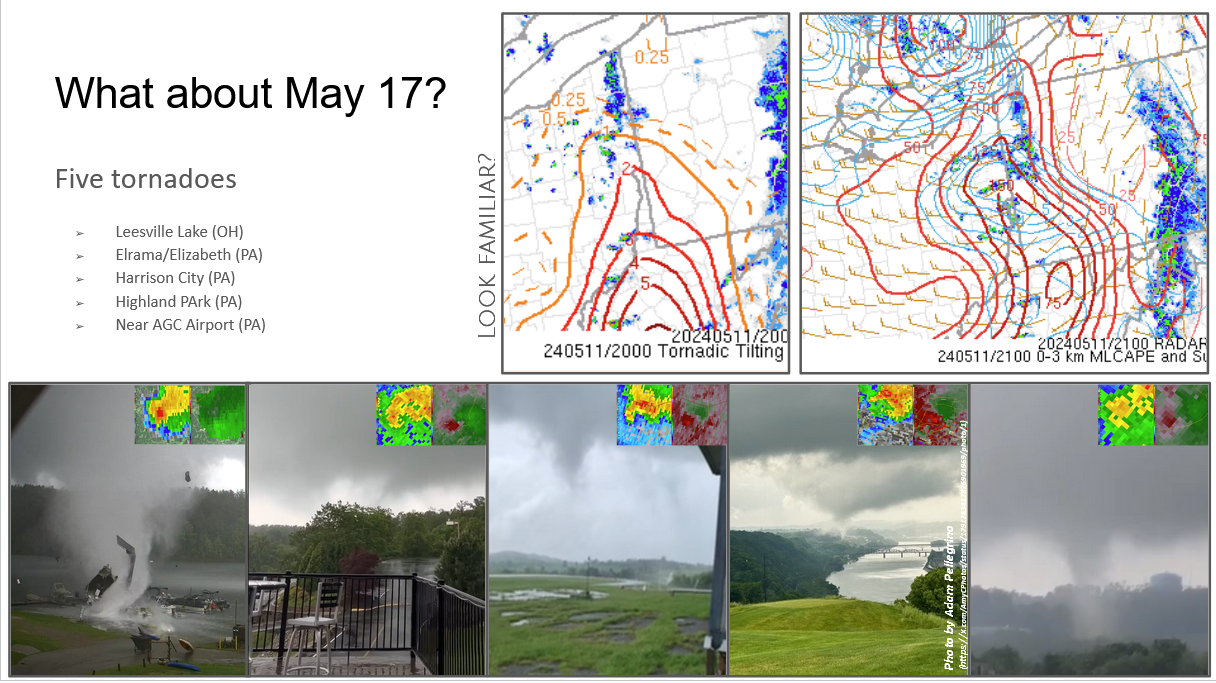
 - Indicates paper has been withdrawn from meeting
 - Indicates an Award Winner