
The Centers for Disease Control and Prevention (CDC) and the National Weather Service (NWS) have collaborated to identify temperature thresholds and develop a service that issues heat forecasts using data and methods relevant from a public health perspective. Each year, hot weather results in an average of over 1,220 deaths for which heat is listed as the underlying or a contributing cause on death certificates. However, these estimates might not capture the full spectrum of heat–related deaths, especially if excessive heat is not explicitly documented in death records. The CDC and NWS employed a nationally consistent study design and a modeling framework to link heat exposure with all-cause mortality data, determining heat-attributable deaths across locations with diverse climates.
The National Weather Service integrated health-based temperature thresholds provided by the CDC with local temperature parameters to devise experimental HeatRisk — a numeric and color-coded alert system. HeatRisk is the first multi-tiered framework that applies a consistent approach across different climate regions, incorporates high-resolution climatology and locally-relevant health evidence, and provides decision makers with an easy-to-use, public heat-appropriate heat service. This new system highlights the importance of collaborating with multiple stakeholders and across multiple disciplines. It can complement existing information systems by offering consistent prevention messages for heat through better coordination between weather and public health agencies at various geographic levels before, during, and after extreme heat events.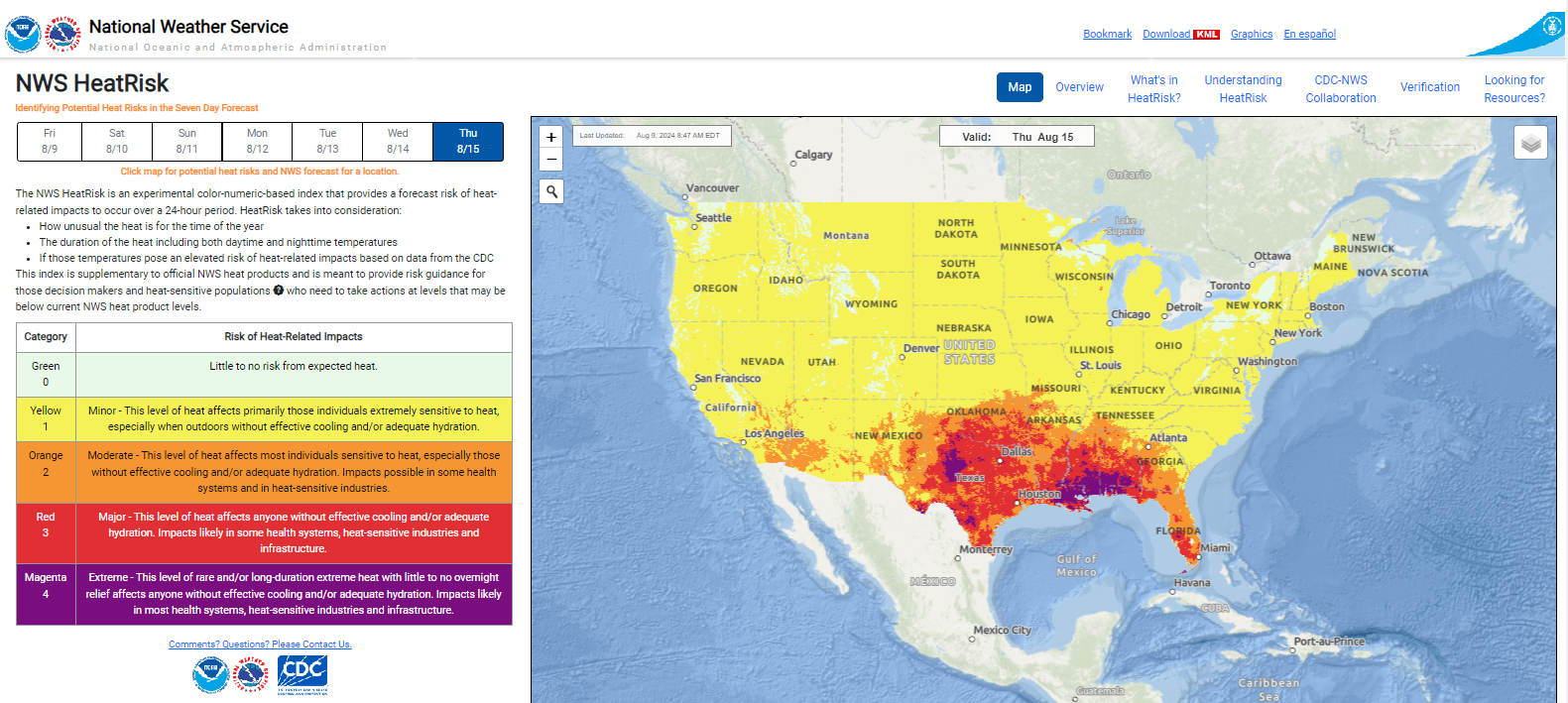
 - Indicates paper has been withdrawn from meeting
 - Indicates an Award Winner