
As global temperatures rise due to climate change, the frequency and intensity of heatwaves are increasing, posing significant threats to human health, productivity, and well-being. Vulnerable populations, such as the elderly, those with pre-existing medical conditions, and individuals living in poverty, are at heightened risk. Understanding and mitigating the risks associated with extreme heat across various demographics are crucial for informing policy, infrastructure decisions, and behavioral interventions aimed at reducing these dangers.
Heat stress assessments have traditionally relied on simplified models or indices that primarily consider air temperature and humidity. While these methods provide a general indication of environmental stress, they fall short in accurately predicting physiological responses, particularly under extreme conditions. Complex models, such as the multi-node and multi-segment models validated in this study, incorporate detailed thermoregulatory controls, body segmentation, and tissue types, offering a more nuanced understanding of heat stress. However, the application of these models has been limited by challenges related to reproducibility, accessibility, and the computational resources required for their deployment, particularly for 3D anatomical models. Furthermore, previous evaluations of these models have often focused on low activity levels and semi-nude conditions, limiting their applicability to real-world scenarios involving diverse populations and environmental conditions.
This study aims to address these limitations by enhancing and validating an updated open-source thermoregulation model, alongside other established models, to ensure accurate prediction and assessment of heat strain under a wide range of extreme heat conditions.
Method
This study validated five thermoregulation models with varying levels of complexity: Gagge’s two-node model, Stolwijk-1971, Stolwijk-2024, JOS3, and UTCI-Fiala (1–4). These models represent a spectrum of complexity from simple two-node models to advanced multi-segment, multi-node models. The models were tested against human trial data under a diverse range of heat stress conditions, including transient extreme dry-heat, humid-heat, and scenarios involving different physical activity levels and clothing insulation. To improve the reliability of the Stolwijk model, the study updated its efferent control signals, convective and radiative heat transfer, temperature setpoints, and adjusted to account for clothing insulation, resulting in the Stolwijk-2024 model. This model was specifically designed to maintain the integrity of the original framework while enhancing its predictive capabilities.
Results
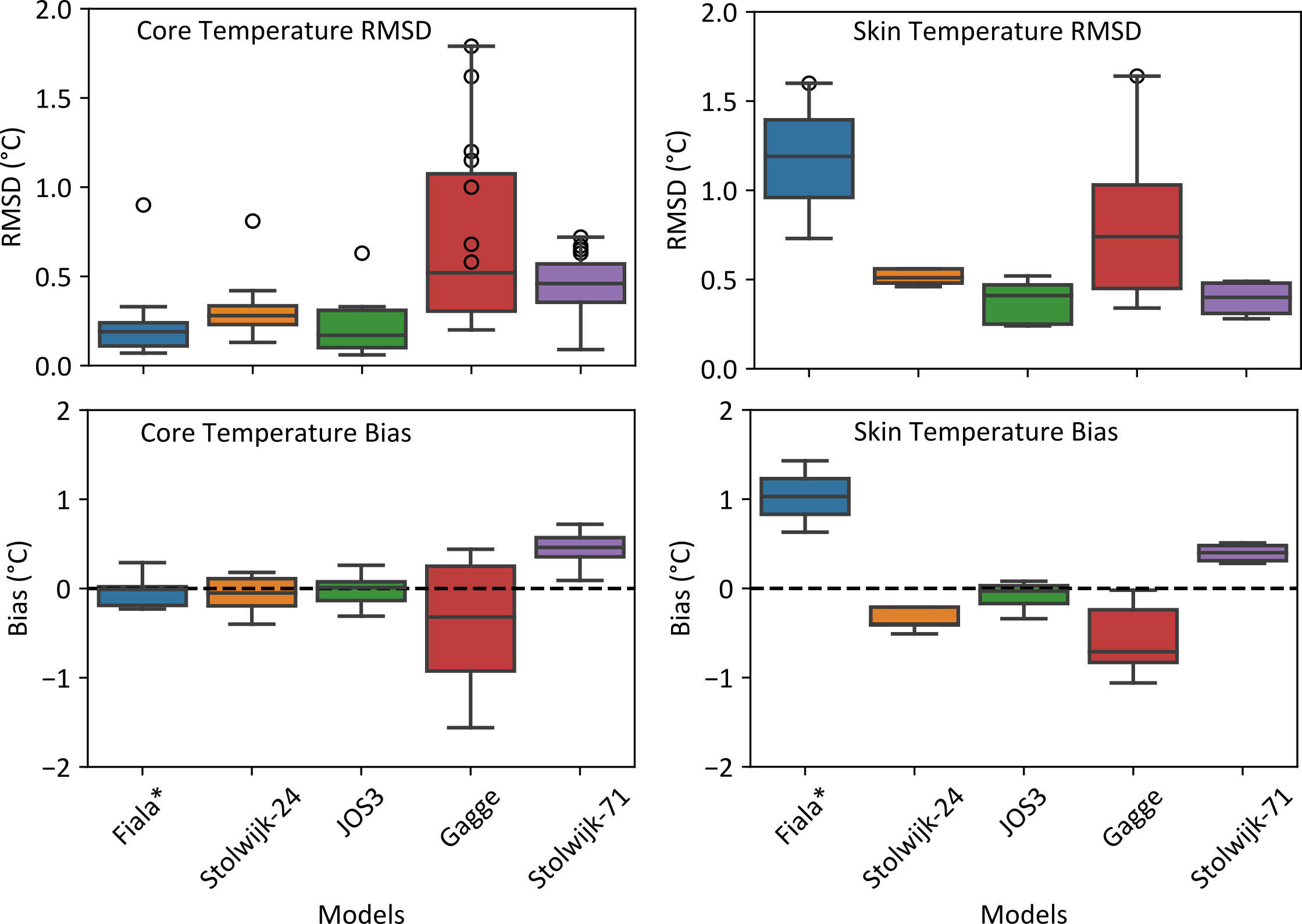
Our findings highlight the superior predictive performance of multi-node and multi-segment models like JOS3, UTCI-Fiala, and the updated Stolwijk-2024. These models achieved RMSD values of less than 0.3°C for core temperatures and 1.0°C for skin temperatures, which is less than maximum standard deviation in human subjects making them highly reliable for assessing heat strain and thermal comfort across a broad range of environmental conditions (5,6). The updated Stolwijk-2024 model, in particular, demonstrated significant improvements over its predecessor, especially under conditions involving high metabolic rates and extreme heat. These enhancements can be attributed to the updated setpoint temperatures, improved convective and radiative heat transfer coefficients, and refined efferent control signals.
In contrast, simpler models like Stolwijk-1971 and Gagge’s two-node model exhibited higher RMSD values, particularly under conditions involving high metabolic rates and extreme heat. The Stolwijk-1971 model consistently underpredicted core temperatures, which could lead to a false sense of safety in real-world applications. Gagge’s two-node model, while not showing a clear bias, also had lower overall accuracy in scenarios involving higher metabolic rates.
Discussion
The results underscore the importance of using advanced multi-node and multi-segment models for accurate heat stress assessment, particularly under extreme conditions. These models provide critical insights into the physiological strain experienced during extreme heat events, making them invaluable tools for public health planning, urban design, and climate impact research. The study also highlights the accessibility and adaptability of open-source models like JOS3 and Stolwijk-2024, which can be modified to reflect individual differences in thermoregulation, such as age, gender, and health status.
However, the limitations of over simplified models emphasize the need for caution when applying them in high-risk scenarios. The underperformance of these models under extreme conditions suggests that validated and robust models are necessary for accurate assessments, particularly in environments with high metabolic rates and extreme heat.
Conclusion
This research contributes to the broader goal of improving heat stress assessment under extreme conditions by validating and refining thermoregulation models that can be applied across various demographic groups. By enhancing the accuracy and applicability of these models, we aim to support better policy-making and community-based interventions, ultimately reducing heat-related health risks in vulnerable populations. Future work should focus on further refining these models to incorporate individual differences more effectively and ensure they remain robust under increasingly variable and extreme climate conditions. This will be essential for developing tailored, effective strategies to protect all populations, especially those most at risk, from the escalating dangers of extreme heat.
References
- Fiala D, Havenith G, Bröde P, Kampmann B, Jendritzky G. UTCI-Fiala multi-node model of human heat transfer and temperature regulation. Int J Biometeorol. 2012;56:429–41.
- Stolwijk JA. A mathematical model of physiological temperature regulation in man. 1971.
- Gagge AP. An effective temperature scale based on a simple model of human physiological regulatory response. Ashrae Trans. 1971;77:247–62.
- Takahashi Y, Nomoto A, Yoda S, Hisayama R, Ogata M, Ozeki Y, et al. Thermoregulation model JOS-3 with new open source code. Energy Build. 2021 Jan 15;231.
- Haslam RA, Parsons KC. Using computer-based models for predicting human thermal responses to hot and cold environments. Ergonomics. 1994;37(3):399–416.
- Joshi A, Wang F, Kang Z, Yang B, Zhao D. A three-dimensional thermoregulatory model for predicting human thermophysiological responses in various thermal environments. Build Environ. 2022 Jan 1;207.
 - Indicates paper has been withdrawn from meeting
 - Indicates an Award Winner