
Tuesday, 14 January 2025
Hall C (New Orleans Ernest N. Morial Convention Center)
Handout (1.2 MB)
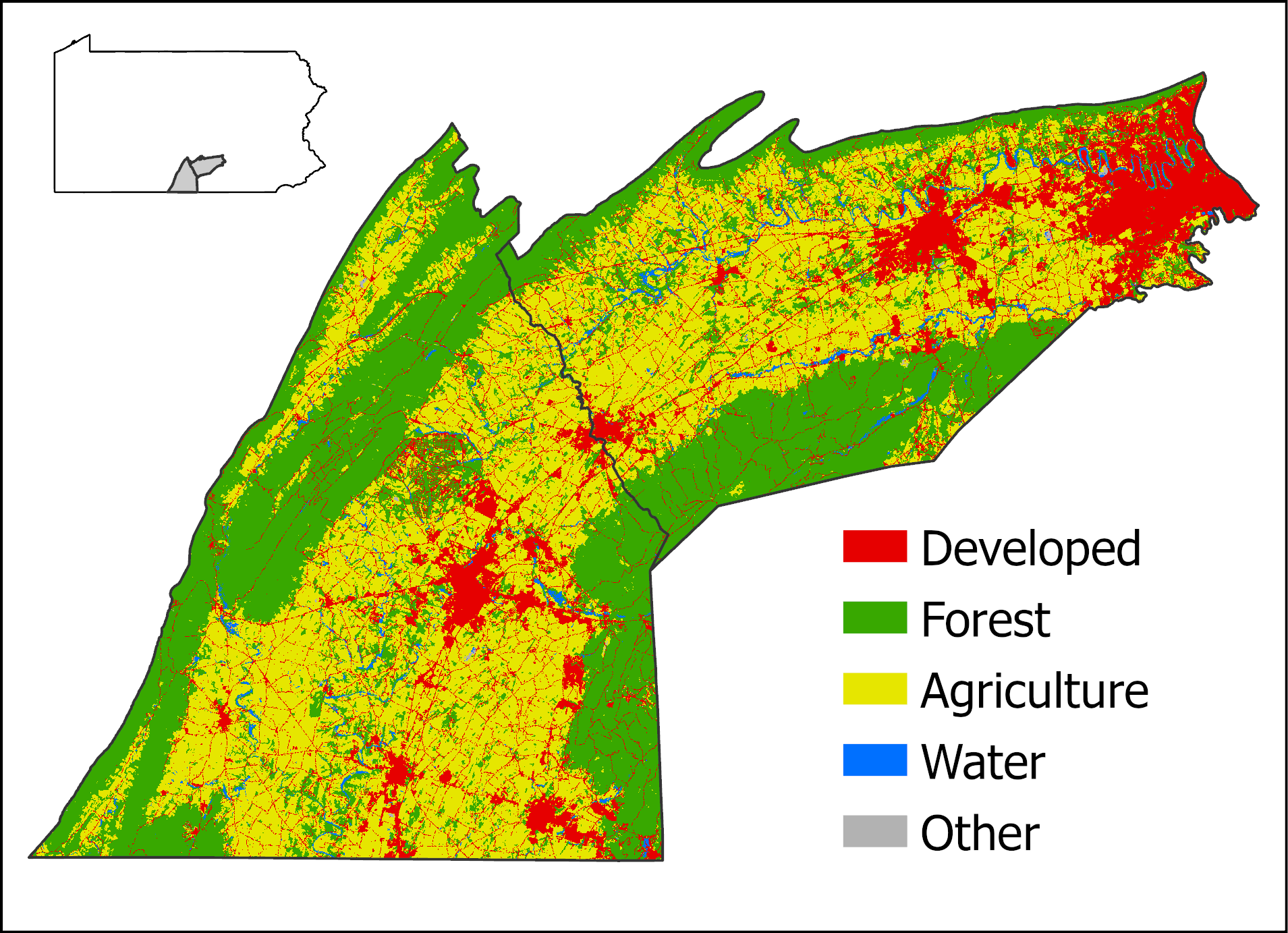
Although Pennsylvania is located outside the traditional “Corn Belt” of the United States, corn production is a critical element of the state’s agricultural output and economy, ranking as the second most harvested crop in the Commonwealth. Variations in precipitation, temperature, and drought conditions have all been shown to significantly influence agricultural yields. This study focuses on the Cumberland Valley in Cumberland and Franklin counties, located in the south-central part of Pennsylvania. Agriculture represents approximately 50% of the land use in the valley, with corn representing most of the agricultural production. Monthly and seasonal regression analyses and composite averaging and mapping indicate the relative importance of climate variables and synoptic climate patterns in assessing corn yields. At the seasonal scale (April through September), corn yield is strongly and significantly correlated with PDSI values while temperature and precipitation are less correlated but still significant. PDSI values for the months of May through September are all significantly correlated with seasonal corn yield, with July and August correlations being largest. Most monthly temperature and precipitation correlations with seasonal corn yield are not significant, suggesting that the combination of temperature and precipitation, and their combined role in drought formation, is most important. Composite averages of the top and bottom 10% of corn yield years indicates high yield years have 0.9°C cooler temperatures, 71 mm more precipitation, and a PDSI value that is 2.5 units higher (less drought) on a standardized scale. Seasonal correlations between PDSI and both temperature and precipitation indicate that only the precipitation correlation with PDSI is significant and is nearly four times larger than the temperature correlation with PDSI. However, monthly values indicate significant temperature vs. PDSI correlations for July and August, while precipitation vs PDSI correlations for July and August are weakest compared to other moths, and in the case of July, nonexistent, suggesting that while overall, precipitation is most important in determining PDSI values, temperature plays a critical role in July and August. The relative roles of precipitation and temperature in determining PDSI values and thus corn yields are corroborated through composite synoptic atmospheric maps for the top and bottom 10% of corn yield years. During August of high corn yield years, 250 hPa geopotential heights across the United States are lower, thereby allowing cooler temperatures to blanket the region as well. Precipitable water values are lower over the Midwest and higher over the Atlantic Ocean with values of near-zero over the Cumberland Valley, again suggesting that while overall, precipitation and moisture are most important to determining PDSI values and therefore corn yield, it is cooler temperatures in July and August that are key to differentiating between the highest and lowest corn yield years. A cursory economic analysis indicates that the difference between a 15% increase or decrease in corn yields is equal to a profit of $3.6 million or a loss of $0.5 million respectively for the Cumberland Valley corn industry.
 - Indicates paper has been withdrawn from meeting
 - Indicates an Award Winner