
Thursday, 16 January 2025
Hall C (New Orleans Ernest N. Morial Convention Center)
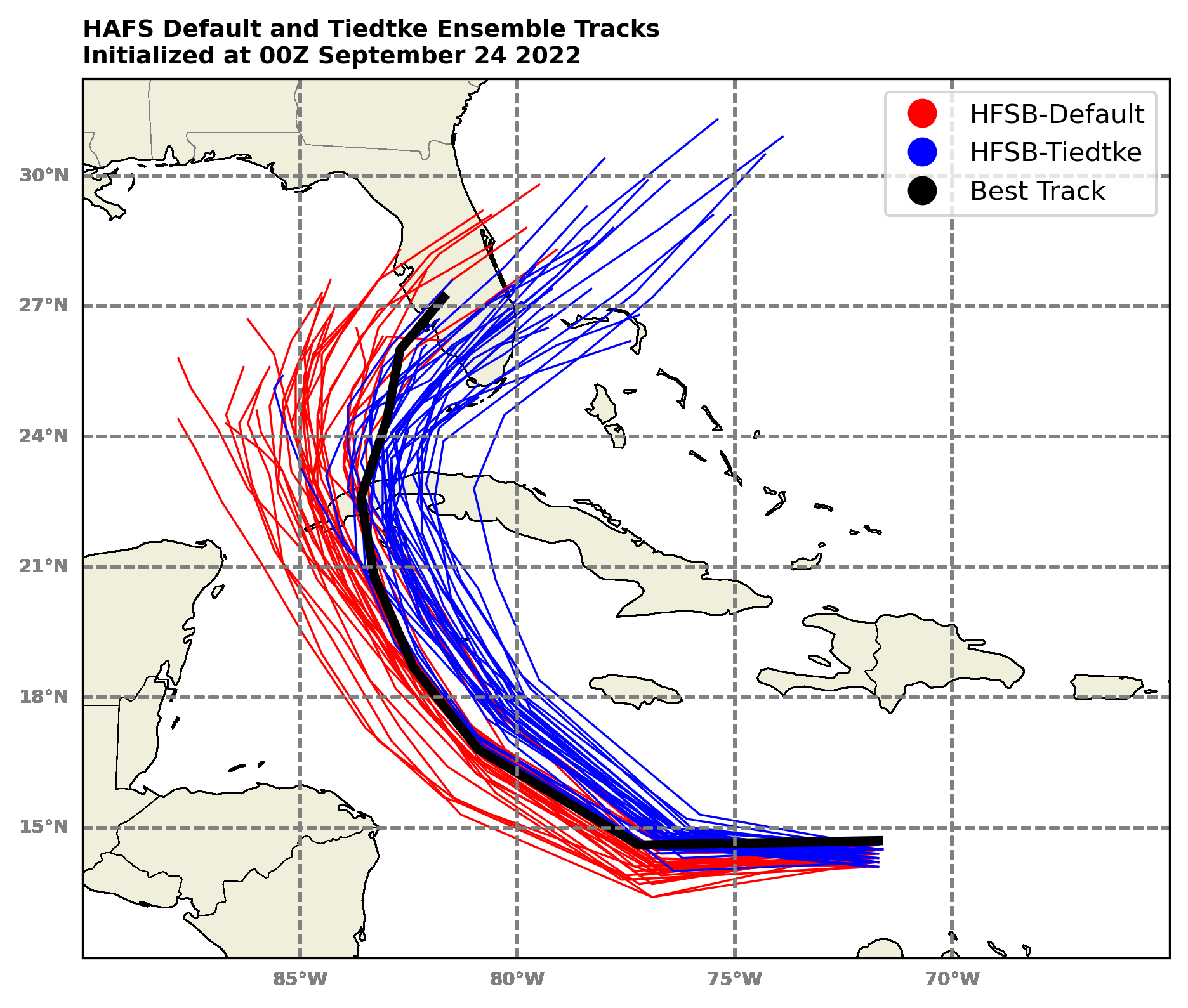
The Hurricane Analysis and Forecast System (HAFS) is NOAA’s next generation hurricane model. Running the HAFS on past storms, a concept known as hindcasting, can reveal biases that can then be corrected to improve forecast skill. One common approach used to evaluate a model is to run it repeatedly but with slight tweaks to the initial conditions (ICs). This creates an ensemble set that can help expose periods of enhanced uncertainty and provide a realistic range of forecast possibilities. Another method to evaluate uncertainty is to instead vary the sub-grid physics (e.g., convective parameterization scheme) that the model uses. The idea here is to try to reveal forecast sensitivities that simply altering the ICs wouldn’t show. In this study, the HAFS was evaluated on two 30 member ensemble sets, with each set run on a different convective scheme. A forecast cycle early in the lifespan of Hurricane Ian was used. The goal of this study was to leverage the varying convective schemes and ICs to discover synoptic-scale and vortex-scale forecast sensitivities. Through various methods such as visual analysis, clustering, and storm attribute comparison, it was found that convective schemes are indeed able to unveil additional uncertainties that were overlooked by standard ensemble analysis. When comparing within the ensemble sets, the primary culprit for track differences with Hurricane Ian was the strength of the subtropical ridge. When comparing convective schemes, however, differences in vortex-tilt and vortex-scale convection played a major role as well. Additionally, in the case of a disorganized TS Ian, varying the convective scheme helped to enhance forecast diversity, an attribute valued by operational forecasting agencies. Expanding this analysis to different forecast hours and storms could allow for stronger conclusions to be made regarding the specific benefits and drawbacks of the different convective schemes.
 - Indicates paper has been withdrawn from meeting
 - Indicates an Award Winner