
Thursday, 16 January 2025
Hall C (New Orleans Ernest N. Morial Convention Center)
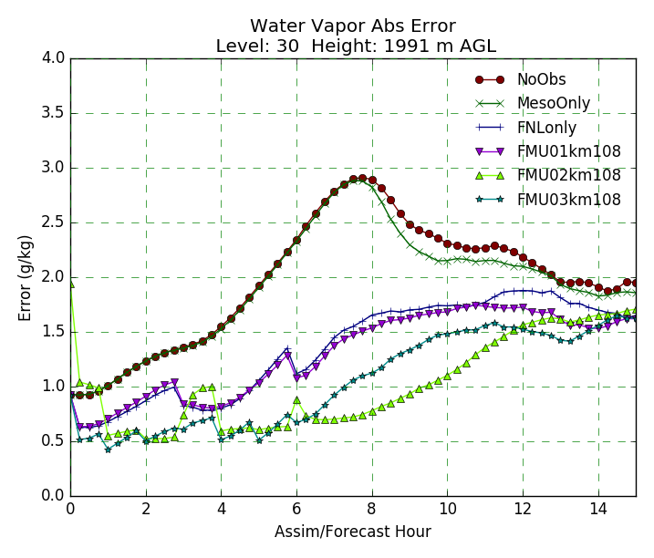
A system for running Observing System Simulation Experiments (OSSEs) in a storm-scale numerical weather prediction modeling system has been developed and is applied to simulated atmospheric profiles from Uncrewed Aircraft Systems (UAS). The OSSE system here uses Incremental Analysis Updating (IAU) data assimilation and analysis increments from the ARPS Data Analysis System or 3DVAR. The OSSE system is used to measure the potential impact of networks of UAS profiles such as might be deployed in a 3D-Mesonet configuration at some or all of the Oklahoma Mesonet observing sites and operated at 30-minute or hourly profile intervals. Simulated profiles are extracted from 1-km WRF nested model "Nature Run" simulations while simulated observation errors are applied using targeted error characteristics of the OU Coptersonde. Maximum heights of profiles are examined at 400-ft up to 3 km AGL. Cases of springtime severe weather and winter weather with mixed precipitation are examined and impacts to ARPS model forecasts at 3-km grid spacing are measured. For the spring severe weather case (May 20, 2013), forecast improvements are seen most clearly for profiles extending to 2 km and above, with improvements seen in dryline structure and convection initiation. Impacts for the winter case (Feb 19, 2019) are weaker and mainly seen at and below the levels observed. Further details and verification statistics will be shown. Sample images shows verification of time series of forecasts vs. Nature Run for water vapor at 2-km AGL level for the spring severe weather case.
 - Indicates paper has been withdrawn from meeting
 - Indicates an Award Winner