
Monday, 13 January 2025: 2:00 PM
215 (New Orleans Ernest N. Morial Convention Center)
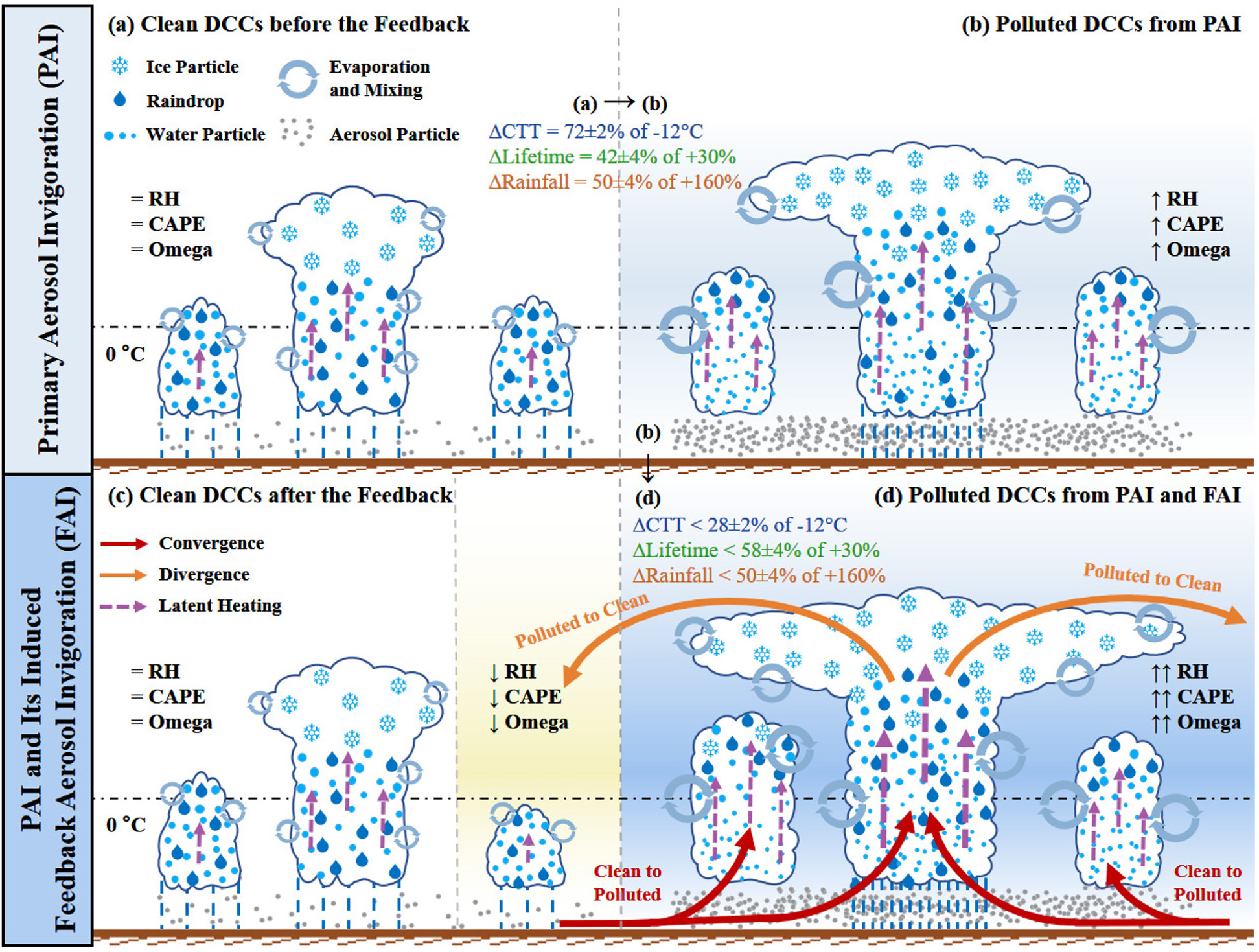
To quantify aerosols' effect on deep convection systems (DCS), we developed a full lifetime tracking algorithm that encompasses all their splitting and merging components. Based on 9 years of METEOSAT 2nd Generation data bounded by 30S-30N and 50W-50E combined with MERRA-2 aerosol and reanalysis data, we found that: (a) Rainfall amount from DCS increased by ×5 when fine aerosols changed from the cleanest to an optimal concentration of 5 µg/cm3. This was associated with further cloud top vertical growth and cooling by ~4K. Added coarse (radius> 1 µm) salt aerosols by up to 75 µg/cm3 to clouds containing optimal fine aerosol amounts over the ocean further enhanced DCS rainfall by up to an additional factor of ×2 while slightly warming cloud tops. The associations were causal, as indicated by the repeated for different narrow ranges of cloud controlling factors. However, since total precipitation must balance the evaporation, which is bounded by energetic considerations, the large indicated effects must be a manifestation of rainfall redistribution from clean to aerosol-rich clouds, which, in turn, must involve changes in the regional circulation systems as a result of feedback to the primary aerosol convective invigoration effect. This is illustrated in the figure. Supporting evidence of aerosol-cloud-mediated changes in regional circulation systems is presented.
 - Indicates paper has been withdrawn from meeting
 - Indicates an Award Winner