
Unusually high concentrations of ice crystals were found to be consistently present in Arctic low-level stratiform mixed-phase clouds. Cloud top temperature in the studied clouds varied from -3°C to -6°C, and the concentration of ice particles usually varied from a few to a few tens per liter. Multiple occurrences of such observations in different Arctic regions extended over thousand kilometers suggest such clouds are omnipresent in the Arctic during spring and summer. The presence of ice crystals in liquid clouds may affect their longevity and radiative properties and eventually affect the rates of sea ice melting and polar region warming.
The mechanism of the formation of ice particles in the observed clouds is unclear. In the frame of existing knowledge, the formation of ice particles at such high temperatures cannot be attributed to primary (heterogeneous) ice production (PIP) since the expected concentration of ice nucleating particles (INP) in the temperature range -3C to -6C is several orders of magnitude lower than the observed ice concentration. Secondary ice production (SIP) also cannot account for the formation of the observed ice particles either since none of the recognized SIP mechanisms can explain the formation of the observed ice crystals for these environmental conditions.
The observations presented here are intended to stimulate further research on INP nucleation at subfreezing temperatures and explore SIP mechanisms, which may explain the observed phenomenon of anomalously high concentration of ice in such Arctic low-level stratiform clouds.
Figure Left panel: Images of columnar ice crystals (rectangular shapes) among the cloud liquid droplets (small dots) collected by the SPEC 2DG probe. Right panel: Image of a newly formed ice particle in the liquid cloud measured by the SPEC CPI probe. Measurements were conducted in stratiform clouds with cloud top altitude Htop=550m and temperature Ttop =-5C from the NASA P-3 research airplane over Baffin Bay on 10 June 2024.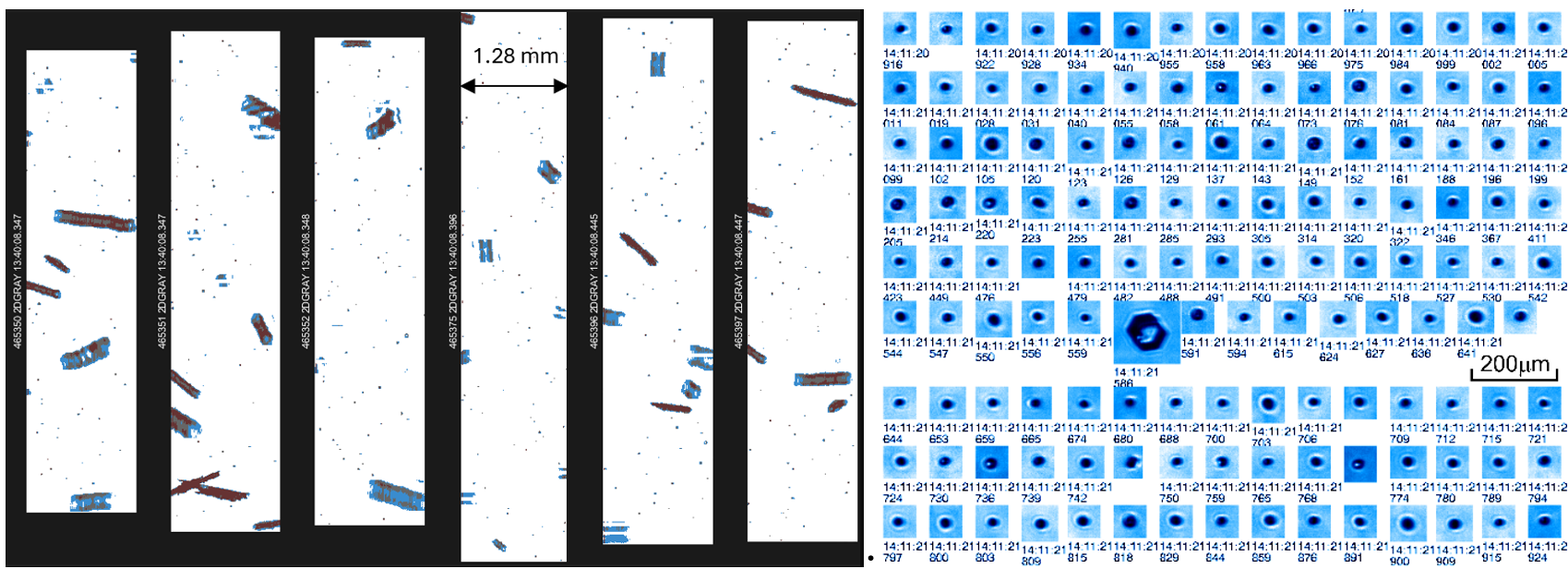
 - Indicates paper has been withdrawn from meeting
 - Indicates an Award Winner