
Results from the field campaigns in cumulus clouds suggest that the HM SIP has often been employed to explain high ice concentrations from in situ observations and in numerical models when there was insufficient evidence to support this conclusion. The data from observations and models suggest that the ice was most likely recirculated from colder regions aloft into the HM temperature range (-3° to -8°C).
In the Arctic, stratiform clouds with cloud-top temperatures from -3° to -7°C were ubiquitous and endured for hours and days at a time. The data show very high ice concentrations in clouds within the HM temperature range that did not meet the HM requirement of containing large rimed ice. In contrast, clouds that did meet all of the HM requirements showed ice concentrations of the same magnitude. This suggests that if HM SIP were active, it was not producing more ice than cloud regions that did not meet HM requirements, which tends to support some old and much more recent laboratory work showing the inefficiency of HM SIP.
Numerical models have often parameterized HM to generate high ice concentrations in the -3° to -8°C temperature range in order to agree with in situ observations, but the (Eulerian) models do not have the capability to trace individual ice particles and determine if they originated in colder regions aloft. The physical mechanism of HM SIP is still under debate, and the efficiency of the secondary ice production due to the HM process needs further laboratory examination.
This presentation presents data from eight recent field projects and uses physical arguments to explain where and how the HM SIP mechanism may have been misused.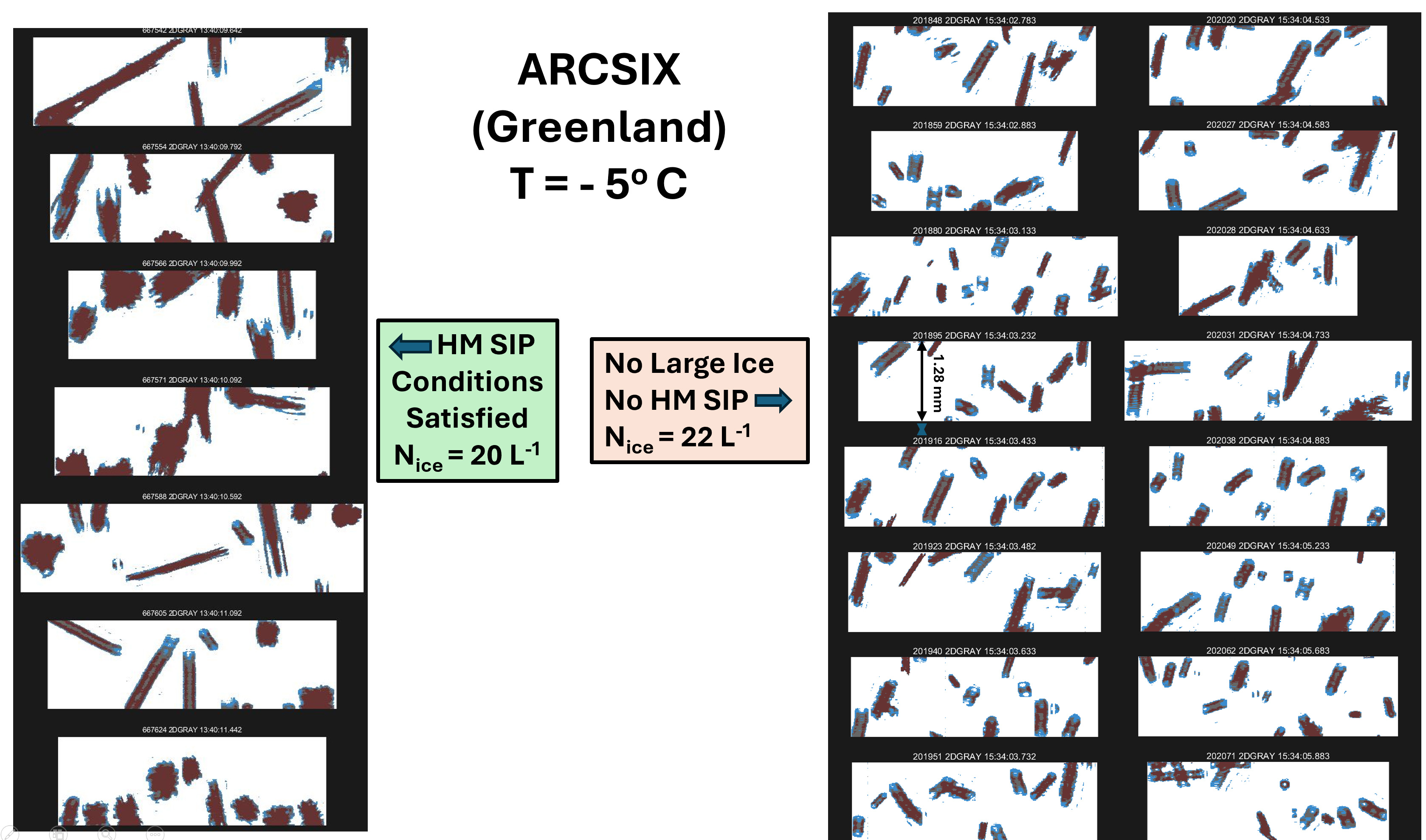
 - Indicates paper has been withdrawn from meeting
 - Indicates an Award Winner