
Leo Matak and Mostafa Momen
Rapid urbanization and industrial growth can exacerbate air pollution and human health problems in densely populated areas. Urban environments, characterized by their complex and heterogeneous surface structures, can significantly influence microclimates and air quality. Cities are typically warmer than their surrounding areas due to the Urban Heat Island (UHI) effect, which is intensified by both anthropogenic activities and the unique surface properties of urban areas. Due to an increase in impervious areas and buildings, the overall drag in urban areas is significantly different compared to rural areas. However, the impacts of UHI and surface heterogeneity on urban meteorology and air quality forecasts have not been well understood (Matak & Momen, 2024a).
In this talk we aim to address this knowledge gap by examining how improved urban parameterization influences meteorological and aerosol forecasts in cities. To this end, over 30 days of simulations were conducted for two major U.S. cities (Houston and Dallas) using the Weather Research and Forecasting model (WRF) and WRF model coupled with Chemistry (WRF-Chem). Over 70 simulations were performed by varying the Planetary Boundary Layer (PBL) schemes, urban models, different representations of UHI and surface roughness (Matak & Momen, 2024b).
Our findings reveal that the current urban schemes implemented in WRF are insufficiently capturing the UHI effect and the variability in roughness’s of urban surfaces, leading to inaccuracies in forecasts. These deficiencies result in substantial errors in both meteorological and air pollution forecasts. The model’s failure to properly account for UHI and surface heterogeneity effects leads to an overly stable nocturnal atmosphere, as it overlooks the additional heating and surface variations present in major urban areas. The attached figure illustrates how this issue in WRF can cause an accumulation of aerosol forecasts on urban surfaces and an overestimation of particulate matter (PM) levels. We improved the default model by accounting for the nocturnal UHI effects in the urban schemes of WRF. The default urban model (gray line in figure a) significantly underestimates the nocturnal temperature compared to observed values (black), while our improved urban model (green) demonstrates enhanced agreement throughout the entire simulation period. Similarly, our improved urban model aligns better with the observed values in wind speed forecasts (figure b). The inaccuracies in urban models can have significant impacts on air pollution forecasts. As shown in the attached figure (c,d), the default urban model produces unrealistically high values due to the accumulation of nighttime PM2.5, whereas our improved urban model (d) mitigates this issue. The error is especially visible at CAMS404 measurement station (denoted with a cross on the contour plots), which is color-coded to the observed value of PM2.5.
By enhancing the UHI and urban surface heterogeneity representation in WRF, we were able to improve the forecasts of particulate matter and ozone by an average of ~50% and ~12% in Houston, respectively. We will also briefly introduce a machine-learning based method for improving complex surface roughness representations in urban schemes of WRF, which led to significantly enhanced meteorological forecasts. This study underscores the importance of urban-specific models, including UHI parameterizations and accounting for surface heterogeneity, for producing accurate meteorological and aerosol forecasts in cities.
References:
Matak, L., & Momen, M. (2024a). Enhancing Air Quality Forecasts in City Environments. AMS 104th Annual Meeting.
Matak, L., & Momen, M. (2024b). Enhancing Air Pollution Forecasts in Cities by Characterizing the Urban Heat Island Effects on Planetary Boundary Layers. Atmospheric Research. Manuscript Submitted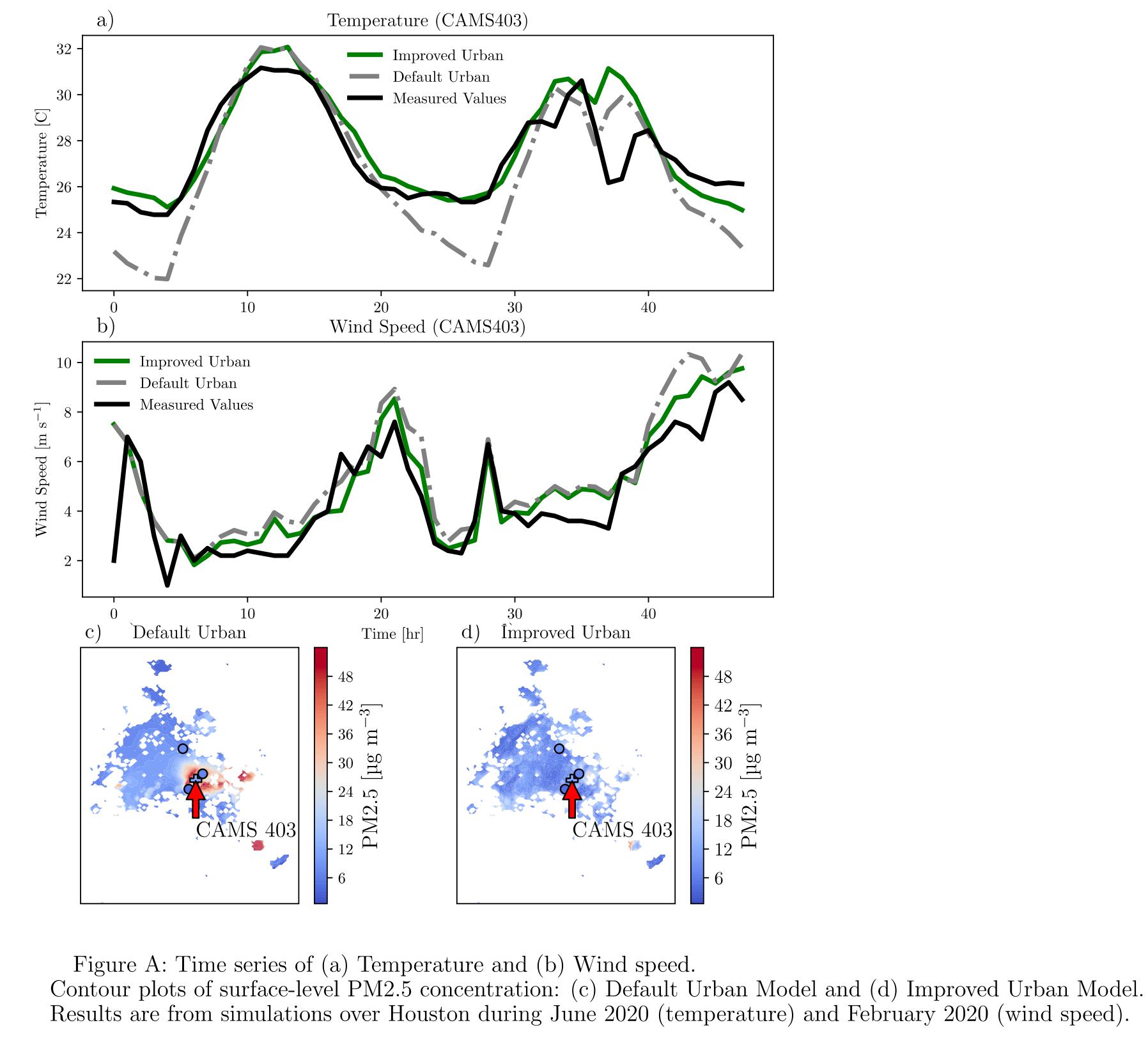
 - Indicates paper has been withdrawn from meeting
 - Indicates an Award Winner