
DeepMMF represents a significant advancement over traditional methods by leveraging the power of deep learning to model the nonlinear relationships between atmospheric observations and emissions. The core of DeepMMF lies in its innovative use of a neural network architecture that fuses multiscale atmospheric data with physical models, capturing the complexities of atmospheric transport and chemistry processes. This fusion allows for more accurate inversion of emissions data, leading to improved emissions inventories that are both temporally and spatially resolved.
Our methodology involves training the neural network on large-scale atmospheric datasets, including satellite observations, ground-based measurements, and chemical transport model outputs. We employed a supervised learning approach, where the network was trained to minimize the difference between model-predicted concentrations and observed values. A key feature of DeepMMF is its integration of physically-informed constraints during the training process, which ensures that the model’s predictions remain consistent with known physical laws and atmospheric processes. This physically-informed approach distinguishes DeepMMF from purely data-driven models, enhancing its robustness and interpretability.
To validate the performance of DeepMMF, we conducted extensive testing using synthetic data as well as real-world atmospheric measurements. The results demonstrate that DeepMMF significantly outperforms traditional inverse modeling techniques in terms of both accuracy and computational efficiency. Specifically, DeepMMF was able to reduce the uncertainty in emissions estimates by up to 30% compared to conventional methods. Furthermore, the model exhibited strong generalization capabilities across different geographical regions and time periods, underscoring its potential for global applications.
The implications of DeepMMF extend beyond emissions estimation, as the framework can be adapted to other environmental modeling challenges where complex interactions between physical processes and observational data need to be resolved. By advancing the integration of machine learning with physically-informed models, DeepMMF opens new avenues for improving our understanding of atmospheric processes and refining climate models.
In conclusion, DeepMMF offers a powerful tool for enhancing the accuracy and resolution of emissions inventories. Its innovative combination of machine learning and physical modeling represents a significant step forward in the field of atmospheric science, with the potential to inform policy decisions and support efforts to mitigate climate change.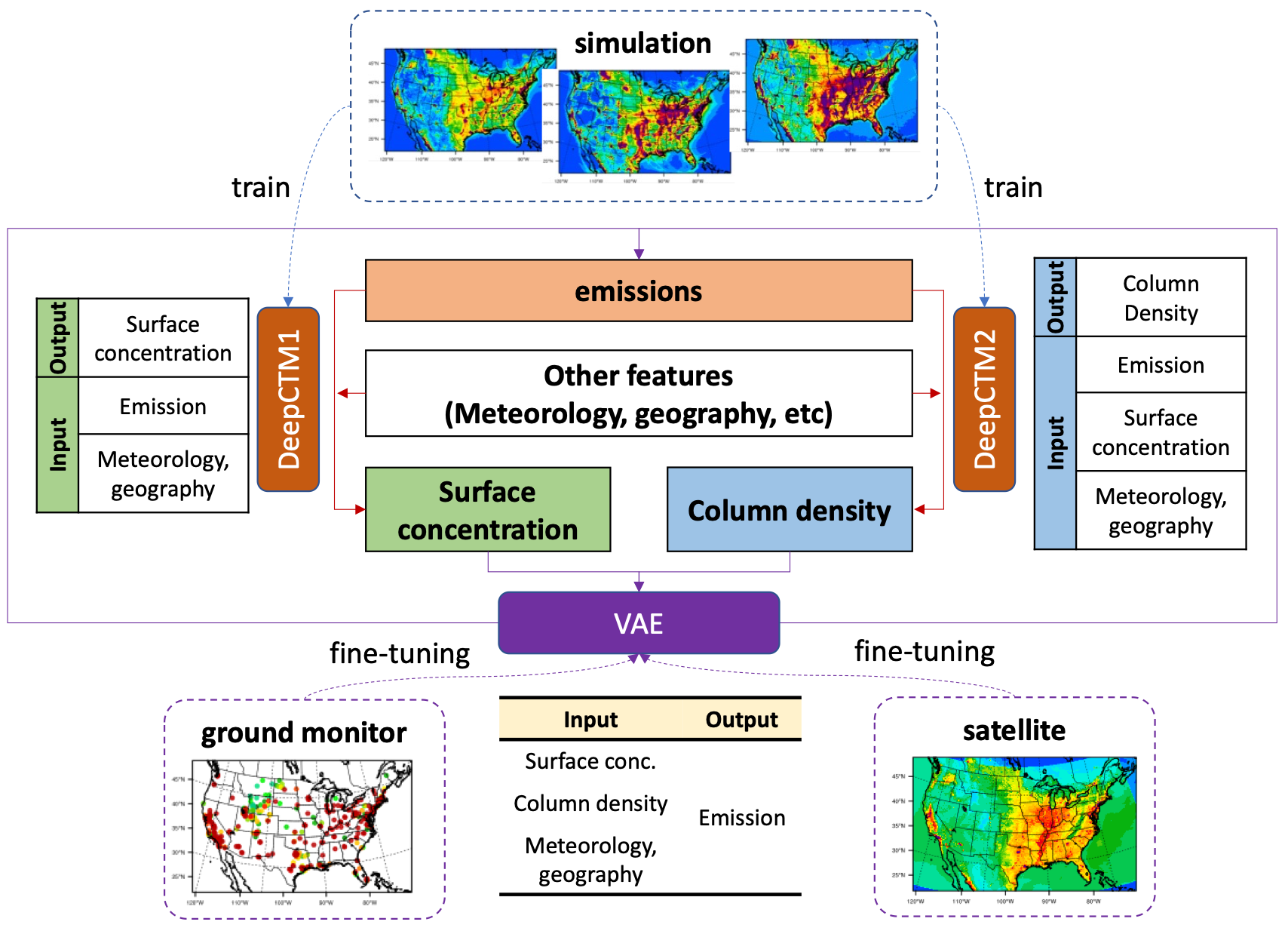
 - Indicates paper has been withdrawn from meeting
 - Indicates an Award Winner