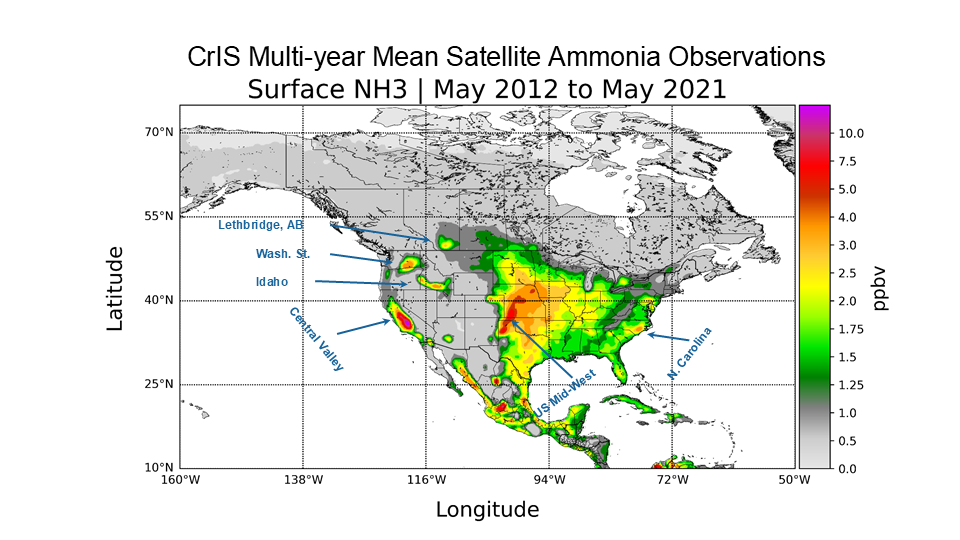
Poor ambient (outdoor) air quality is a major environmental risk factor for premature death globally, with a World Health Organization reporting 4.2 million premature deaths per year in 2019 (WMO, 2021). Air pollution also can have negative economic impacts with most cost damages due to human health impacts, plus other costs like reduced agriculture yields. For example, air pollution cost the US ~100 billion in annual damages in 2002 mainly from illness (Muller and Mendelsohn, 2007). Atmospheric ammonia is an important air pollutant as it is a main precursor to the secondary production of fine particulate matter (PM2.5), which is a key contributor to smog and associated with increased risk of cardiovascular and respiratory diseases (e.g. Reiss et al., 2007, Pope et al, 2009). Atmospheric ammonia is also an important source of reactive nitrogen deposition, which in excess leads to soil acidification, eutrophication (e.g. algal blooms), and biodiversity loss to the ecosystem. The spectral signature of atmospheric ammonia occurs in the infrared portion of the spectrum, and thus, can be observed by operational meteorological satellite sensors commonly used for profiling atmospheric temperature and water vapour, such as the NASA Cross-Track Infrared Sounder (CrIS). These satellite observations provide complementary information to the more traditional surface-based in-situ observations as they can help capture the high spatiotemporal variability of ammonia in the atmosphere, which can be challenging using only surface-based observations. The publicly available CrIS Fast Physical Retrieval (CFPR) (e.g. Shephard and Cady-Pereira, 2015, Shephard et al, 2020) ammonia retrievals starting from May 2012 are being used in many air quality applications to improve our knowledge of ammonia. Presented here are results of using the CFPR satellite ammonia retrievals to provide insights on the spatiotemporal variability and monitoring of ammonia, its emissions from forest fires and large agricultural sources, air quality chemical transport model evaluations and data assimilation of ammonia, and dry deposition reactive nitrogen from ammonia across North America.
Pope, C. A., Ezzati, M., and Dockery, D. W.: Fine-particulate air pollution and life expectancy in the United States, N. Engl. J. Med., 360(4), 376-386, 2009.
Muller N.Z., and R. Mendelsohn, Measuring the damages of air pollution in the United States, J. Environ. Econ. Manage., 54 (1), pp. 1-14, 2007.
Reiss, R., Anderson, E. L., Cross, C. E., Hidy, G., Hoel, D., McClellan, R., and Moolgavkar, S.: Evidence of health impacts of sulfate- and nitrate-containing particles in ambient air, Inhal Toxicol, 19, 419–449, doi:10.1080/08958370601174941, 2007.
Shephard, M.W. and K.E. Cady-Pereira, Cross-track Infrared Sounder (CrIS) Satellite Observations of Tropospheric Ammonia, Atmos. Meas. Tech., 8, 1323–1336, doi:10.5194/amt-8-1323-2015, 2015.
Shephard M. W., E. Dammers, K. E. Cady-Pereira, S. K. Kharol, J. Thompson, Y. Gainariu-Matz, J. Zhang, C. A. McLinden, A. Kovachik, M. Moran, S. Bittman, C. Sioris, D. Griffin, M. J. Alvarado, C. Lonsdale, V. Savic-Jovcic, and Q. Zheng, Ammonia measurements from space with the Cross-track Infrared Sounder (CrIS): characteristics and applications, Atmos. Chem. Phys., 20, 2277–2302, https://doi.org/10.5194/acp-20-2277-2020, 2020.
WMO, 2021, https://www.who.int/multi-media/details/air-pollution-silent-killer

 - Indicates paper has been withdrawn from meeting
 - Indicates an Award Winner