
Here, we introduce a new cloud mask product (MVCM-sounder) for both MODIS and VIIRS by utilizing collocated sounder observations to improve MVCM performance to better match with MYD35. Taking Aqua-MODIS as an example, the infrared hyperspectral radiance from sounder (AIRS) are collocated with imager (MODIS) footprints and then convolved with MODIS spectral response function to match with MODIS spectral resolution. The convolved radiance value is then assigned to all collocated imager pixels within the sounder footprint to ensure spatial resolution consistency. When compared to collocated Cloud-Aerosol Lidar with Orthogonal Polarization (CALIOP) cloud mask, our results show that for polar night scenes, both the MVCM-sounder and the MYD35 has an agreement of ~77% with CALIOP, whereas the original MVCM agrees with CALIOP at 64%. Globally, the difference between MVCM-sounder, MYD35 and the original MVCM are within 1-2%. When the same approach is applied to CrIS and VIIRS, similar performance of the MVCM-sounder is observed. It is expected that the new MVCM-sounder would be valuable for research for long term climate studies. The collocated sounder-imager L1B radiance as a byproduct of the MVCM-sounder would also be useful for deriving cloud macrophysical properties such as cloud top height. The new MVCM-sounder product will be available to the public at LAADS by the end of 2024. Further product development/improvement will focus on investigating the use of full hyperspectral information from sounders, as well as the use of more advanced approaches (e.g., machine learning) to improve upon the current MVCM/MYD35 cloud mask.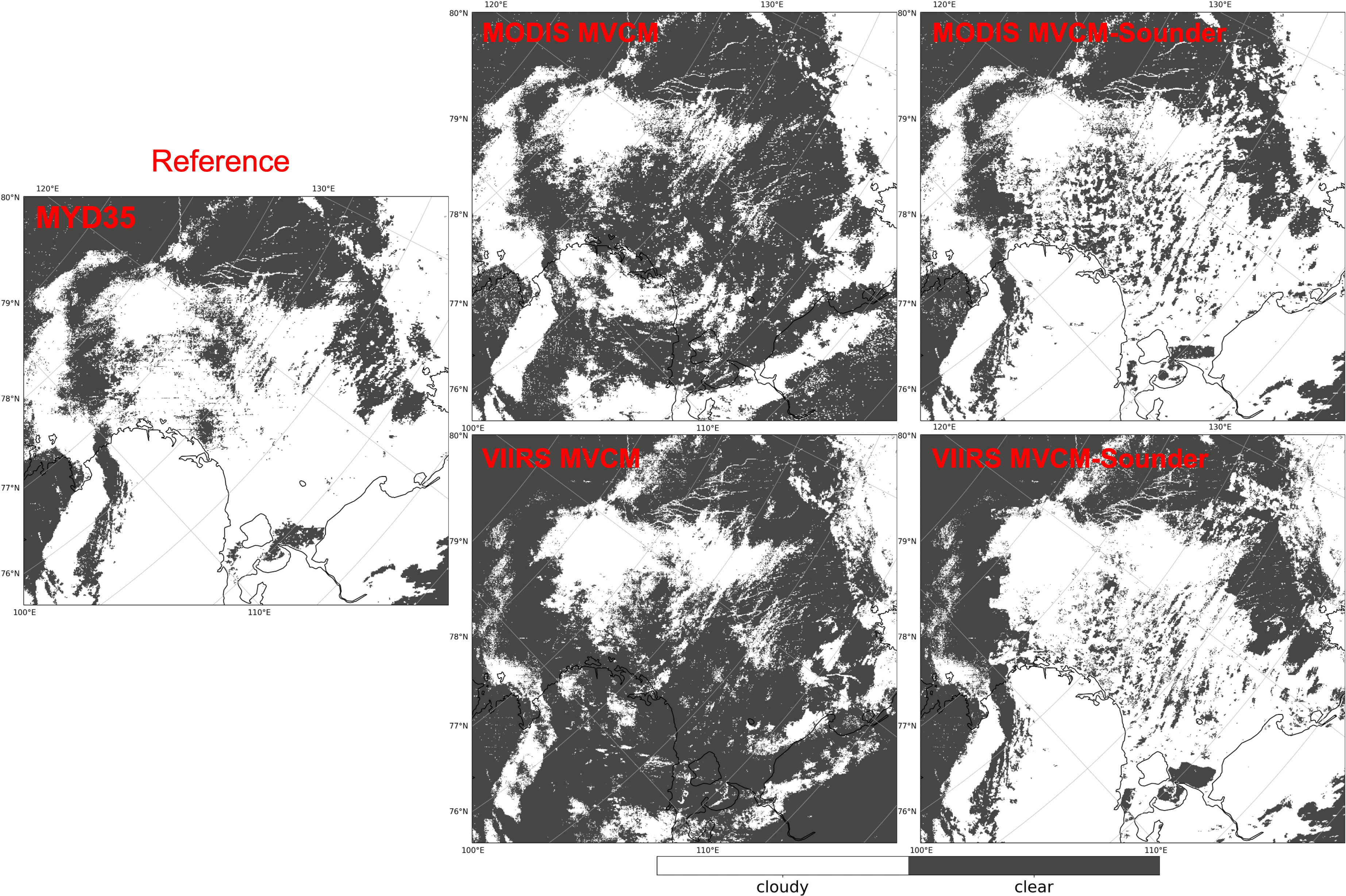
 - Indicates paper has been withdrawn from meeting
 - Indicates an Award Winner