
The tornado paths present a significant difference between the flat ground case and the cases that include a terrain, providing a clear evidence that a terrain significantly affects the tornado's path. It is noted that the complexity of the real terrain significantly increases the path deviation compared to the flat ground case.
This study further employs along-track analysis to measure maximum negative pressure on the terrain's surface, as well as maximum horizontal and vertical velocities at 10 meters above ground level (AGL). These metrics illustrate the terrain's impact on damage extent as categorized by the EF scale, indicating significant alterations in the spatial distribution of tornado intensity. The variation of the core radius, maximum horizontal velocity, and angular momentum along height among the cases with different terrain is also investigated. In conclusion, interaction between terrain and tornado at low boundary is complicated and alters the tornado behavior.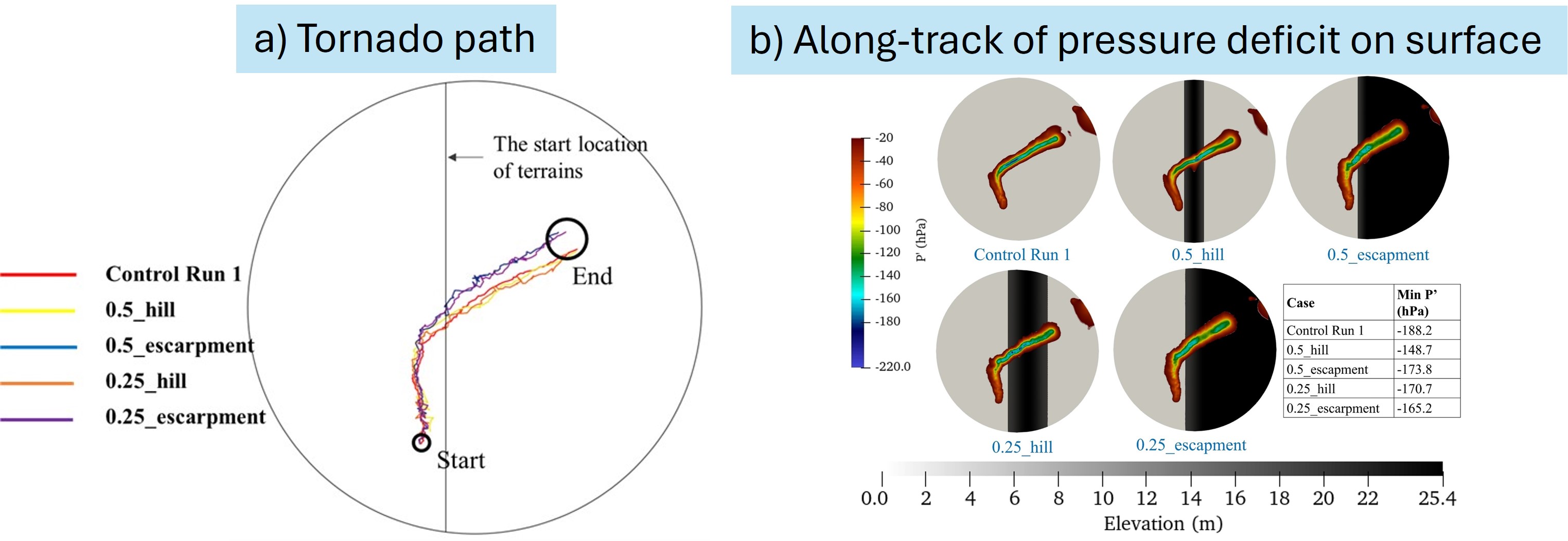
 - Indicates paper has been withdrawn from meeting
 - Indicates an Award Winner