
Self-organizing maps (SOM) are a type of neural network that performs unsupervised learning. Classify the dataset into a two-dimensional map. Many previous studies have classified the patterns of sea-level pressure by the SOM. We analyzed polar cold air mass (PCAM) classification based on the SOM. The SOM was trained using 6-hr standardized PCAM fields around the northern hemisphere. The training was performed using 85 CAO events input vectors and projected onto a 3 × 3 DP pattern (9 nodes) map.
The events were classified into Europe and East Asia pattern (#1, #2), East Asia and Aleutian pattern (#3, #6, #9), Europe and North America pattern (#4, #5, #8), and North America and Mediterranean pattern (#7) by SOM. In all cases, nodes with the same pattern are adjacent to each other.
Europe and North America CAO appears to be caused by planetary waves. The result indicates that polar cold air mass is generated in the polar regions about four days earlier, causing a CAO. East Asia and Aleutian CAO are suggested to be caused by baroclinic waves, as PCAM is generated in the high latitude regions about one to two days earlier. It is because of different time scales of planetary waves and baroclinic waves. Europe and East Asia pattern are possibly affected by planetary waves and baroclinic waves simultaneously. The present study shows that CAO which are non-linear phenomena, can be classified using SOM. Even though no information time scale is given, SOM classification even classifies differences in time scale.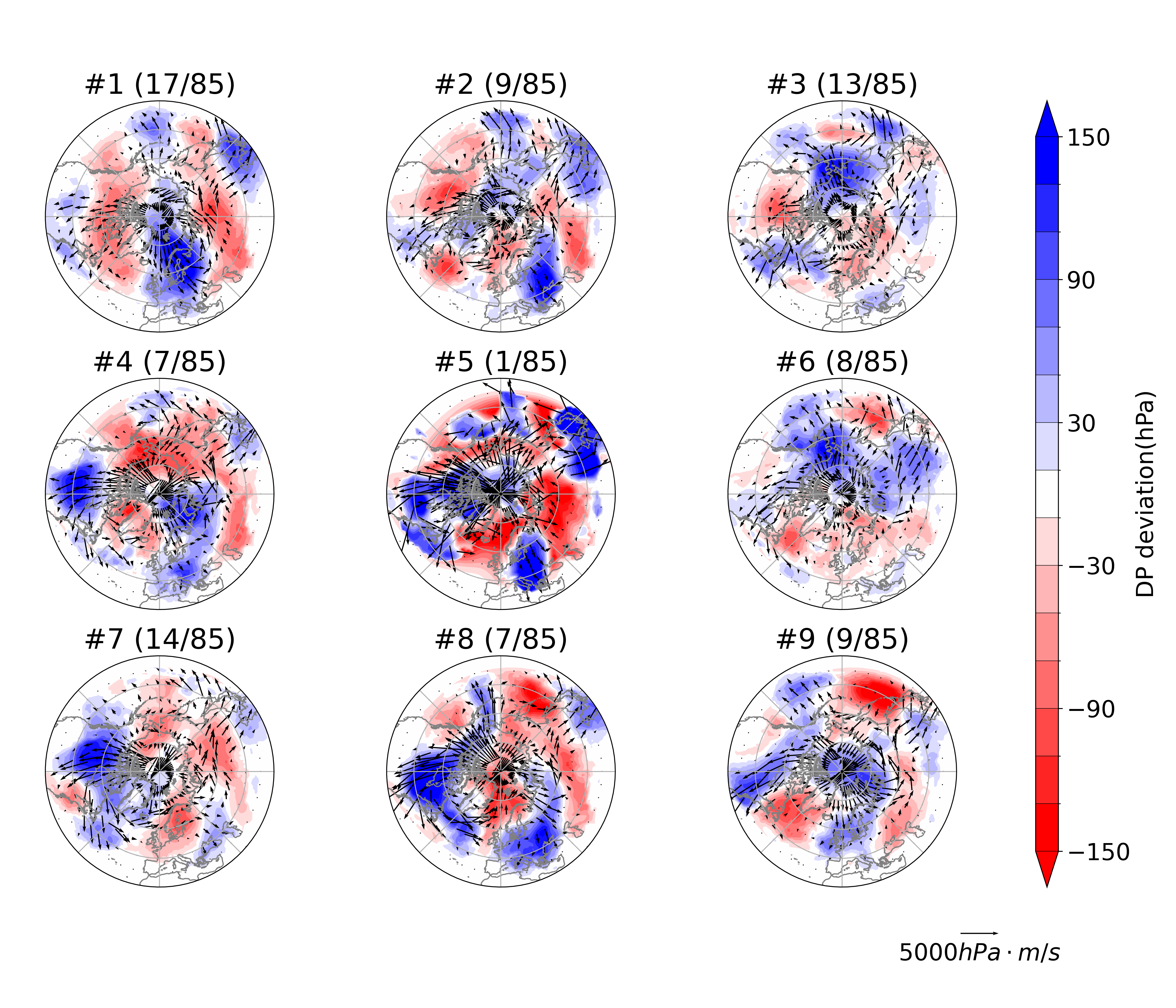
 - Indicates paper has been withdrawn from meeting
 - Indicates an Award Winner