
Handout (2.4 MB)
This work also examines the potential effects of existing wind farms located on the Tug Hill Plateau in New York on CG strike frequency, by analyzing NLDN data from before and after the deployment of the turbines in the mid 2000’s. The analysis uses NLDN data from 1990-2020, beginning when the network became fully operational. To mitigate potential misrepresentation of low-current intracloud flashes as CG strikes due to enhanced sensor sensitivity, the dataset excludes any positive CG strikes with a current amplitude of less than 15 kiloamperes (kA) and any negative CG strikes below -5 kA.
The analysis of CG flash density from 1990-2020 shows some interannual variability, likely influenced by the variability of storm activity and location between years. Coastal and offshore areas in the New York Bight exhibit slightly lower flash densities compared to Upstate NY, with more significant disparities in spring and summer when land temperatures exceed water temperatures. According to the National Weather Service, positive CG flashes constitute less than 5% of strikes globally, with the offshore region and Upstate NY regions seeing 5.53% and 4.64% respectively during the period studied. A notable shift in peak lightning times occurs across the New York Bight, moving from late afternoon to the overnight hours from west to east. An examination of CG strikes near wind turbines highlights a statistically significant increase in negative CG strikes over the Tug Hill Plateau since 2005, likely tied to lake-effect precipitation in winter.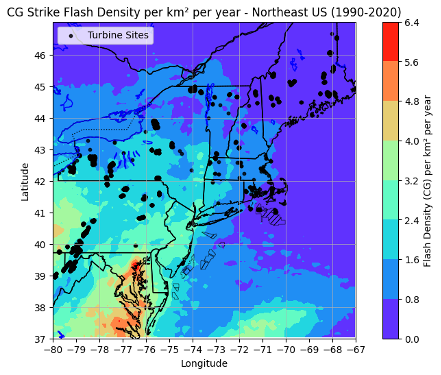
 - Indicates paper has been withdrawn from meeting
 - Indicates an Award Winner