
Several WoFS aviation use cases were documented and forecasters were surveyed, participated in focus groups, or volunteered their insights as part of a) Aviation Weather Testbed (AWT) experiments in 2022 and 2024, and b) a 4-week WoFS Aviation Experiment in 2024 that was led by the AWT and involved Center Weather Service Units. The WoFS Aviation Experiment enabled study of the logistics of WoFS grid placement and timing to support decision-making in aviation. For example, on 12 July 2024, a WoFS run was initiated at 0300 UTC, a first in the history of WoFS, and was followed by a new domain spun up in the same location at 1500 UTC; sequential runs in the same location was also a WoFS first. Much was also learned about forecaster preferences for WoFS products and potential new products. Aviation forecasters were most often concerned with permeability, and relied on ensemble representations of thunderstorm growth and timing, and mean and probability products for echo tops and lightning. Operations to research relationships forged during the experiment will help inform new WoFS development. A summary permeability product and better-calibrated echo top probabilities have already been suggested.
One area that will need much more study is best practices for applying WoFS to aviation decision making. The NWS aviation weather product suite is mostly schedule- rather than event-driven; WoFS is particularly skillful at short, event-driven lead times. Many aviation customers are accustomed to or prefer deterministic forecasts, which may not take advantage of WoFS’ probabilistic design. There were, however, several instances in the 2024 experiment of forecasters using WoFS to brief partners on-the-fly, or adding/eliminating thunderstorm areas depicted in graphical forecast products such as the Traffic Flow Management Convective Forecast. This presentation will illustrate the newly developing conversation on WoFS in the aviation forecast community.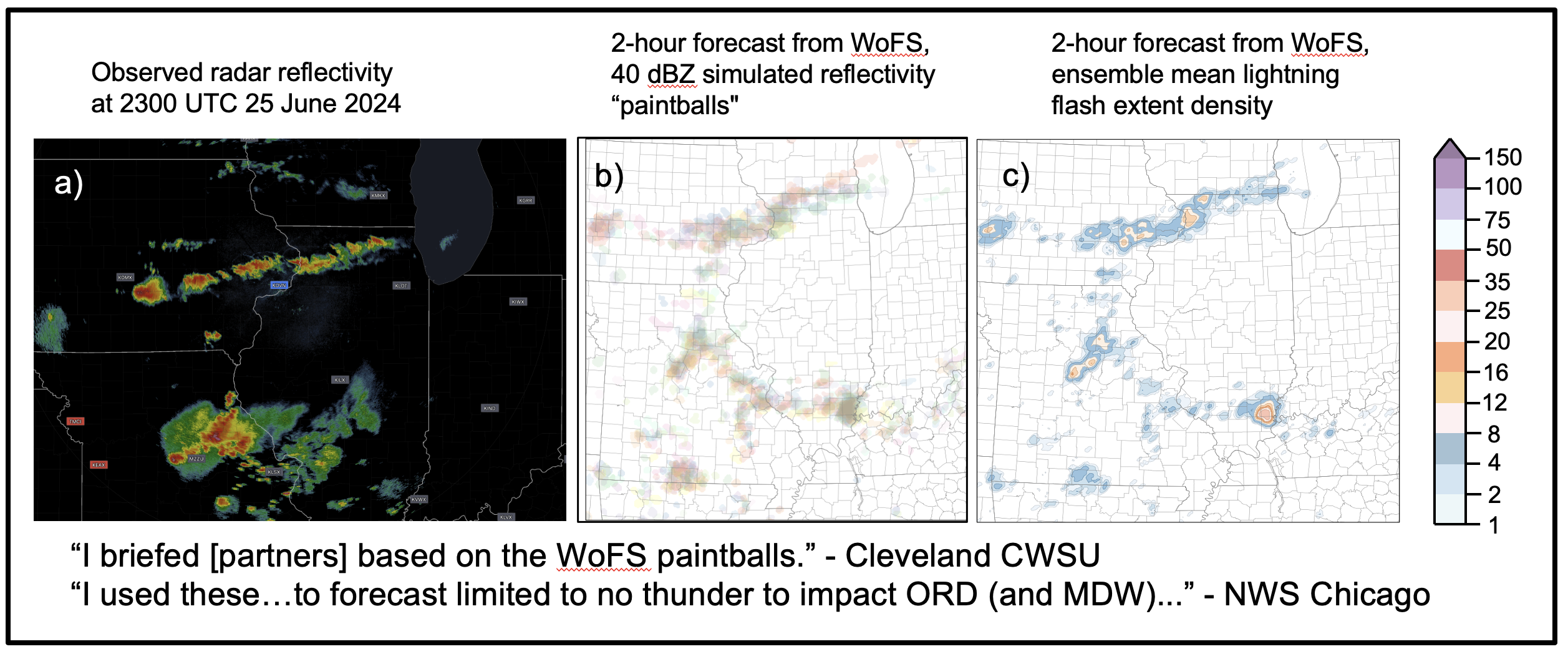
 - Indicates paper has been withdrawn from meeting
 - Indicates an Award Winner