
Thursday, 16 January 2025: 1:45 PM
244 (New Orleans Ernest N. Morial Convention Center)
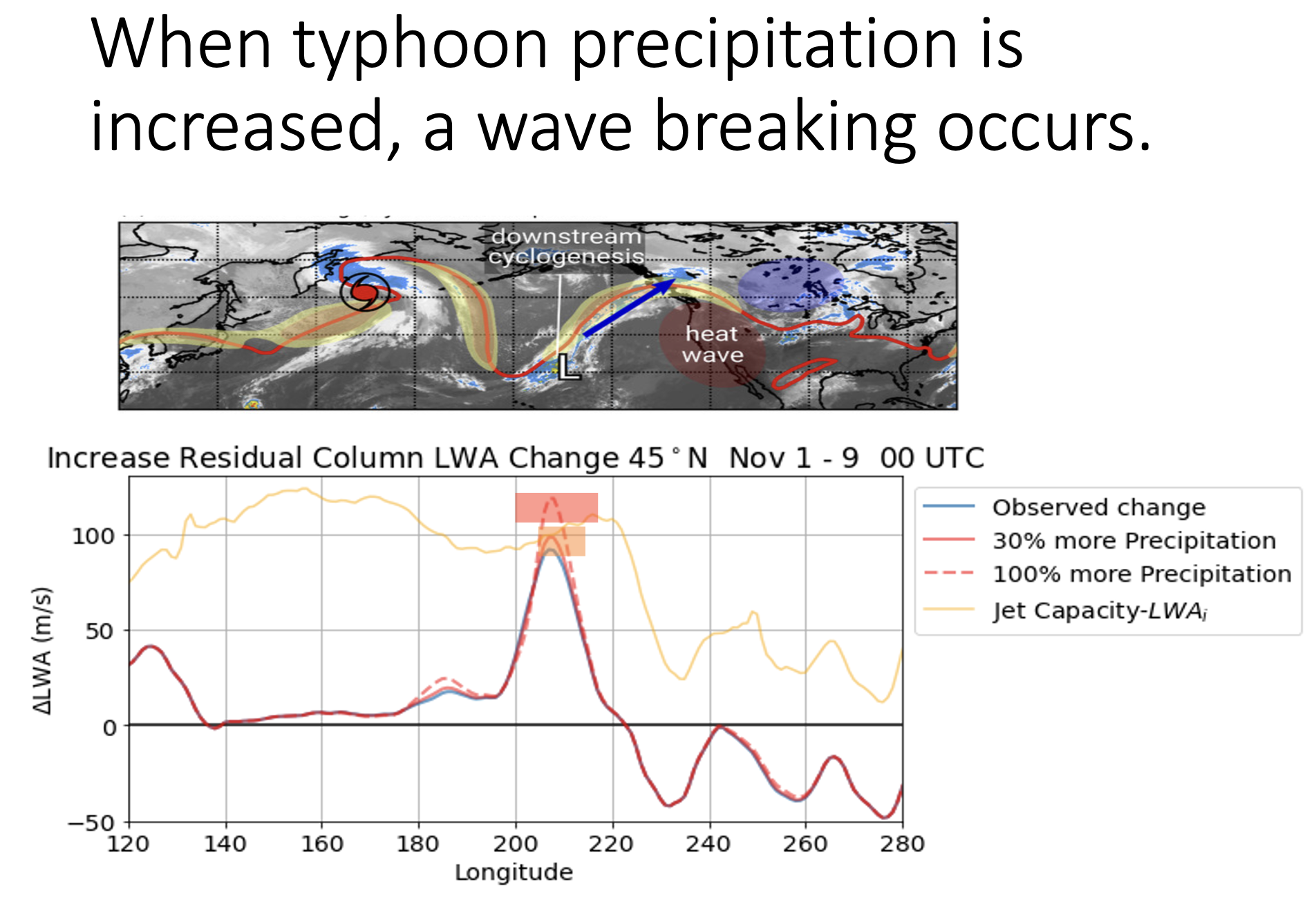
Tropical cyclones (TC) undergoing extratropical transition (ET) are known to amplify the jet stream, acting as a wave source for Rossby waves. An amplifying Rossby wave packet during ET can cause extreme weather thousands of miles downstream of the TC (Keller et al. 2019). The jet is mainly amplified by the circulation of the TC itself, latent heating released during the transition, and advection of upstream waviness. It is important to quantify the contributions from each term, because TCs undergoing ET are expected to become more frequent (Liu et al. 2017), carrying increased moisture and associated latent heat release (Jung and Lackmann 2021).Our modified Local Wave Activity (LWA) budget (Nakamura and Huang 2018) quantifies the waviness of the jet in a PV framework. All the relevant physical process are separate terms in the budget, making it easy to understand which term is driving the changes in jet waviness. Moreover, the LWA budget allows to calculate a jet carrying capacity of maximum waviness, meaning a maximum waviness before the jet breaks. Rossby wave breaking is relevant because the downstream impacts of ET terminate.We track all TCs undergoing ET from 2000 to present in ERA5 and apply the LWA budget. We analyze the contributions from latent heating and radiation using MERRA2 temperature tendencies. The LWA budget allows us to modify the existing terms and compute theoretical changes. For instance, when we increase latent heating, we find that the downstream waviness increases non-linearly. We create a climatology of ET events in each basin, analyzing how the separate terms contribute to downstream amplification, and how each basin differs in jet capacity. We also perform the LWA analysis in MPAS simulations of present and future climates to better quantify the changes in the latent heating term.
 - Indicates paper has been withdrawn from meeting
 - Indicates an Award Winner