
The “peak bloom” date is defined as the day when 70 percent of the blossoms are in full bloom. Peak bloom date for the most common type of cherry tree around Washington’s Tidal Basin—the Yoshino variety—has been carefully recorded since 1921 by the National Park Service.
Many plants are sensitive to and respond to environmental cues such as when temperature reaches a certain threshold. The exact timing of peak bloom varies from year to year, and it is largely driven by local temperatures during the winter and early spring, and indeed can be well modelled by the length and depth of winter and rapidity of onset of spring [1].
2024’s peak bloom date of March 17 not only occurred before the start of the National Cherry Blossom Festival, but also tied 2000 for the second-earliest bloom, behind only March 15, 1990. One may immediately notice that those three years are the peaks of their respective solar activity cycles. Looking over the whole century of Washington DC data, we show that there is a statistically significant early peak bloom just before solar max, normalizing time to the phase of the solar cycle [2,3].
We subsequently show that the discrepancy between the model and observed peak bloom has no dependence on the phase of the solar cycle. Thus if solar activity has any effect on cherry blooms, it is likely through the indirect effects on temperature patterns [2] and not direct solar radiation effects.
We expect that unlike 2024, where the National Cherry Blossom Festival missed the early peak bloom dates entirely, 2025 may not have such a discrepancy.
[1] Chung et al., PLoS ONE 6(11): e27439. doi:10.1371/journal.pone.0027439 (2011)
[2] Leamon et al., Earth and Space Sci 8, e2020EA001223. doi: 10.1029/2020EA001223 (2021)
[3] Leamon et al., Frontiers Astron Space Sci 9: 8986670. doi:10.3389/fspas.2022.886670 (2022)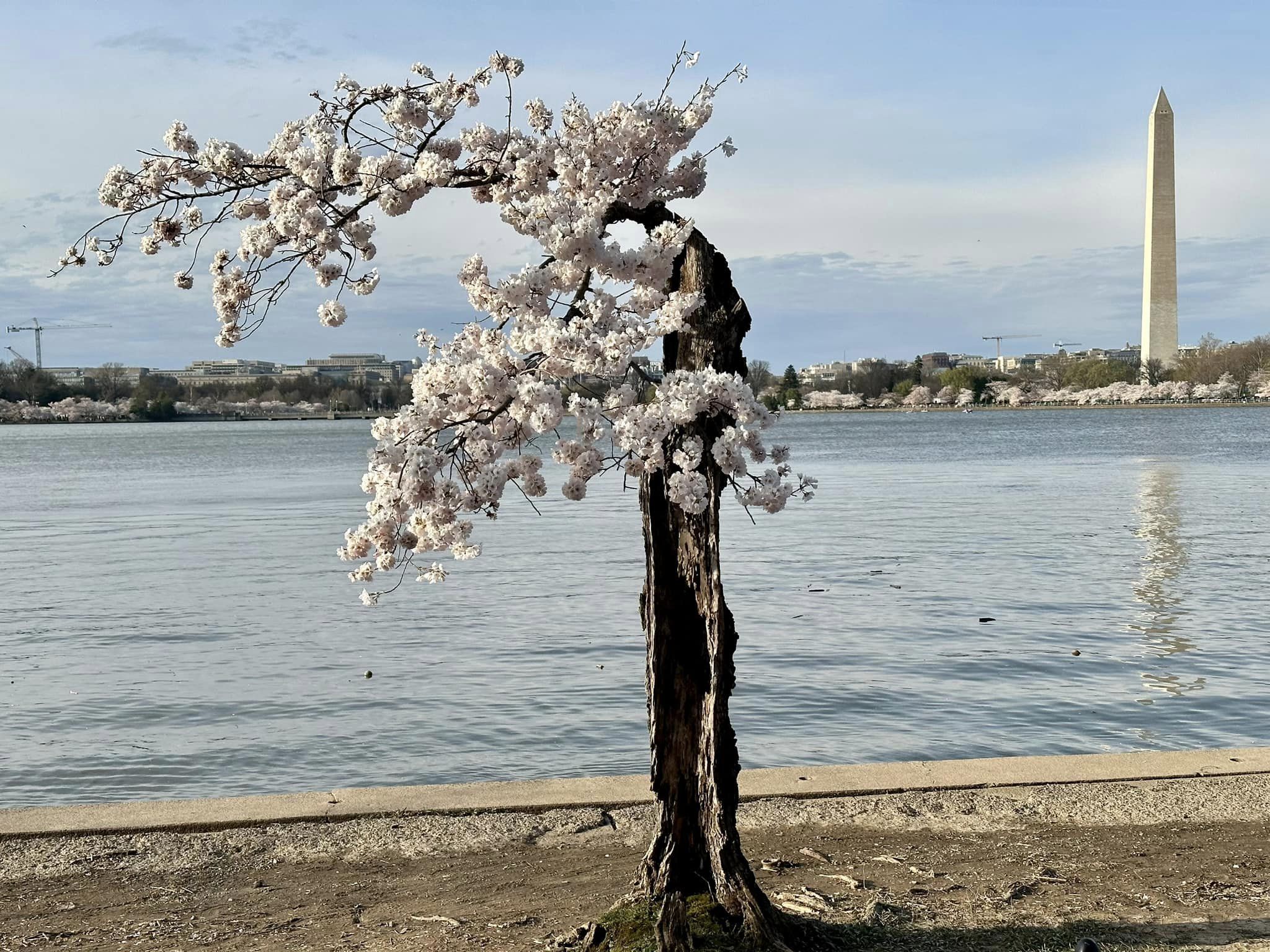
 - Indicates paper has been withdrawn from meeting
 - Indicates an Award Winner