
Wednesday, 15 January 2025: 11:00 AM
212 (New Orleans Ernest N. Morial Convention Center)
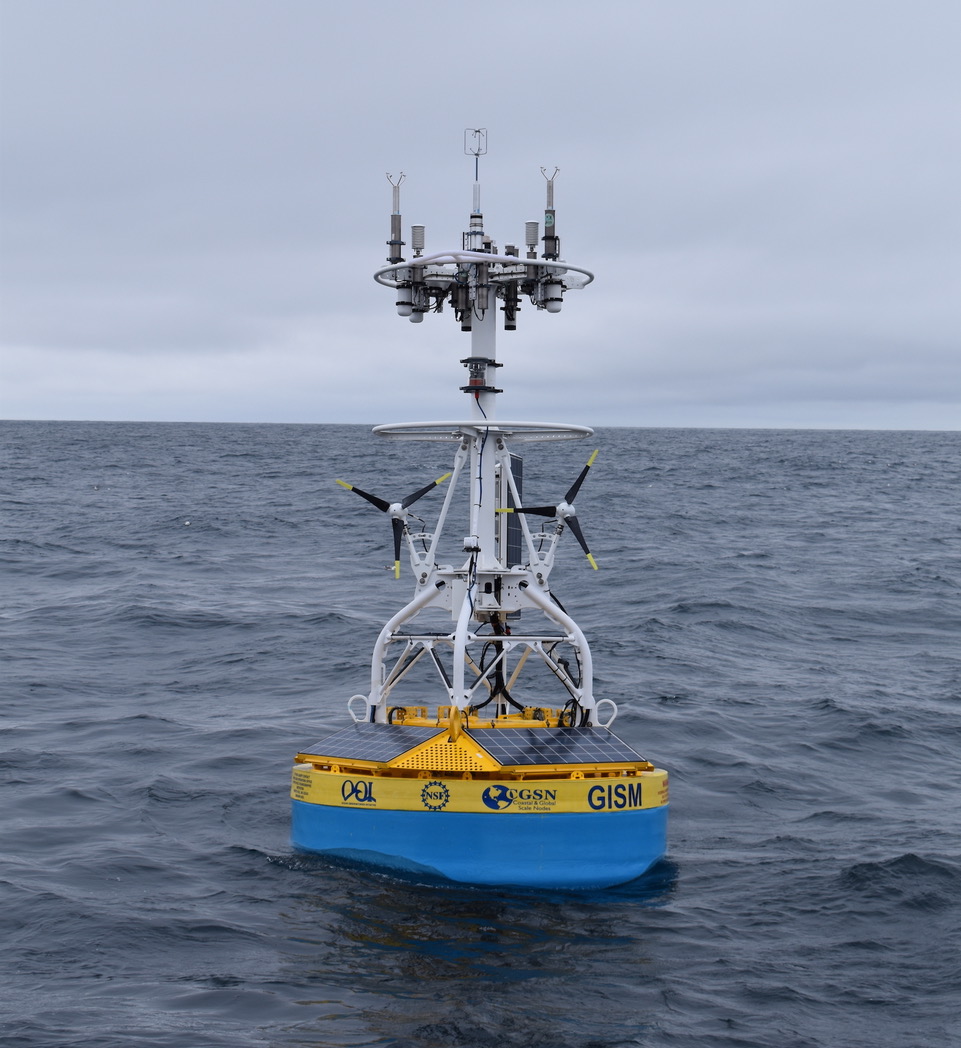
The National Science Foundation's (NSF) Ocean Observatories Initiative (OOI) has been collecting data from a wide variety of platforms in demanding locations since 2014. This includes surface moorings equipped with sonic anemometers and motion sensors to directly measure the momentum and heat fluxes along with wave statistics. These unique moored arrays have surface and subsurface components, along with mobile assets (e.g., gliders and AUVs), which have occupied high latitude sites in the Southern Ocean and Irminger Sea, and mid-latitude sites off the east and west coasts of the US. These regions commonly encounter high wind and wave conditions, which present challenges to ocean engineers. However, with 10-years of experience operating the global and coastal arrays, the NSF OOI engineers, technicians and scientists with input from external PIs have overcome most of these challenges. This has enabled the OOI to provide the user community with years of surface flux data and their associated means for air-sea interaction research. This data is freely available to the scientific community at oceanobservatories.org. This includes processed fluxes using motion corrected code that is fully available to the user. It also includes access to the raw data that can be exploited for any purpose by the user including improvements to the motion correction code and bulk algorithms. In this presentation, the flux data is used to improve the momentum and heat flux parameterizations used in the COARE algorithm beyond 30 m/s. This parameterization removes a weakness of the COARE algorithm that causes too much drag at high winds. The solution relies on a least square fit to the high wind flux data collected by the OOI surface mooring under conditions that exceed 25 m/s. Direct measurements of the heat flues are used to investigate the roll of sea-spray on latent and sensible heat at high winds. The presentation will also provide an update on the wave-based parameterizations in COARE. The objective of ongoing investigations is to finalize COARE 4.0 and develop sea-spray parameterization that can be used in COARE and mesoscale models such as WRF.
 - Indicates paper has been withdrawn from meeting
 - Indicates an Award Winner