
Tuesday, 14 January 2025: 8:45 AM
229 (New Orleans Ernest N. Morial Convention Center)
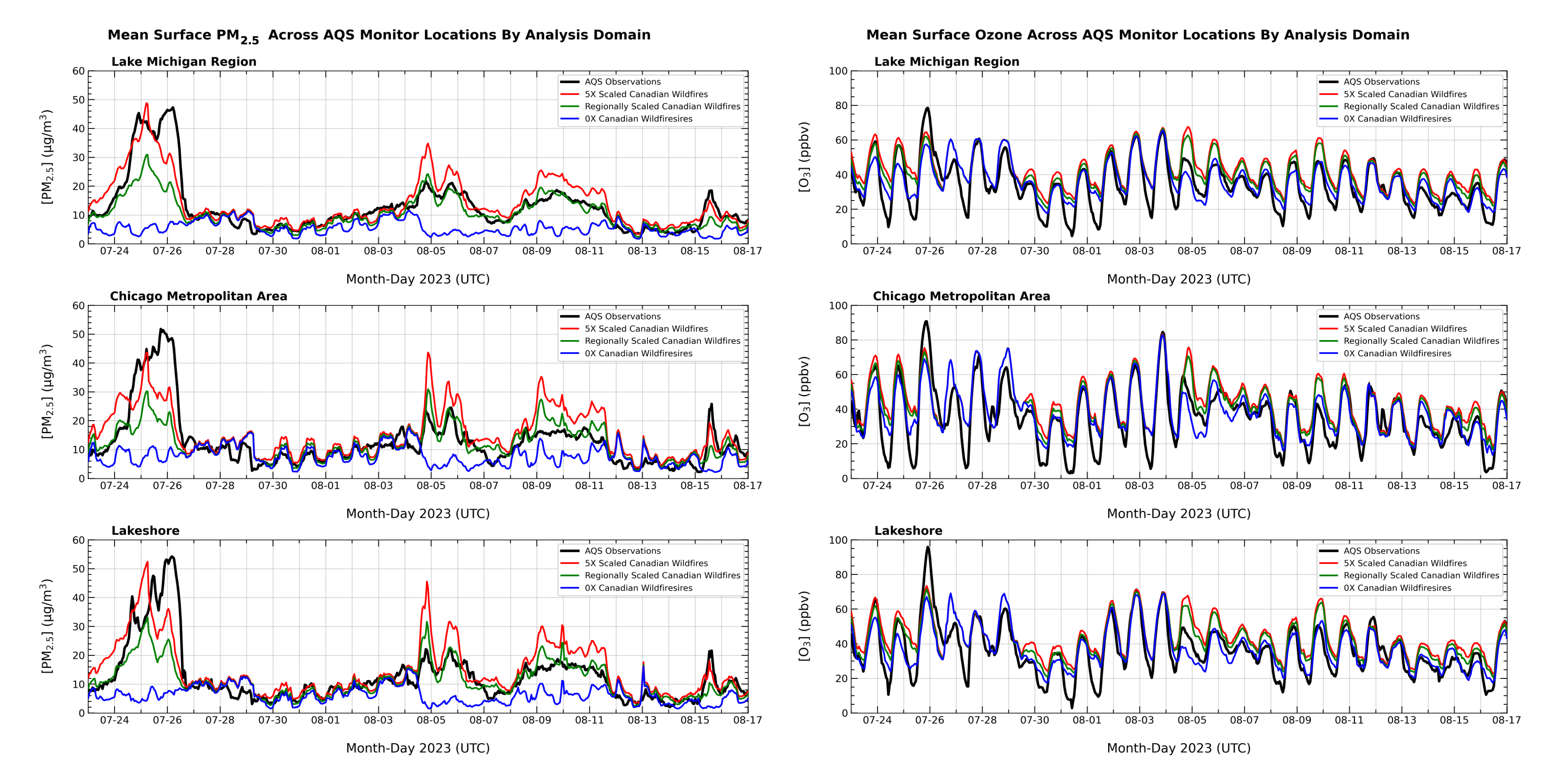
The record-breaking 2023 Canadian wildfire season led to the degradation of air quality in the United States due to smoke transport across international borders. To estimate the impact of these fires on air quality in the Lake Michigan region during the AGES+ field campaign period, we conducted three sets of model runs using WACCM6 as chemical boundary conditions for regional WRF-Chem simulations. These simulations include: (1) a control run with Canadian wildfire emissions set to 0, (2) a run with Canadian wildfire emissions regionally scaled by physiographic region, and (3) a run with Canadian wildfire emissions multiplied by a factor of 5. We evaluated the simulations using surface ozone (O3) and fine particulate matter (PM2.5) measurements from the U.S. EPA Air Quality System (AQS) database, GOES-16 aerosol optical depth data, and vertical profiles of O3 and aerosol extinction measured by a High Spectral Resolution Lidar-2 + Ozone Differential Absorption Lidar (HSRL-2 + O3 DIAL) instrument onboard the NASA G-V aircraft. Our results show that between July 23 and August 16, 2023, there were three separate periods of enhanced surface PM2.5 associated with Canadian wildfire smoke. Additionally, there were two distinct periods of surface O3 exceedances above the U.S. EPA’s National Ambient Air Quality Standards, one of which was impacted by Canadian wildfire smoke and the other was not.
 - Indicates paper has been withdrawn from meeting
 - Indicates an Award Winner