
Tuesday, 14 January 2025: 8:30 AM
229 (New Orleans Ernest N. Morial Convention Center)
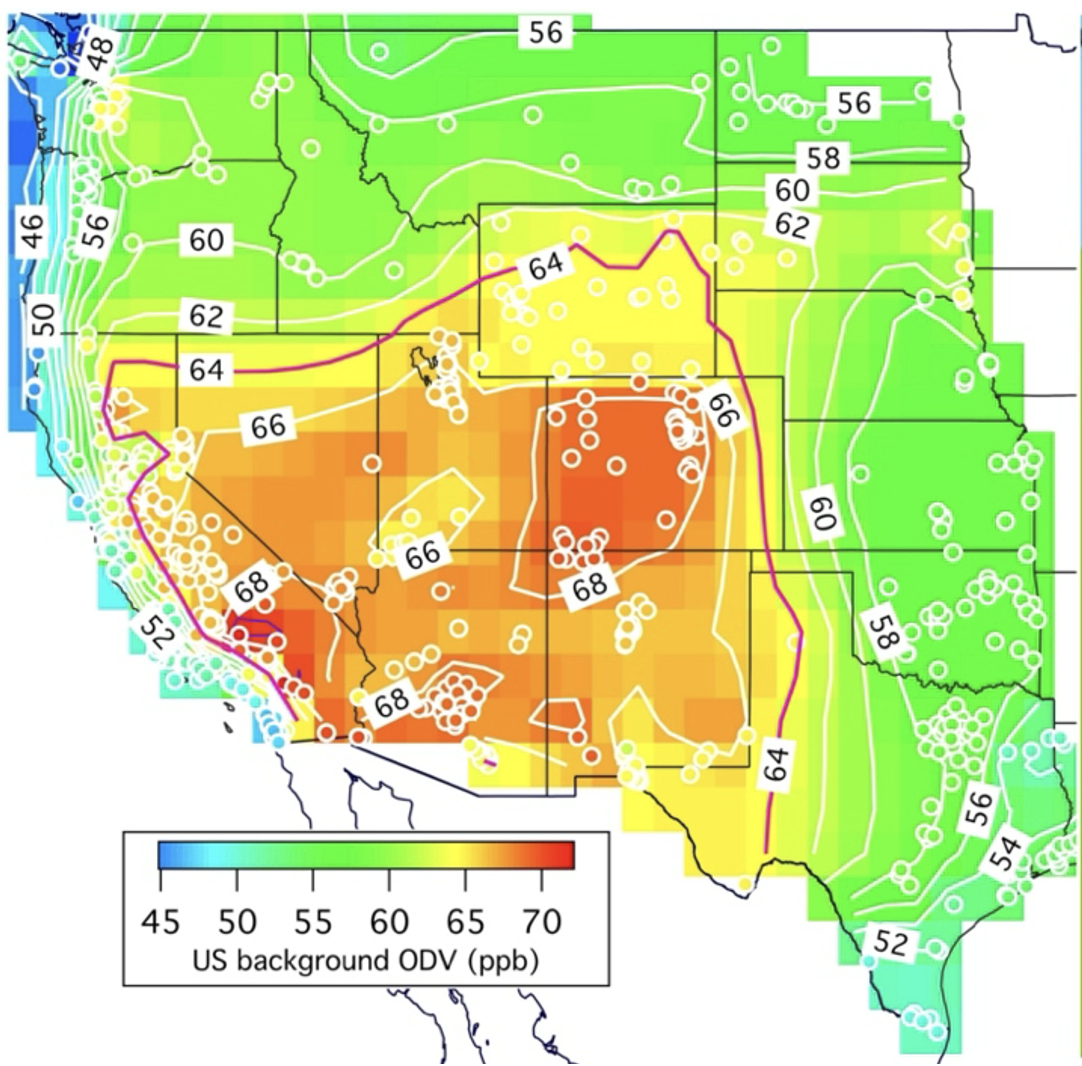
Tropospheric ozone (O3) is widely recognized as centrally important to the Earth System because it fundamentally controls the inhabited atmosphere’s oxidation potential and impacts the secondary production of particulate matter, which influences the climate. Near-surface ozone levels are known to be responsible for many adverse effects including an ever-expanding array of damages to human health such as cardiovascular, respiratory, and even cognitive diseases like dementia, and further to ecosystems by degrading crop yields and vegetation carbon sequestration. Moreover, tropospheric ozone acts as a powerful man-made greenhouse gas, third in order of importance behind CO2 and CH4. Despite significant progress over the past few decades, several areas of the US still exceed the current ozone National Ambient Air Quality Standard (NAAQS, a running 8-hour average of 70 ppb), including many parts of California, Texas, and the US Southwest. In fact, not only are O3 level improvements conspicuously absent over the last decade or so, in cities like Denver, Salt Lake City, and Phoenix, the trends appear to be increasing. We present here an argument using an observational-based analysis to quantitatively estimate the US anthropogenic, “background”, and wildfire contributions to the temporal and spatial distributions of maximum ozone concentrations throughout the southwestern US, including Texas & California. We find that the background ozone, which we further argue is becoming more and more impacted by soil and wildfire emissions of NOx (the most important ozone precursor), now dwarfs the traditional anthropogenic sources throughout the US Southwest, and precludes future attainment of the NAAQS. The upshot of this research is that the photochemical regime of our atmosphere is fundamentally shifting. Some of the consequences of such a shift include a call to reformulate our existing air pollution regulatory policies which might include an international effort to reduce background ozone concentrations, and/or the implementation of a standard based on the anthropogenic increment above the regionally varying US background. Finally, we point out that the predominant contribution of US background ozone across the southwestern US presents a profound challenge for current air quality modelling efforts because so many of the processes controlling it occur on small spatial scales, in statically stable environments, and evolve over hemisphere-wide distances. We therefore propose the development and use of a hierarchy of atmospheric chemistry models of varying complexity, including simplified conceptual models, to study these processes, similar to what is done in the field of geophysical fluid dynamics which includes ‘dynamical core’ and ‘aquaplanet’ models.
 - Indicates paper has been withdrawn from meeting
 - Indicates an Award Winner