
Wednesday, 15 January 2025
Hall C (New Orleans Ernest N. Morial Convention Center)
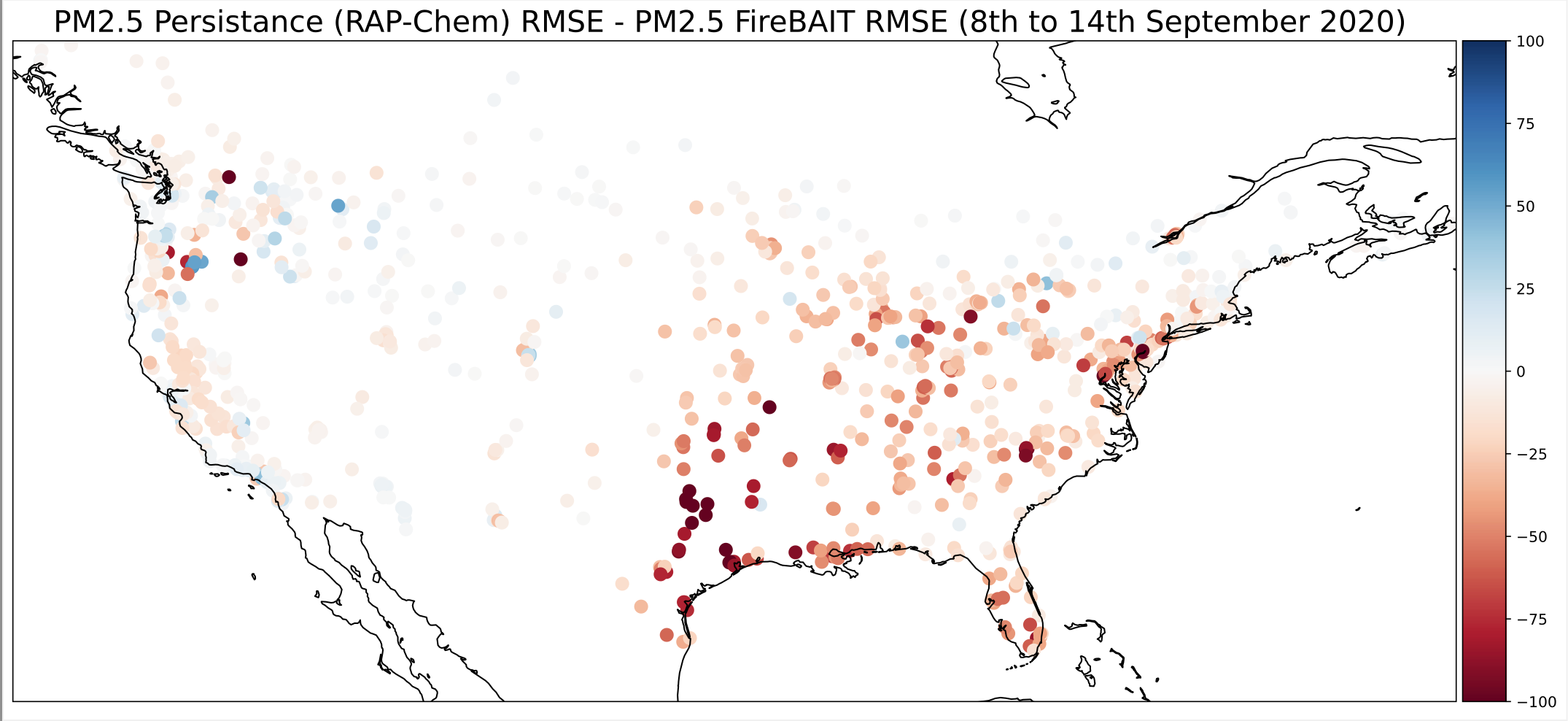
The severity and frequency of wildfires has increased as a direct result of human driven climate change, intensifying extreme weather conditions caused by forest fires. Essential to mitigating the effects of wildfires is to forecast fire energy emissions given the environmental conditions surrounding the fire. We combine high-resolution satellite active fire products from the Visible Infrared Imaging Radiometer Suite (VIIRS) and meteorological fields from the High Resolution Rapid Refresh (HRRR) model to train a Machine Learning (ML) based forecast of hourly wildfire intensity in the contiguous US (CONUS) domain. The improved fire radiative power (FRP) given by this model has proven beneficial in predicting emissions from biomass burning. Using FRP generated using the ML model air quality model numerical experiment gave improved estimates of PM2.5, particularly in the eastern US. During fire intensity peaks the ML model provided a more representative FRP diurnal cycle than the current persistence model used in air quality forecasts currently. As a specific case study the peak hour and fire duration were shown to better represent FRP for the Cameron Peak fire and consequently the PM2.5 resulting from the fire. These results show that machine learning is a promising tool for improving forecasts that rely on complicated microphysical processes.
 - Indicates paper has been withdrawn from meeting
 - Indicates an Award Winner