
In 2024 the NSRDB was updated using the latest version of the underlying PSM (PSM v4). This update includes improved surface albedo under snow conditions and an improved DNI model under cloudy conditions. The inclusion of these updates reduced the uncertainty in the data compared to previous versions of the NSRDB. Meteosat data was added to the NSRDB to make our coverage coverage global (GOES East and West, Meteosat, Meteosat IODC and Himawari). While standard data from the GOES continues to be served at an hourly 4km x 4km resolution, full resolution data has also been made available to the user. The user is provided significant flexibility for downloading data depending on the amount of data required. Data can be downloaded using either the web-interface, an Application Programming Interface or directly from the cloud using Amazon Web Services. Services such as spectral data use on-demand computation and delivery.
Evaluation of the NSRDB was conducted for 18 stations and the the Mean Bias Error (MBE), Mean Absolute Error (MAE) and Root Mean Square Error (RMSE) were computed for both GHI and DNI. The evaluation was conducted for the 1998-2021 period. Generally, the MBE lies within plus or minus ±5% for GHI and ±8% for DNI. Using PSM v4 has resulted in a 25% reduction in uncertainty in the DNI. The RMSE is less than 20% for GHI and 30% for DNI.
There are additional plans to include information about cloud fraction using 500 m data and include data from polar orbiting satellites to cover Alaska. This presentation will provide users with the latest information about the NSRDB as well as plans for future development and updates.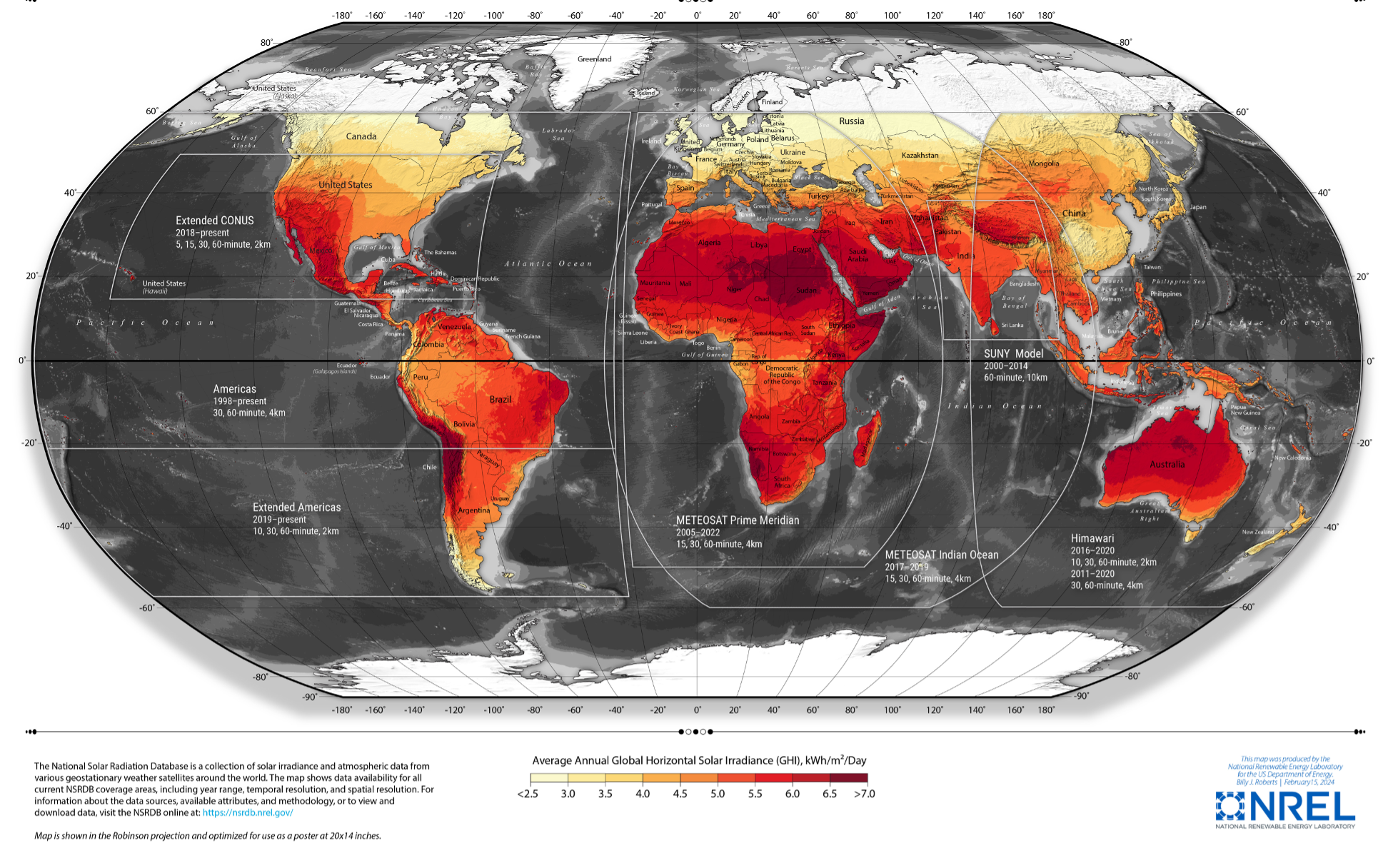
 - Indicates paper has been withdrawn from meeting
 - Indicates an Award Winner