
Machine Learning probabilistic forecasts were also generated using all members of the operational High Resolution Ensemble Forecasting (HREF) along with 4 members of the CAPS FV3-LAM ensemble that had been run in previous winters. Individual members and ensemble consensus products were evaluated for their ability to improve on winter weather forecasting, particularly snow accumulation. A sample ML forecast case from the 13th WWE is shown in the sample image. Neighborhood maximum ensemble probability is plotted for 1-inch and 2-inch thresholds for 24h snowfall ending at 00 UTC 24 Jan 2023 alongside the NOHRSC verification snowfall.
The CAPS CAM ensemble was designed with a control member and 10 additional members with physics variations and/or variations in initial conditions and boundary conditions. The physics variations consisted of different combinations of microphysics, Planetary Boundary Layer (PBL), surface layer physics, and Land Surface Model (LSM).
Graphics products relevant to the forecasting of winter weather were produced, including 2-m temperature, liquid-equivalent precipitation and snowfall accumulation at 6- and 24-h intervals, precipitation type paintball plots, and precipitation type plots for each ensemble member. These graphics products are publicly viewable at https://caps.ou.edu/forecast/realtime/ .
Subjective and objective evaluations of the CAPS individual ensemble members, ensemble consensus products and machine learning probabilistic and deterministic products from recent Winter Weather Experiments will be presented at the meeting.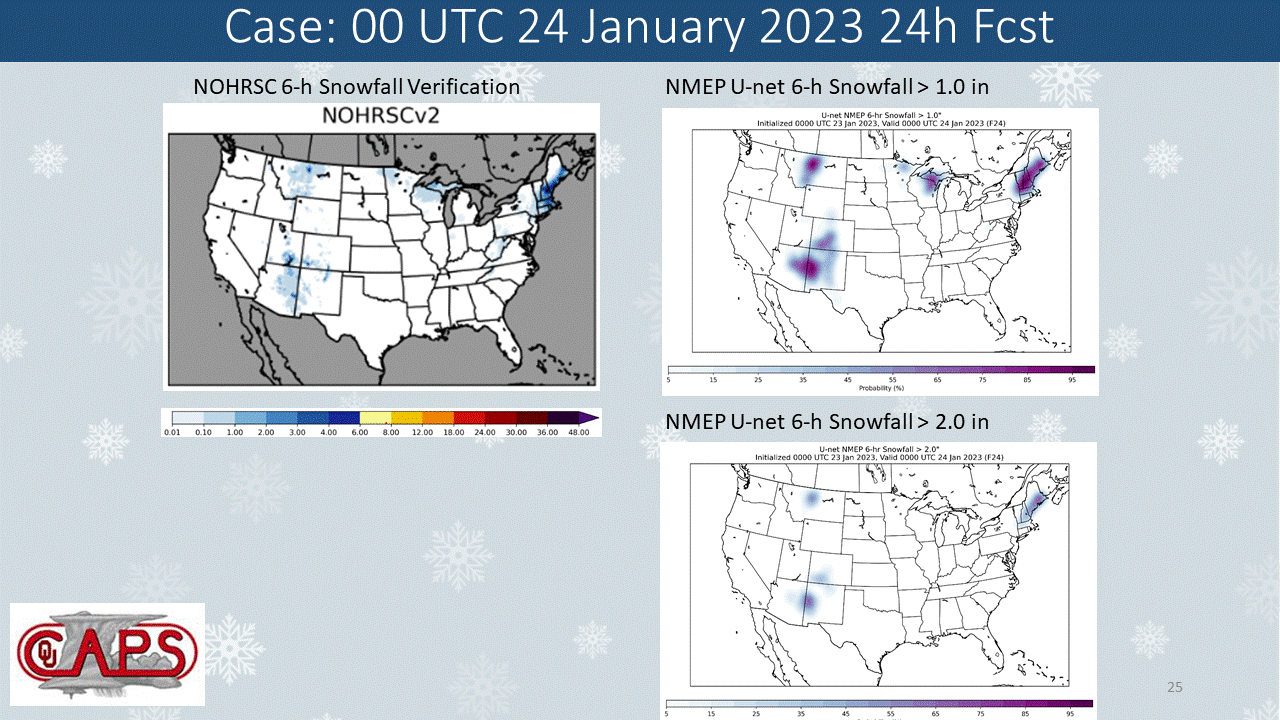
 - Indicates paper has been withdrawn from meeting
 - Indicates an Award Winner