Monday, 13 January 2025: 2:45 PM
341 (New Orleans Ernest N. Morial Convention Center)
Jason M. Cordeira, UCSD Scripps Institution of Oceanography, La Jolla, CA; and A. M. Wilson, C. Castellano, E. Knappe, R. Weihs, D. Axisa, and M. M. Ralph
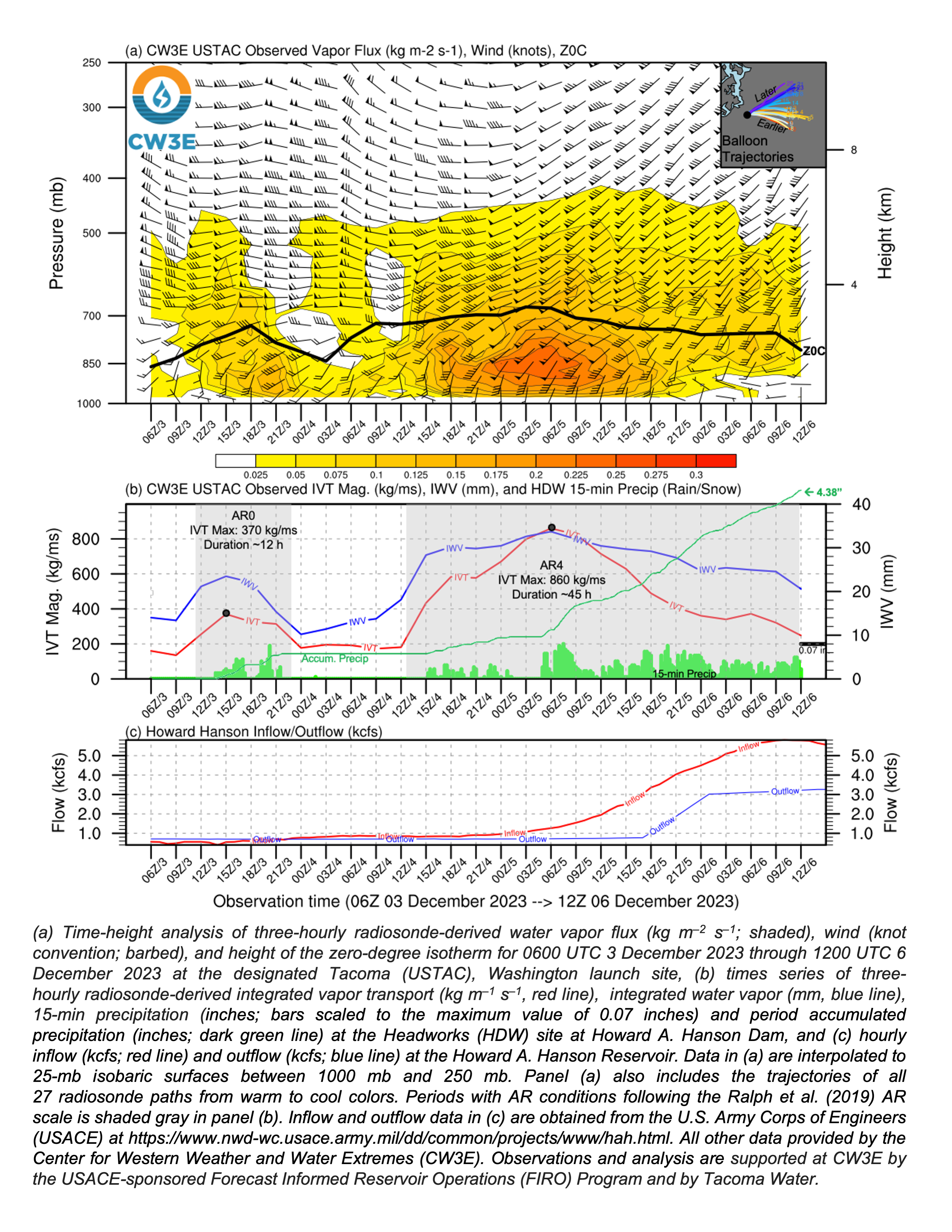
Forecast-Informed Reservoir Operations (FIRO) aims to improve and add flexibility to water resources management by leveraging forecasts of extreme precipitation events, particularly atmospheric rivers (ARs). In support of FIRO activities at the Howard A. Hanson Dam in western Washington, a network of in-situ data and radiosondes were deployed during a pair of landfalling ARs in early December 2023 to better observe moisture transport, wind profiles, and freezing levels. These in-situ observations complemented coincident upstream airborne reconnaissance during the AR Recon field campaign over the Northeast Pacific during IOPs 2–5 on 3–6 December 2023, respectively. These observations were critical in understanding the dynamics of the event, which produced over 10 inches of rain in the Cascades and more than 4 inches in the lowlands, leading to significant flooding.
Reanalysis and observational data captured the back-to-back ARs in association with a mesoscale frontal wave that produced prolonged heavy precipitation, including first snow and then rain-on-snow that exacerbated flooding. Radiosonde data from 27 consecutive three-hourly balloon launches during the event revealed key atmospheric structures, including the low-level jet and the evolution of water vapor flux, that were subsequently compared with model forecasts. Model verification demonstrated that the NCEP–GFS model struggled to accurately represent these features, including the IVT magnitude, tropospheric water vapor flux within and at the top of the boundary layer, and associated precipitation.
These findings underscore the importance of continued validation and verification efforts using in-situ observations to better understand processes and predictability of features driving water resource management decisions associated with landfalling ARs.

- Indicates paper has been withdrawn from meeting

- Indicates an Award Winner
