Wednesday, 15 January 2025
New Orleans Ernest N. Morial Convention Center
Kwo-Sen Kuo, GSFC, Greenbelt, MD; ESSIC - Earth System Science Interdisciplinary Center, Univ. of Maryland, College Park, College Park, MD; and B. Altner, D. H. Ton-That, R. Schrom, I. Fenni, I. Adams, G. J. Huffman, and S. A. Braun
OpenSSP, an extensive database of ice and snow particles and their single scattering properties, was created in 2014 to support GPM snowfall retrievals. With its web interface, which was developed later to allow public access to and dissemination of its data, OpenSSP is an essential resource for the physical quantitative precipitation retrieval community, especially for ensuring the consistency of retrievals involving multiple radars and/or radiometers. The OpenSSP database contains ~10,000 realistic solid hydrometeors, with ~3,000 numerically grown pristine ice crystals and ~7,000 heuristically generated snow aggregates. It also warehouses the particles’ (scalar) single-scattering properties at ten frequencies between 3 and 190 GHz, calculated using a discrete dipole approximation code, DDSCAT (version 7.1). The OpenSSP web interface was implemented in JavaScript (JS) with JS frameworks/tools. It evolved quickly after its inception in 2016 and attained its current profile in 2018. However, it had since fallen out of maintenance after the original developer left in the same year.
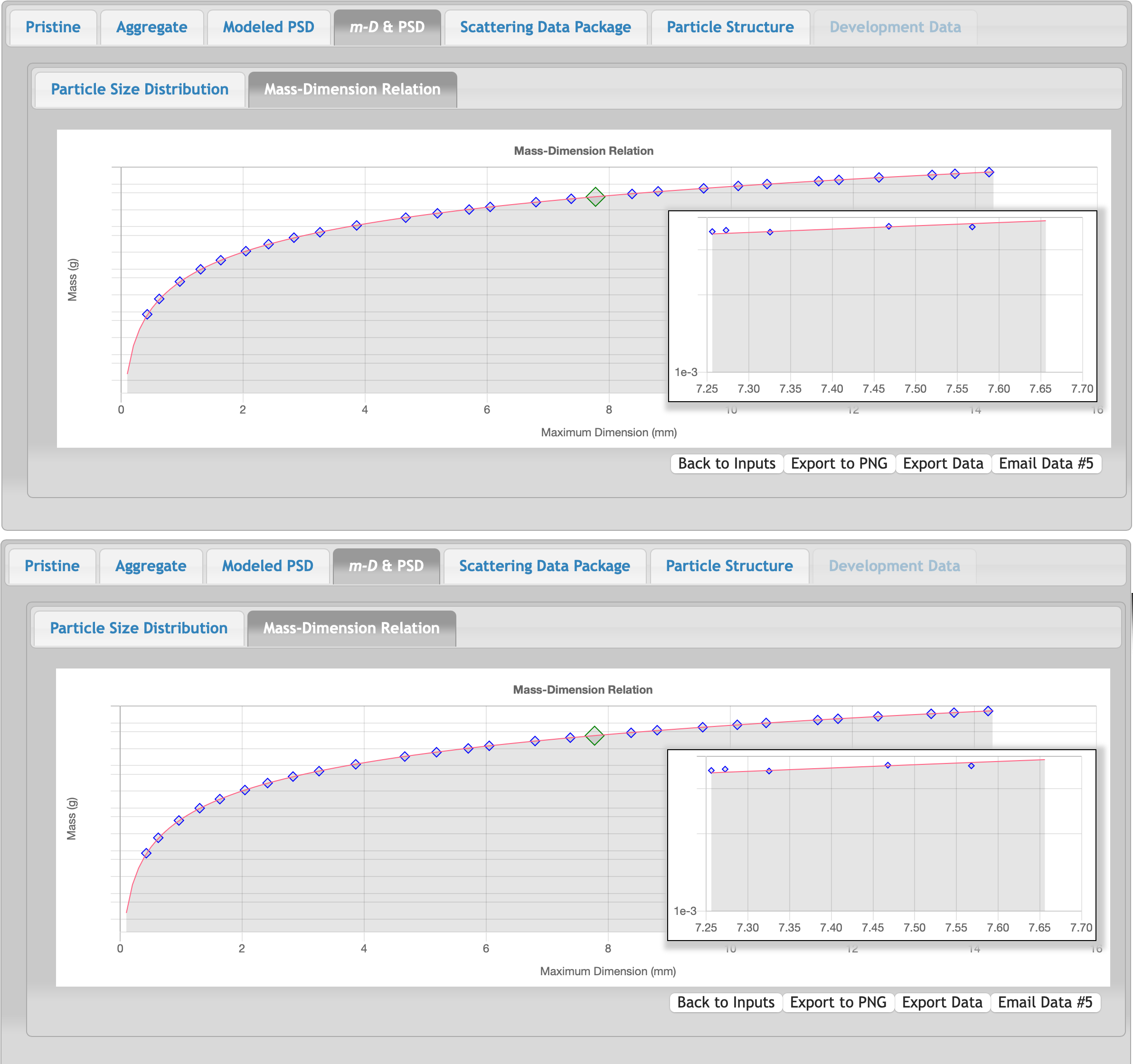
The OpenSSP web interface has undergone a transformation, with its functionality fully restored and enhanced. The underlying data are now managed by a robust database management system, a substantial improvement over the previous reliance on file access. This upgrade supports better flexibility and performance. The most useful query of the interface is perhaps the one that allows a mass-dimensional constraint on a (normalized) particle size distribution (PSD), either exponential or gamma distribution, also specified by the user. Following the selection of desired frequencies, the scattering data satisfying the query conditions and integrated over the size distribution are assembled and emailed to the user. However, this can only be done for one mass-dimensional relation and one particle size distribution at a time. It becomes very tedious if one wishes to get enough data to build a scattering lookup table.
Thus, on top of the restoration and enhancement, we have implemented a bulk query mechanism for specifying multiple frequencies, multiple mass-dimensional relations, plus multiple PSDs and obtaining all the PSD-integrated scattering data in one setting. This capability will allow easier custom construction of lookup tables for use by radiative transfer models and, subsequently, snowfall retrievals.

- Indicates paper has been withdrawn from meeting

- Indicates an Award Winner
