
Tuesday, 7 January 2025
The existing National Water Model (NWM) Forcings Engine processes meteorological input data files and supports uniform forcing data over the WRF-Hydro domain for all NWM operational configurations. With the recent development of Next Generation Water Resources Modeling Framework (NextGen), we can now introduce a variety of hydrology models using different discretizations running simultaneously and interacting with a common hydrofabric. To extend meteorological forcings into the NextGen framework, the NWM Forcings Engine was redeveloped into the NextGen Forcings Engine, a universal forcings data provider using the Basic Model Interface (BMI) standard. Here, we evaluate the representation of NextGen hydrofabric sub-basin forcings over a suite of NextGen Forcings Engine regridding techniques and demonstrate the benefits and deficiencies of these methods.
We perform a statistical analysis between surface observation networks and regridded Analysis of Record for calibration (AORC) datasets in order to compare and contrast the weighting schemes and their impact on skill of the original high-resolution retrospective dataset. Results presented here will focus on the influence of Earth System Modeling Framework (ESMF) and ExactExtract weighting schemes for rescaling retrospective data down to the NextGen hydrofabric sub-basins. Conclusions drawn from this analysis will help NextGen users to appropriate the proper NextGen Forcings Engine regridding tools for retrospective datasets used for calibration efforts.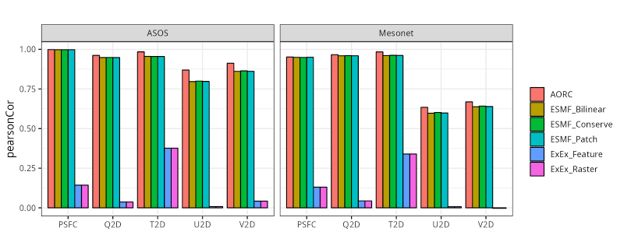
 - Indicates paper has been withdrawn from meeting
 - Indicates an Award Winner