
Wednesday, 15 January 2025: 1:45 PM
202 (New Orleans Ernest N. Morial Convention Center)
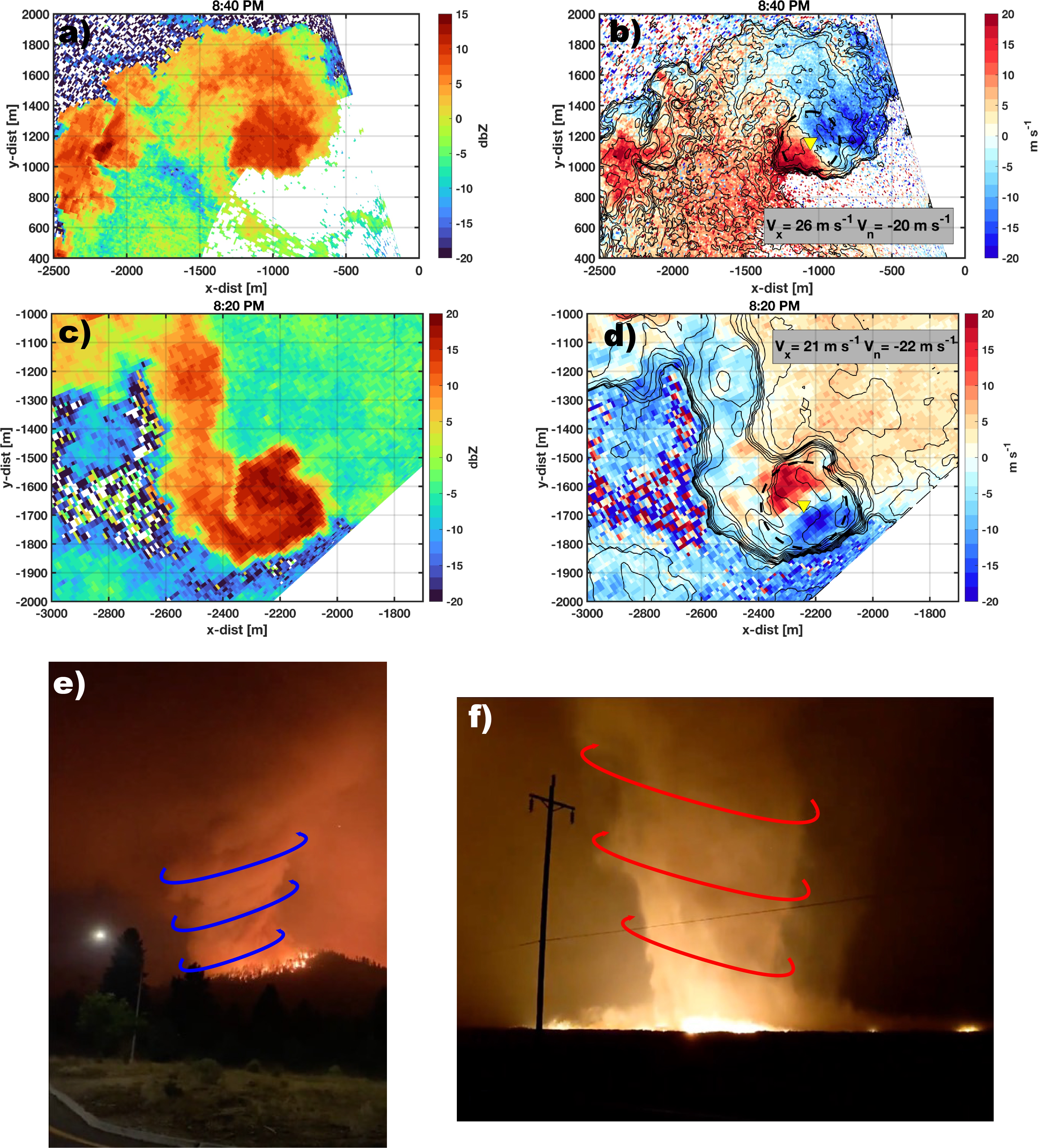
Fire-atmosphere coupling during extreme wildfires remains a poorly understood and under observed phenomenon. This coupling occurs when fire-generated winds (i.e. inflows and updrafts) influence the fire behavior and form a positive feedback loop with the fire intensity and spread. In this talk we use fixed site (e.g., NEXRAD) and deployable Doppler radars to observe and understand the development of these fire-generated winds, including the onset of tornadic vortices, along the fire front during large, high-intensity fires that produce deep (>10 km) convective plumes. First we use NEXRAD radar observations of three large fires (Loyalton Fire, Creek Fire, Bear Fire) to develop a conceptual model of the plume processes that lead to these fire-generated winds, which include flow splitting around the head fire, flow reversal and inflow in the wake of the head fire, and the development of counter-rotating vortex pairs (CVPs) linked to the fire’s updrafts. Next, we confront this model with recent observations obtained with a high resolution (10 m, 10 sec) scanning Ka-band Doppler radar during California’s Dixie Fire, wherein we observe the fine-scale temporal and spatial evolution of a nearly-tornadic CVP and its impact on fire spread. These detailed field observations support our conceptual model, and further suggest that there are precursor signals in radar data associated with inflow and flow splitting that presage the development of tornadic vortices that can threaten fire-fighter and public safety and impede fire containment.
 - Indicates paper has been withdrawn from meeting
 - Indicates an Award Winner