
Wednesday, 15 January 2025: 2:00 PM
202 (New Orleans Ernest N. Morial Convention Center)
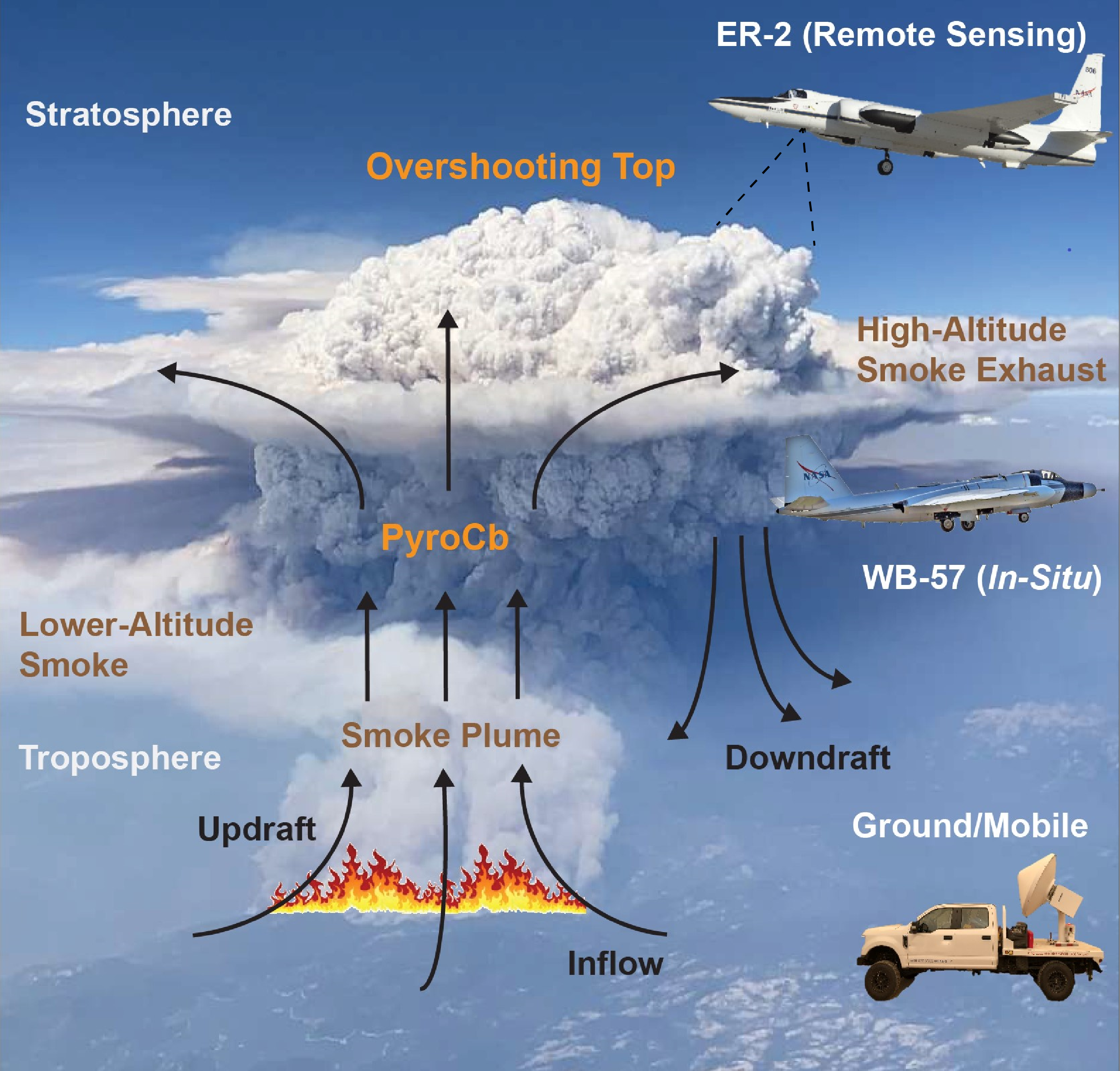
The INjected Smoke and PYRocumulonimbus Experiment (INSPYRE) will constrain the role of pyrocumulonimbus (pyroCb) in the warming climate system and characterize their physical links to extreme wildfire behavior. INSPYRE will test the hypothesis that: Increasing wildfire size and intensity in a warming climate will amplify pyroCb-driven smoke injection into the stratosphere resulting in measurable changes in Earth’s radiative balance. INSPYRE will address three science questions that establish links and feedbacks between the physical processes enabling pyroCb initiation, smoke injection into the upper troposphere and lower stratosphere (UTLS), and downstream consequences: (1) Which fires produce pyroCbs and why? (2) What mechanisms determine if a pyroCb will directly inject smoke into the stratosphere, and how much smoke is directly injected? (3) How do pyroCb-injected smoke plumes modify UTLS composition and radiation budget? INSPYRE requires sustained measurements and modeling of co-evolving fire and pyroCb processes including: fire energetics, plume development, pyroCb cloud properties, and smoke plume evolution. Measurements will span the spatial and temporal scales of pyroconvection, including non-pyroCb plumes, plumes capped by pyrocumulus, active pyroCbs, and downstream smoke plumes in the UTLS. The NASA ER-2 will be used in combination with the WB-57, along with ground-based measurements and support from modeling teams. INSPYRE has flexibility to use several deployment sites in western North America based on pyroCb climatology, which are expected to yield multiple pyroCb events and many large/intense fires per year during deployments planned for 2026 and 2027.
 - Indicates paper has been withdrawn from meeting
 - Indicates an Award Winner