
This work seeks to improve wildland firefighter situational awareness by improving gust front detection in complex terrain. To this end, we leverage the Neuro Fuzzy Gust Front Detection Algorithm (NFGDA), which was developed for the WSR-88D. NFGDA learns based on a hybrid algorithm that optimizes the parameters of fuzzy membership functions via neural networks. Its inputs include reflectivity, radial velocity, differential reflectivity, cross-correlation coefficient and differential phase. On the output side, NFGDA predicts a score, upon which a threshold is applied to determine if a given gate comprises a gust front.
NFGDA was fine-tuned on data collected from neighboring KABX (Albuquerque, NM) and KIWA (Phoenix, AZ) WSR-88Ds during the month of July 2021. The locations were selected because of their mountainous topography, while the time period coincides with the local Monsoon season in order to ensure the presence of gust fronts. Initial observations revealed declining NFGDA performance with declining gust front reflectivities. However, fine-tuning by relaxing the final classification threshold was found to increase sensitivity to these weak cases. Figure 1 below shows an example of our findings for the 23:49 UTC scan collected from KABX at the 0.5 degree elevation on 8 July 2021. Here, NFGDA detections are denoted in black while the gust front region, as determined by human ocular estimation, is circumscribed by yellow lines. It can be observed that no detections are made before finetuning in Figure 1a while a majority of the gust front is detected after finetuning in Figure 1b. These results demonstrate NFGDA’s potential for monitoring gust fronts in complicated terrains. Comparisons will also be conducted with the Machine Intelligent Gust Front Algorithm (MIGFA) to verify performance relative to the operational algorithm.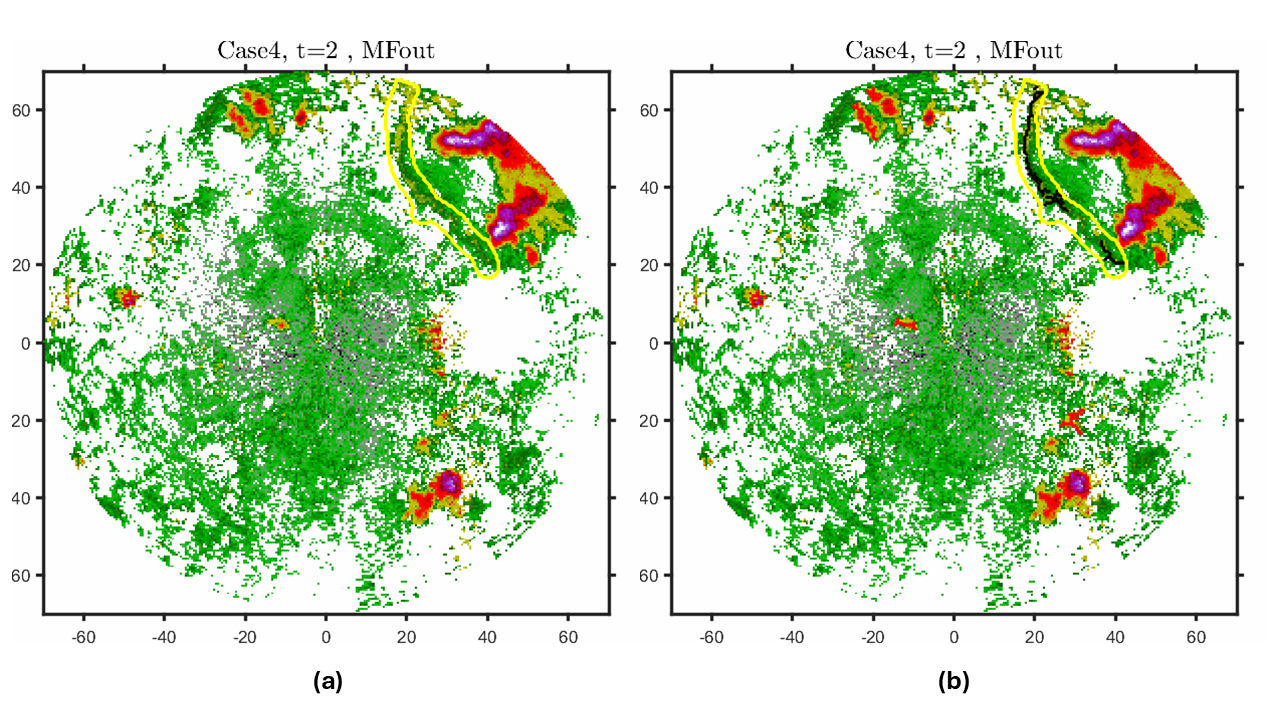
 - Indicates paper has been withdrawn from meeting
 - Indicates an Award Winner