
Wednesday, 15 January 2025: 11:30 AM
344 (New Orleans Ernest N. Morial Convention Center)
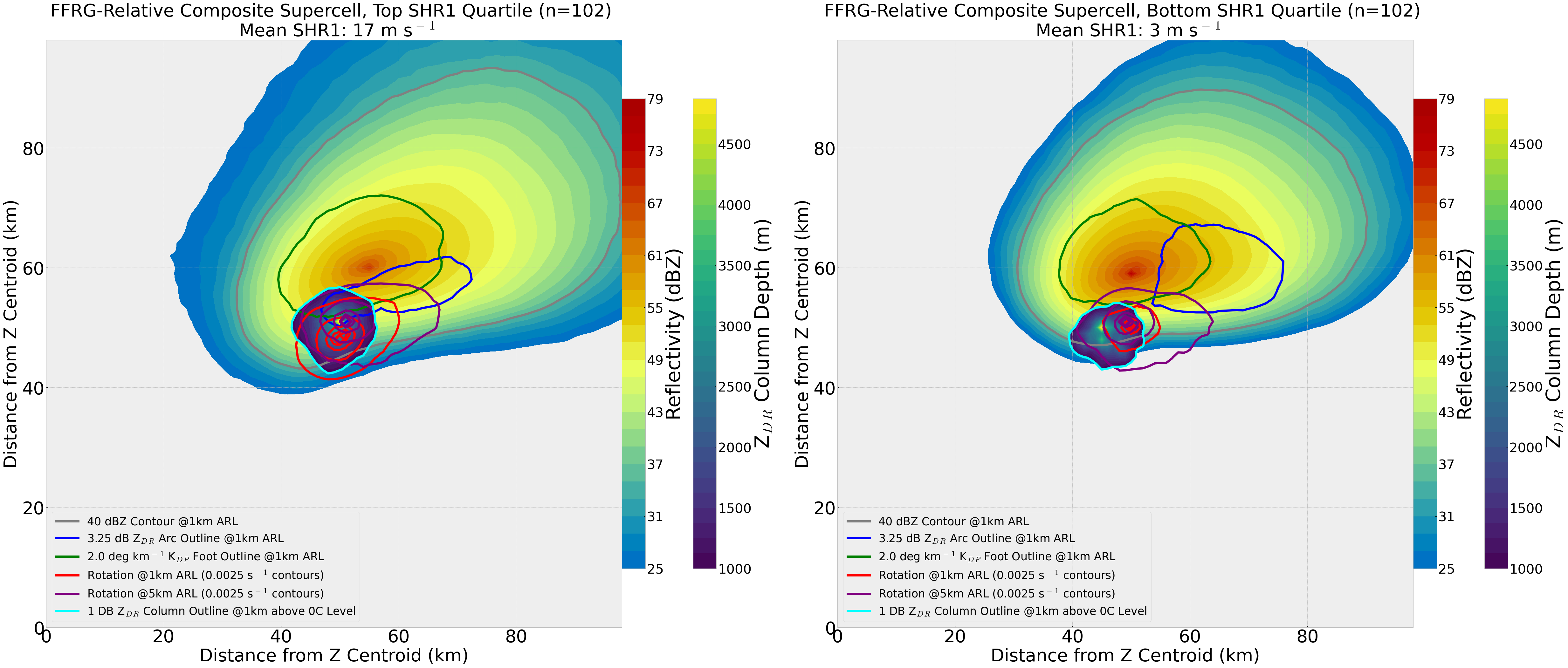
Numerous modeling studies have investigated how supercell organization changes as a function of various environmental metrics, including low-level and deep-layer shear magnitude and orientation, storm-relative wind strength, LCL height, and the amount of SRH present in a storm’s inflow. However, it is often unclear how closely some of the organizational changes observed in these studies match those in real-world supercells, or if the relationships posited in these works hold across larger portions of the supercell parameter space than can be explored in a given model experiment. This study uses a preliminary sample of 410 storm-centered radar composites of supercells and associated RAP proximity soundings to examine how the structure and dual-pol signatures of these storms change with various environmental parameters, and compares these changes to those seen in prior modeling work. To examine how radar signatures change with a given environmental metric (such as SRH or LCL height) the radar composites are first sorted by the value of that parameter from the associated proximity sounding. The storm-centered radar composites are then rotated so that the forward flank of each supercell is aligned E-W to ensure alignment of features between storms. Next, probability-matched mean (PMM) composites are created using a 50-storm window which rolls from the low-parameter end of the sorted dataset to the high-parameter end. The impact of different-sized windows on the results is also examined. This allows for the comparison of the PMM composite structure of storms on the low end of the parameter space with those from the high end of the parameter space for a given parameter (an example figure comparing composite supercells from low- and high-surface-1-km shear environments is included below). These composites will be used to evaluate the following hypotheses: that storms in higher-SRH and lower-LCL environments display better alignment of their low- and mid-level mesocyclones and that storms with stronger low-level storm-relative flow will display larger ZDR columns and stronger mesocyclones. In addition, changes in the spatial structure and alignment of other dual-pol signatures within the composites as a function of environmental metrics will be explored.
 - Indicates paper has been withdrawn from meeting
 - Indicates an Award Winner