
Thursday, 16 January 2025: 11:15 AM
224 (New Orleans Ernest N. Morial Convention Center)
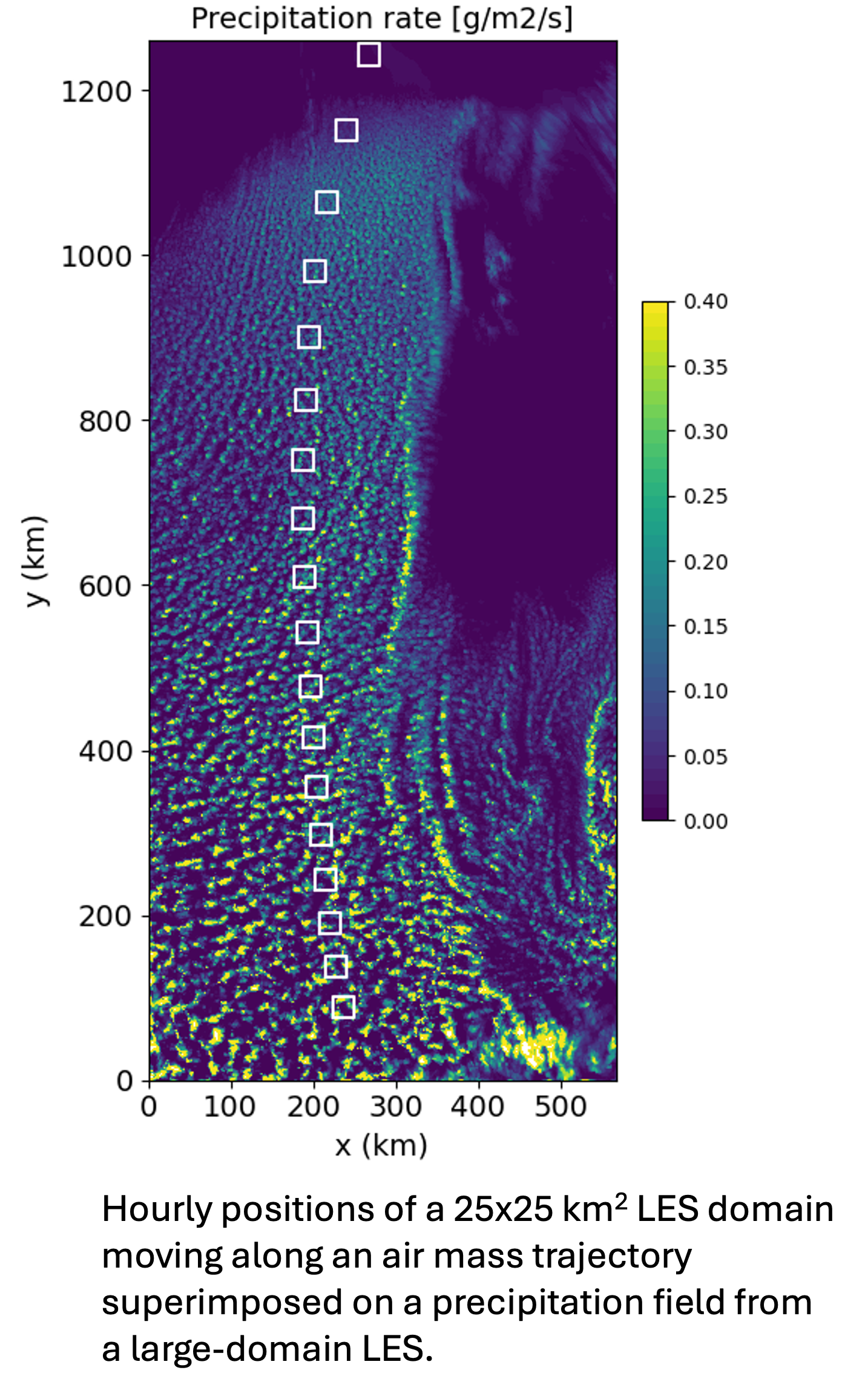
Cold-air outbreaks (CAOs), including those that occur often over the Greenland and Norwegian Seas in springtime, produce characteristic cloud fields stretching over open water for up to 1000 km. Over that distance, the cloud structure changes from narrow rolls off the ice edge to wider rolls at a fetch of few hundreds of kilometers, and then to individual cloud cells further down the stream. Capturing the details of these transitions is challenging in both models and observations because of the need to combine a high resolution to represent boundary layer clouds and turbulence with large horizontal extent of these cloud fields and their persistence over many hours. Largangian large-eddy simulations (LES), in which a modeled domain of a limited horizontal extent on the order of 10 to 100 km is moving along an air mass trajectory, has been increasingly used to study interactions among clouds, aerosol, turbulence, and surface fluxes in CAOs. This study explores strengths and limitations of this approach by comparing boundary layer and mixed-phase cloud evolutions in Lagrangian LES to a mesoscale LES using a domain covering the full extent of a CAO, from the ice edge to the Norwegian coast. The comparison is performed for the CAO case that occurred on March 13, 2020, during the Atmospheric Radiation Measurement (ARM) Cold-air Outbreaks in the Marine Boundary Layer Experiment (COMBLE). The comparative analysis of the two approaches demonstrates a general agreement between them. Although the large-domain LES contain significant additional information on the effects of mesoscale processes, semi-idealized Largangian LES setup is shown to be a practical alternative for studying the roles of microphysical and other local processes on the evolution of cloudy boundary layer in CAOs.
 - Indicates paper has been withdrawn from meeting
 - Indicates an Award Winner