
Sunday, 12 January 2025
Hall C (New Orleans Ernest N. Morial Convention Center)
As global surface temperatures continue to rise, the Caribbean and Gulf of Mexico are experiencing an increased frequency of excessive heat events, exacerbated by higher humidity levels. The Gulf of Mexico, in particular, is warming at nearly twice the global average, resulting in higher evaporation rates, increased humidity, and elevated heat index values. This intensification of heat exposure is particularly dangerous for rural coastal communities, especially as access to air conditioning and other cooling infrastructure may be limited. Using ERA5-Land data from the European Centre for Medium-Range Weather Forecasts (ECMWF) at 9km resolution, this study analyzes heat trends for the Caribbean and Gulf of Mexico from 1981 to 2010. The analysis measures both temperature and humidity to assess the "feels-like" temperature, providing a more accurate representation of human heat exposure. Heat index calculations are based on the Rothfusz regression equation. The results highlight regions persistently facing high heat index conditions, with risks expected to increase in the future. Between 1981 and 2010, heat index trends show a significant rise in the Gulf of Mexico and Caribbean regions. The Mexico Peninsula, eastern Honduras, and Nicaragua have experienced increases of approximately 1°F per decade, while the Caribbean region has seen a rise of 0.5°F per decade. These trends, statistically significant at the 99% confidence level, reflect a clear and persistent pattern of increasing heat exposure in these areas.
Analysis of summer 2023 show that widespread dangerous heat affected large areas within the Caribbean and the Meso-America regions, with heat index exceeding 115°F. This warming was further exacerbated by a weakened Azores High, reducing surface winds, and allowing for more residence time for the heat. Proactive measures will be essential to mitigate the growing risks to public health, agriculture, and energy infrastructure in these vulnerable regions.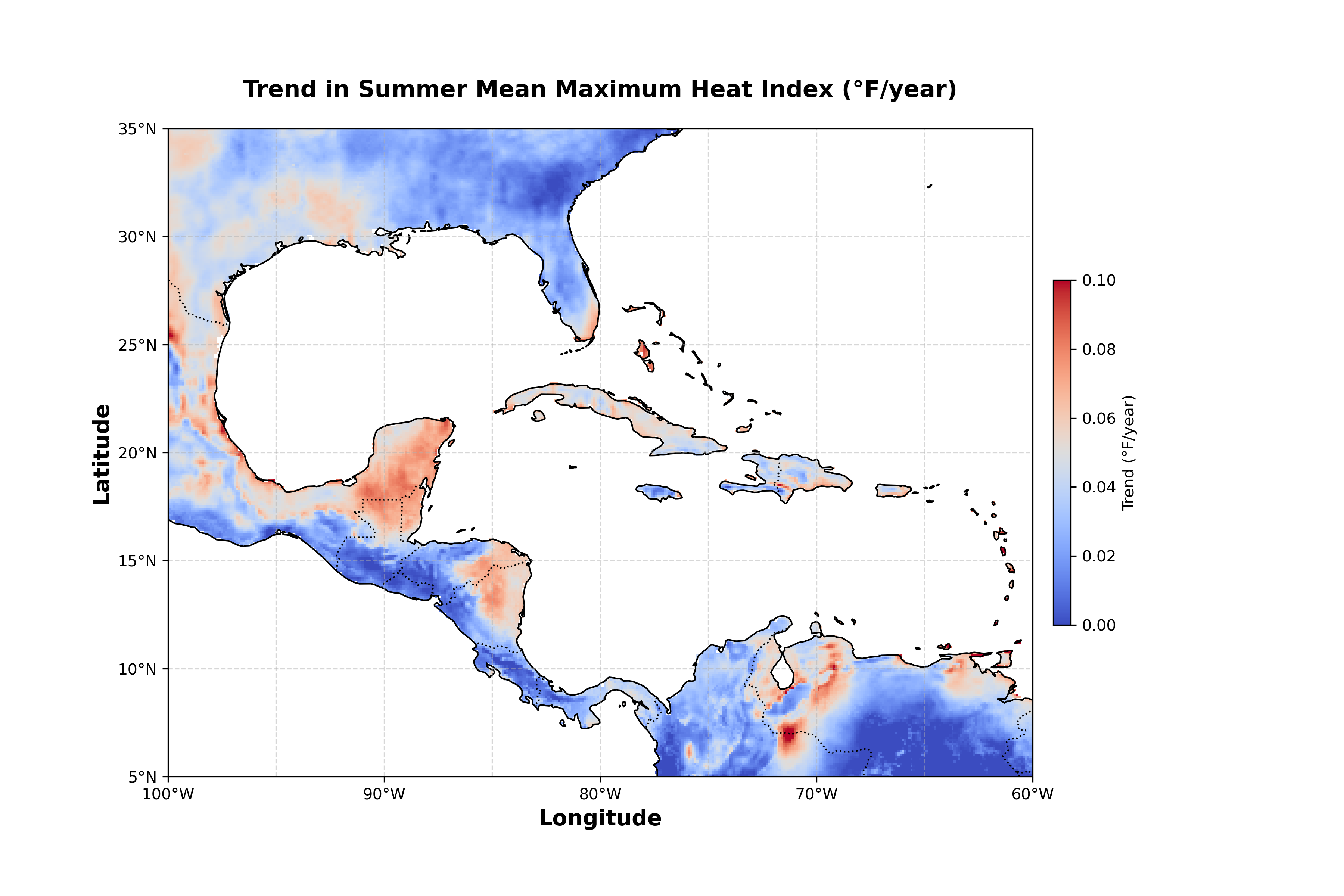
 - Indicates paper has been withdrawn from meeting
 - Indicates an Award Winner