
Sunday, 12 January 2025
Hall C (New Orleans Ernest N. Morial Convention Center)
Rising atmospheric CO2 concentrations lead to stomatal closure in vegetation, significantly affecting humidity and temperature as represented in climate models. Using the Community Earth System Model (CESM), we analyzed alterations in latent heat flux and sensible heat flux to illuminate and understand their impact on regional humidity reductions, despite a global increase in humidity. Stomatal closure diminishes latent heat flux by curbing evaporation, while simultaneously amplifying sensible heat flux, which elevates surface temperatures. The analysis reveals a broad-based decline in latent heat flux paired with a rise in sensible heat flux. Notably, specific humidity increased contrary to the expected reduction in moisture release from plants. This paradox is attributed to the combined latent and sensible heat flux changes, which collectively enhance atmospheric moisture and temperature. These results corroborate previous studies, emphasizing the critical role of surface-based total heat flux changes in humidity dynamics under warming scenarios.
Future research will investigate cloud feedback mechanisms and radiative effects on both regional and global humidity patterns. Evaluating cloud cover variations could allow us to determine if there was more behind the total heat flux change. Moreover, additional simulations will assess the impact of vegetation greening, which may modulate the influence of stomatal closure on atmospheric humidity. These efforts aim to refine projections on how vegetative responses to climate change affect atmospheric variables, particularly in arid and semi-arid regions.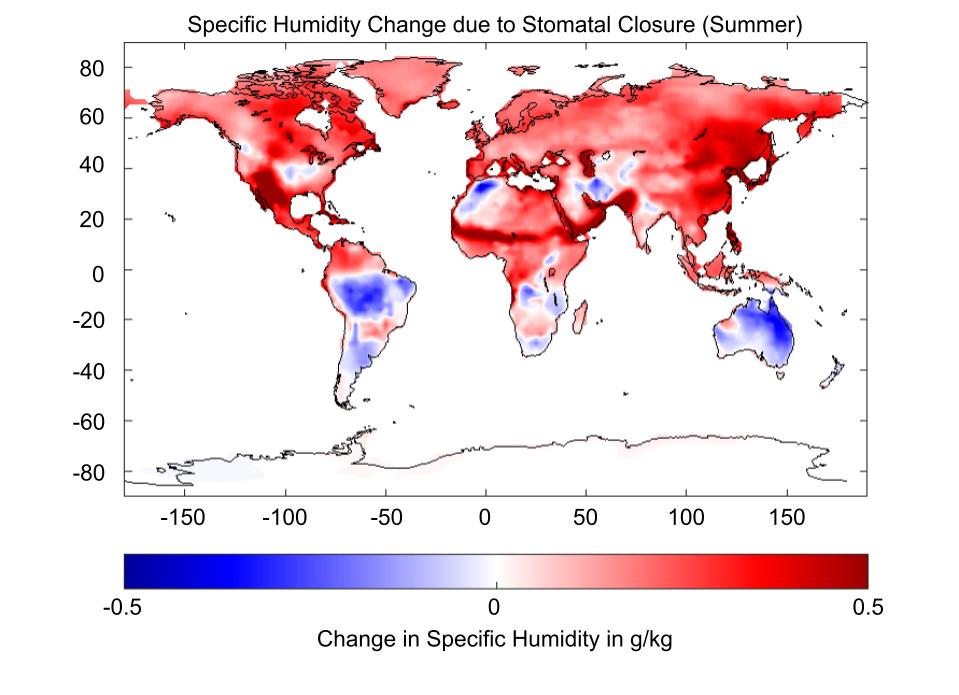
 - Indicates paper has been withdrawn from meeting
 - Indicates an Award Winner