S309 Observed Ice Crystal Characteristics and Atmospheric Conditions Near Cloud Top in Northeast U.S. Winter Storms

Sunday, 12 January 2025
Hall C (New Orleans Ernest N. Morial Convention Center)
Rebecca Moore, North Carolina State Univ., Raleigh, NC; and W. R. Johnson, S. E. Yuter, and M. A. Miller

Winter storms often have a layer of generating cells near cloud top where ice grows to precipitation-size (> 0.2 mm diameter) and subsequently falls through the storm to the surface. We investigate the atmospheric conditions favorable for ice growth and the varying environments precipitation-sized particles experience during their lifetime falling through a cloud. The journey through environments with different relative humidities and temperatures influences the sequence and types of growth forms ice crystals will experience. As snow particles move through the storm, they can grow by vapor deposition, shrink by sublimation, and/or collect liquid droplets, yielding various degrees of riming.

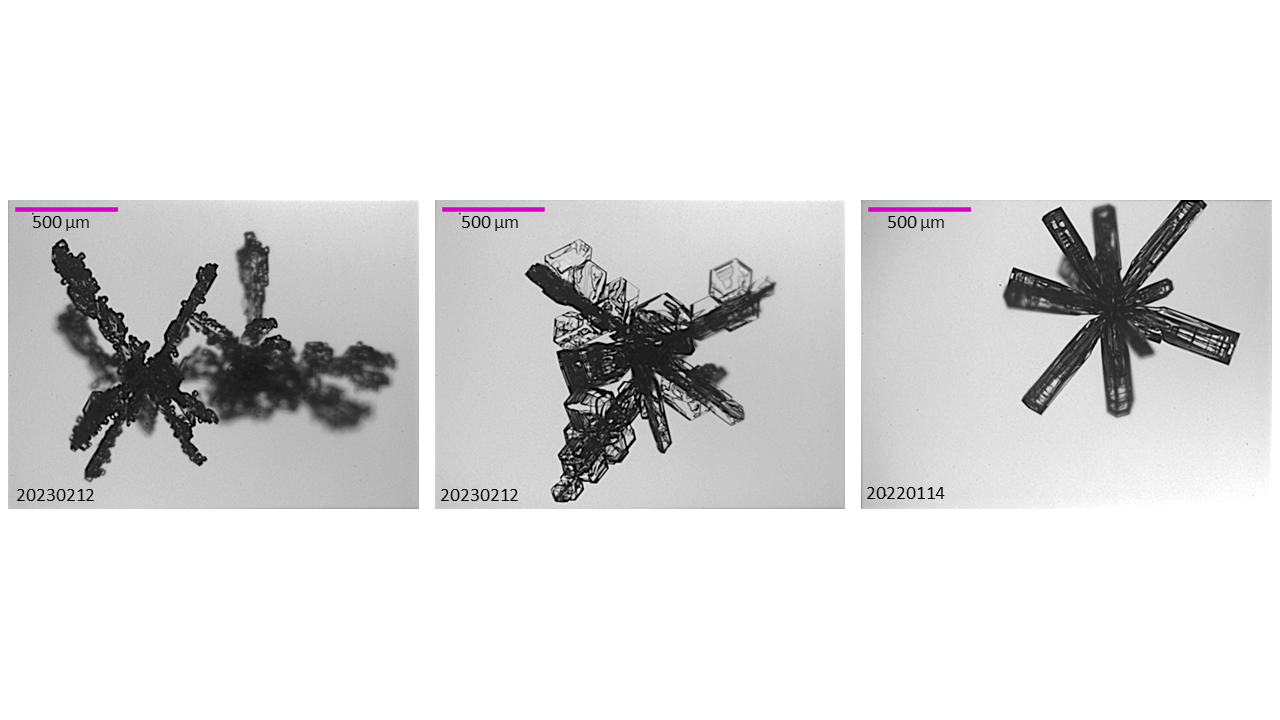
We analyze data from two research aircraft deployed during NASA’s Investigation of Microphysics and Precipitation for Atlantic Coast-Threatening Snowstorms (IMPACTS) 2020-2023 campaign to investigate the local environment within winter storms. We use high-resolution images of snow particles obtained from the Particle Habit Imaging and Polar Scattering (PHIPS) probe aboard the NASA P-3 aircraft to categorize the amount of riming present on ice crystals and to examine the various growth forms observed during flight legs from multiple winter storms. We are particularly interested in atmospheric conditions near cloud tops and temperatures colder than -22 degrees Celsius.

Figure: Three polycrystalline ice crystal images taken by the PHIPS probe on NASA’s P-3 research aircraft. Scale bar in the top left corner and the flight date in the bottom left corner.
- Indicates paper has been withdrawn from meeting
- Indicates an Award Winner