
Extreme heat events and drought are common in the Southwest USA. These extreme heat events have been shown to increase hospitalizations due to heat related illness especially among disadvantaged populations (Heaviside et Al. 2017). This increased heat affects urban areas disproportionately more compared to rural areas because of factors including, Relative Humidity (%RH), Surface Temperature (ST), Air Temperature (TAIR), Surface Materials (SM), surface orientation and decreased green cover. This phenomenon of increased temperature in densely populated urban areas has been named the Urban Heat Island Effect (UHIE). It is measured by UHI Intensity (UHII). One study that also examined intra-urban microclimates shows a novel mobile approach like the one used in this study (Kousis et. Al 2021). This study aims to further understand the UHIE by observing the relationship between UHII and the aforementioned factors along the spatio-temporal matrix and their effects at human scale.
METHODS
Albuquerque, New Mexcio is a desert city located in the SW-USA. It has an estimated population of 526,000 and area covering 195 square miles. It occupies a high desert climate, characterized by hot summers, cool winters, low precipitation, low vegetative density, and high solar radiation.
Albuquerque has experienced expansion and urban sprawl in the past five decades of development. With this has come an increase in impermeable and manmade surface materials. Using CAPA Strategies 2021 one day heat mapping campaign, the hottest areas of the city were identified. One area is the Piedras Mercadas neighborhood located on Albuquerque’s Westside. The land use of this area can be described as mostly residential with some commercial and a handful of recreational or natural outdoor areas, namely a bike trail and basin located in the SE corner of the transect. In order to understand how environmental factors influence UHII, a mobile-transect of approximately 2.5 miles was walked two days a week at three times a day; morning (8:00-9:00), afternoon (14:00-15:00), and evening (19:00-20:00). During the walking of this transect TAIR and %RH were measured and recorded using an AirBeam3 enclosed handheld sensor probe by HabitatMap. SanLiang Infrared Gun was used to measure ST of various materials along stations of the transect. Kestrel-3000 sensor was used to measure ground truth TAIR and %RH. After collecting these data from Airbeam and Kestrel sensors, a corrected temperature was calculated using a second-order polynomial curve fit model. Lastly, a stationary outdoor HOBO %RH and TAIR sensor was used to collect the rural temperature data necessary to calculate the UHII. July 14, 2024 was selected as a representative day of drought. On this day there was no rainfall for 3 days prior and it had the highest recorded temperature out of all days of data collection. Three sites (2a-c) were selected to be observed as discreet microclimates. 2a is an asphalt parking lot with a shade tree, sensors were allowed to acclimate in shade before starting. 2b is an 8ft tall east-facing dirt retaining wall covered by desert shrubs. 2c is a large asphalt intersection next to a landscaped area with lawns, shade trees, and smaller plants.
RESULTS AND DISCUSSION
(RQ1) How does local RH impact UHII spatio-temporally
(RQ2) How does surface temperature and orientation impact UHII spatio-temporally
(RQ3) How does surrounding green cover and built environment affect UHII
Fig 1 shows the heat maps of the transect of the selected day. Throughout the morning and afternoon sessions we see lower temperatures and higher humidity at the beginning of the transect (2a) associated with shade acclimation. During the evening (1c) this microclimate had elevated temperature associated with back radiation emitting from elevated ST of black asphalt. During the morning transect we see a steady increase in temperature and decrease in RH associated with time. Toward the end of the transect, indicated by the west-east line along the north portion of the transect, we see a slight increase in humidity associated with landscaping. The trend is consistent throughout the day.
In Table 1 we see values for ST, TAIR and %RH throughout the day at the selected sites. The STMORNING of 2a is warmer than 2b indicating a cooling effect of plants by evapotranspiration and ground cover. UHII is 5.4 vs 1.9 respectively.
In the afternoon we see 2a had a lower UHI of 2.8 compared to 2b with UHII of 14.6. UHII at 2c is comparable to 2a. In the evening there is a reverse UHIE wherein UHII in shaded areas is greater as re-radiated heat is trapped by the tree canopy. UHIIEVENING is lower at 2b but UHII overall is higher here. Evening TAIR increased at 2a and decreased at 2c. Evening ST is greatest at 2a and lowest at 2c, however 2c still had the greatest UHII at 12.8. Asphalt appears to be the material to contribute most to UHII in the evening. Sand/gravel surfaces became the hottest in the afternoon, but released heat the quickest, cooling by the evening. RH is inversely related to temperature but does not seem to have strong correlation to UHII.
Conclusions
Shade cover, orientation, ST, and SM seem to be the factors most closely associated with UHII. Shade cover greatly offsets UHII in the afternoon. In the evening it seems to retain heat and increase UHII. East facing (evening shade) experienced the greatest UHII in the afternoon but cooled most quickly in the evening. ST and TAIR are the best predicters for UHII in each micro-climate and asphalt SM retains the most heat throughout the evening.
Acknowledgement
Thank you to Heater Fox-Gardener for setting up and providing HOBO sensor data and to Dr. Melanie Will-Cole for creating and supporting the MCURE program at Central New Mexico CC.
References
CAPA Strategies 2021: Albuquerque NM Heat Watch Report
Kousis, I., Pigliautile, I. & Pisello, A., 2021 Intra-urban microclimate investigation in urban heat island through a novel mobile monitoring system. Sci Rep 11, 9732.
Heaviside, C., Macintyre, H. & Vardoulakis, S. The Urban Heat Island: Implications for Health in a Changing Environment. Curr Envir Health Rpt 4, 296–305 (2017).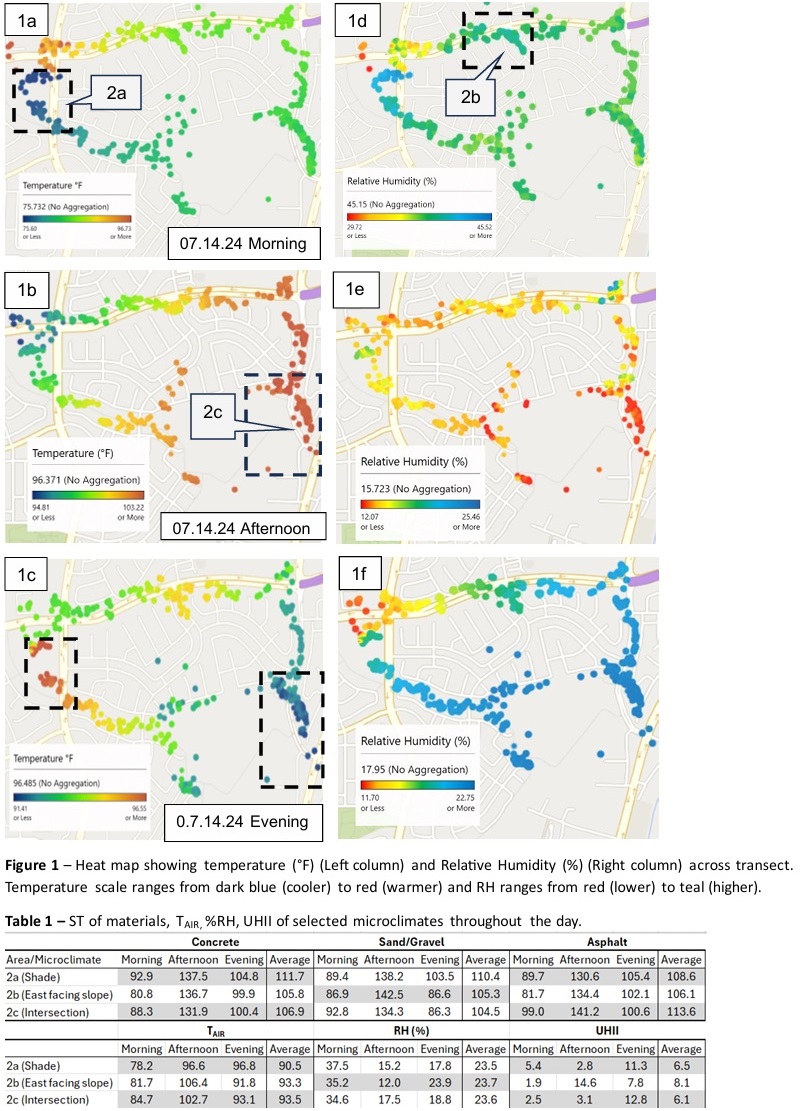
 - Indicates paper has been withdrawn from meeting
 - Indicates an Award Winner