
Using the Sentinel-5p TROPOMI instrument, I observed the 2020 Beachie Creek forest fire that started in late August and ended in early October. The fire truly exploded on September 8th and caused severe destruction. Analyzing this main fire day is important because of how massive the flames were. I looked for formaldehyde and nitrogen dioxide columns and compared these NO2 and CH2O readings to the same area on a non-fire day.
Due to its massive size, the Beachie Creek forest fire released copious amounts of trace gasses into the troposphere and beyond (as seen below in Figure 1). Analyzing these trace gasses is helpful in better understanding the intensity and spatial extent of fire-related NO2 and CH2O and mitigating their health impacts.
There are three underlying questions I am trying to answer within this study:
- How does the presence of the Beachie Creek forest fire affect the columns of formaldehyde and nitrogen dioxide within the troposphere of the Pacific Northwest?
- How do formaldehyde and nitrogen dioxide transport throughout the Beachie Creek forest fire?
- How can we compare the formaldehyde concentrations using Python?
These questions were the vital first step of this project and were thoroughly discussed while analyzing this undertaking.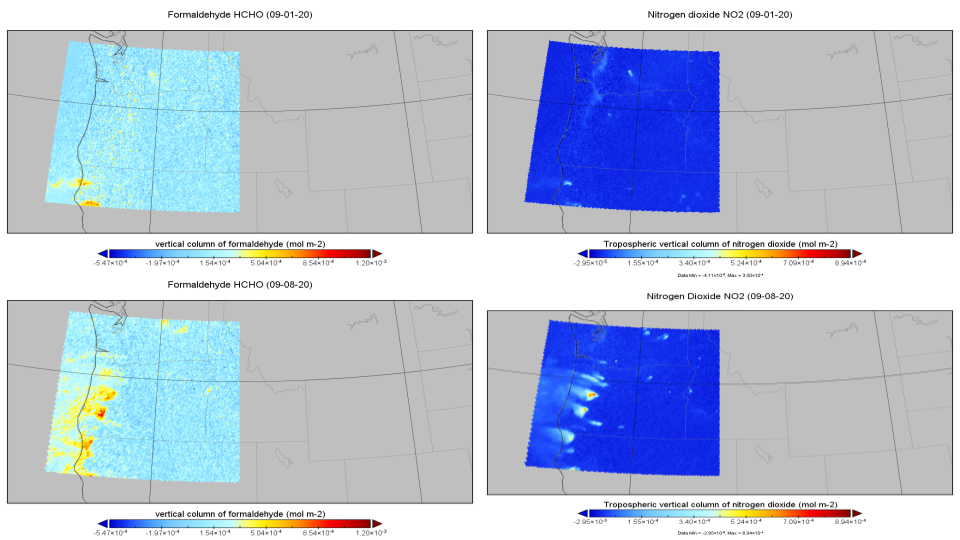
 - Indicates paper has been withdrawn from meeting
 - Indicates an Award Winner